Ball of foot pain when walking: the causes, and when surgery fixes it
The mechanical causes of pain under the ball of the foot, what pads and insoles can and can’t do, and the published results of plantar plate repair, metatarsal shortening, calf lengthening and Freiberg’s surgery.

By Dr. Efe Ozturk
· 6 min read
Medically reviewed by Dr. Efe Ozturk · Last reviewed
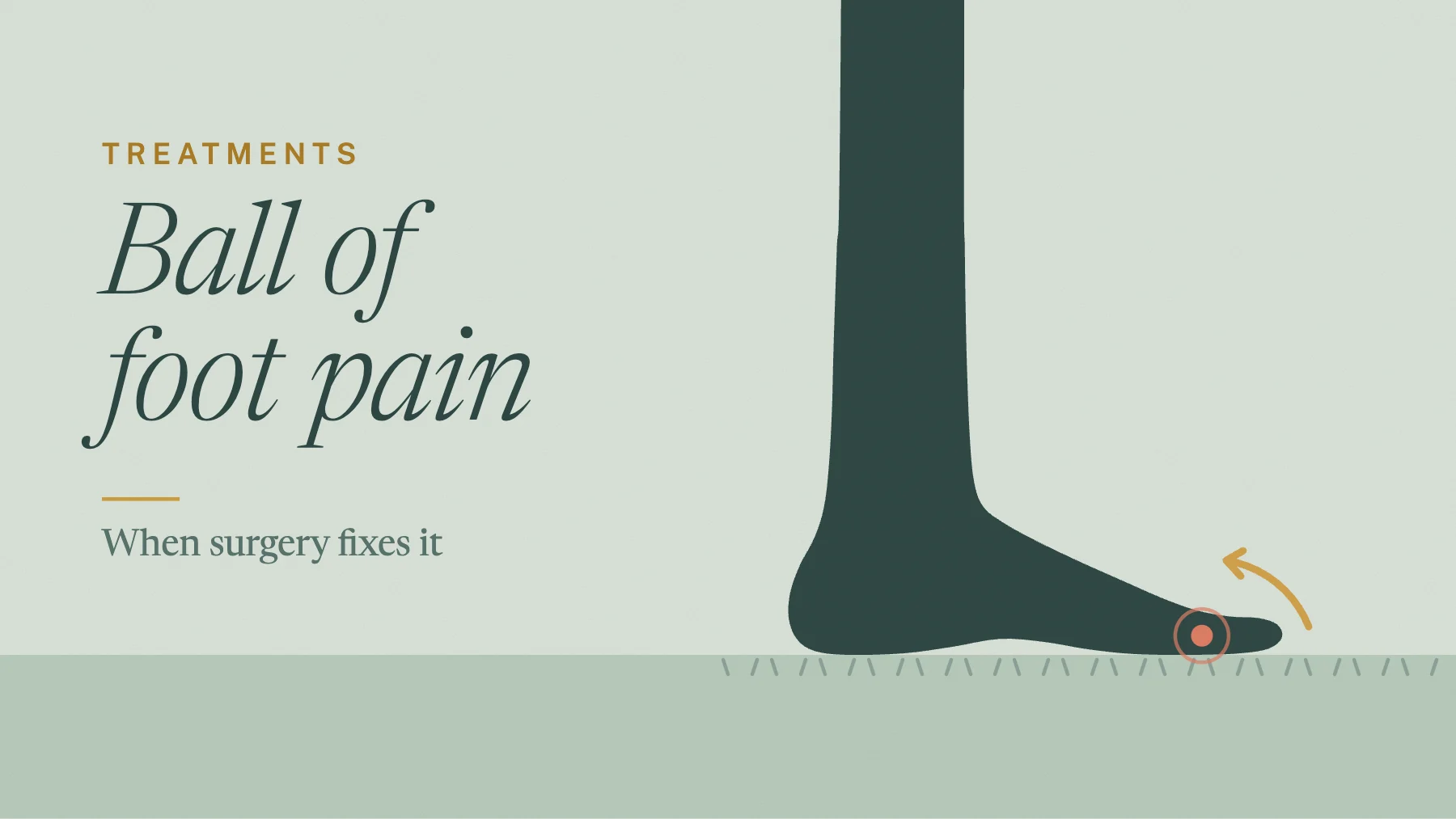
Ball of foot pain when walking can feel like a bruise or a stone in your shoe. Most cases get better with shoes and padding. When they don’t, the cause is often a torn ligament, an overloaded bone or a damaged joint, and an operation can fix it.
What is ball of foot pain called?
The medical name is metatarsalgia: pain at the metatarsals, the long bones that end at the base of the toes. It is a symptom, not one diagnosis, and its causes come back to how the foot is built and carries weight.[1] The common mechanical ones:
- An overloaded metatarsal. A tight calf muscle raises pressure on the front of the foot as you walk.[9] Metatarsalgia often comes with a bunion or bent toes,[1] and some cases follow an earlier foot operation.[2]
- A plantar plate tear. The plantar plate is a tough ligament under each toe joint. In 90 people who had a tear repaired, 95% had pain that came on gradually, swelling, and a toe that moved too much when tested (a positive drawer sign). A crossover toe, drifting over the big toe, was a strong sign of a tear.[3]
- A stress fracture. A small crack from repeated load. Long-distance running and military training often crack the second or third metatarsal.[4]
- Freiberg’s disease. The bone at the end of a metatarsal dies from a lack of blood supply (osteonecrosis). It mostly affects young women and teenagers, and the second metatarsal is the usual one.[5]
- An inflamed toe joint. Swelling of the lining of the second toe joint (synovitis, often called capsulitis) can cause pain there without any injury.[6]
Burning between the third and fourth toes points to a nerve. Our Lower Extremity Nerve Institute explains how to tell a neuroma from metatarsalgia (external site).
Ball of foot pain when walking: which causes surgery fixes
| Cause | Clue when you walk | Operation when shoes and pads fail | What studies found |
|---|---|---|---|
| Plantar plate tear | Swelling at the base of the second toe; the toe may cross over its neighbor[3] | Plantar plate repair | Pain down about 5 points out of 10; function up about 40 points out of 100[7] |
| Overloaded metatarsal | Ache under one or two bones | Shortening cut in the bone (Weil osteotomy or its keyhole version) | The two operations did equally well[10] |
| Tight calf | More pressure on the front of the foot with each step[9] | Calf muscle lengthening (gastrocnemius recession) | Large pain relief, high satisfaction[9,11] |
| Freiberg’s disease | Pain at the base of the second toe[5] | Joint-sparing surgery | Over 90% pain resolution and full return to activity[8] |
| Stress fracture | Pain that builds with walking and eases with rest[12] | Screws or a plate if it needs them to heal, or if it shifts | Late diagnosis can lead to a bone that never knits[13] |
When surgery is the definitive fix
A torn plantar plate
Once a plantar plate tear has advanced, splinting, offloading and injections stop working.[14] Direct repair of the torn plate has become foot surgeons’ treatment of choice. In a 2022 review of 12 studies and 537 repaired tears, pain fell by an average of 5 points on a 10-point scale, and foot function rose by about 40 points out of 100, with follow-up as long as 2 years.[7]
An overloaded metatarsal
When one metatarsal carries too much weight, surgeons shorten it with a cut near its end. A 2017 review judged this operation, the Weil osteotomy, reliable.[2] A keyhole version (distal metatarsal metaphyseal osteotomy, or DMMO) did equally well for pain and function across four studies and 211 patients.[10]
A tight calf
Lengthening the tight part of the calf muscle (gastrocnemius recession) treats the cause directly. In a 2026 review of 86 feet followed for about 3 years, pain improved substantially and satisfaction was high, with few complications, mostly minor nerve symptoms and bruising.[9] Our surgery site explains gastrocnemius recession (external site).
Freiberg’s disease and stress fractures
For Freiberg’s disease that doesn’t settle, surgery is recommended.[5] In a review of 38 studies, operations that kept the joint resolved pain and restored full activity in more than 90%.[8]
Some stress fractures need screws or a plate to heal properly, or because the bone has broken through and shifted.[12] A missed one can mean months of pain and a bone that fails to heal, which then needs surgery.[13] See stress fractures in runners.
How to relieve ball of foot pain: what conservative care does
Nonsurgical care is the first step, and it is usually enough.[1] It means stretching, shoe changes, insoles and trimming any callus.[2]
- Metatarsal pads. Placement matters. In 10 patients, a pad sitting just behind the sore bone cut peak pressure under it by about a third. Set further back, it did not lower pressure significantly.[15]
- Insoles. In a trial of 33 people, one ready-made insole helped 12 of 15 users, against 6 of 18 for another.[16] Across nine trials, custom orthotics usually gave the largest drop in forefoot pain.[17] See custom orthotics.
These steps relieve pressure. They don’t repair a torn ligament, restore damaged bone or lengthen a tight calf. Surgery does. Our ball of foot pain guide covers home care in more detail.
The limits. In a review of 1,131 Weil osteotomies, 36% left a toe that rested slightly off the ground (a floating toe), the problem came back in 15% and pain moved to a neighboring bone in 7%.[18] In a later study with 6 years of follow-up, a floating toe did not affect satisfaction or function.[19] A 2010 review warned that metatarsal osteotomy fails in the long run, while noting that better fixation may improve results.[1] About 30% of calf-lengthening patients also needed a forefoot procedure.[9] Most of this evidence comes from case series rather than randomized trials.[20,8]
How we treat it
Dr. Efe Ozturk is a Foot and Ankle Surgeon and podiatrist. We test each toe joint, check how far your ankle bends and take X-rays or ultrasound at the practice. We start with the right pad, insole and shoe. If the cause is structural and that fails, we talk through the operation that fixes it. We perform forefoot reconstruction, including bunion and hammertoe correction. See foot and ankle surgery. We see patients in Lyndhurst, Paramus and Millburn, NJ.
Common questions
Can ball of foot pain be plantar fasciitis?
Usually not. Plantar fasciitis mainly hurts at the bottom of the heel, often with your first steps in the morning, although the sole can also ache or burn.[21] Pain right behind the toes points to the causes above.
Which ball of foot pain insoles work?
Design matters. In a small trial, one ready-made insole helped far more people than another,[16] and custom orthotics reduced forefoot pain in most trials reviewed.[17]
Does a drifting second toe need surgery?
Often, if it hurts. A crossover toe strongly suggests a plantar plate tear,[3] and advanced tears don’t respond to nonsurgical care.[14]
When to see a Foot and Ankle Surgeon or podiatrist
About the author
Dr. Efe Ozturk
Foot and Ankle Surgeon. Dr. Ozturk is double board certified, as a Diplomate of the American Board of Podiatric Medicine (DABPM) and a Fellow of the Academy of Physicians in Wound Healing (FAPWH), and is a Fellow of the American Society of Podiatric Surgeons (FASPS) and the American Society of Podiatric Medicine (FASPM). Trained in forefoot and rearfoot reconstructive surgery at Morristown Medical Center; sees patients in Lyndhurst, Paramus and Millburn.
Where to be seen
Dr. Ozturk sees patients at each of these offices, and one phone number reaches all of them.
References
- 1.Espinosa N, Brodsky JW, Maceira E. Metatarsalgia. J Am Acad Orthop Surg. 2010;18(8):474-485. PubMed 20675640 (external site)
- 2.Besse JL. Metatarsalgia. Orthop Traumatol Surg Res. 2017;103(1S):S29-S39. PubMed 28109624 (external site)
- 3.Klein EE, Weil L Jr, Weil LS Sr, Coughlin MJ, Knight J. Clinical examination of plantar plate abnormality: a diagnostic perspective. Foot Ankle Int. 2013;34(6):800-804. PubMed 23696184 (external site)
- 4.Sun J, Feng C, Liu Y, et al. Risk factors of metatarsal stress fracture associated with repetitive sports activities: a systematic review. Front Bioeng Biotechnol. 2024;12:1435807. PubMed 39175621 (external site)
- 5.Yoshimura I, Takao M, Wagner E, et al. Evidence-based treatment algorithm for Freiberg disease. Cartilage. 2024;15(1):58-64. PubMed 37815268 (external site)
- 6.Mizel MS, Michelson JD. Nonsurgical treatment of monarticular nontraumatic synovitis of the second metatarsophalangeal joint. Foot Ankle Int. 1997;18(7):424-426. PubMed 9252812 (external site)
- 7.Baker JR, Albright R, Jameson R, et al. Treatment of Lesser Metatarsophalangeal Joint Instability With Plantar Plate Repair: A Systematic Review and Meta-Analysis. J Foot Ankle Surg. 2022;61(5):1114-1118. PubMed 35283034 (external site)
- 8.Schade VL. Surgical management of Freiberg’s infraction: a systematic review. Foot Ankle Spec. 2015;8(6):498-519. PubMed 25990579 (external site)
- 9.Calori S, Giuliani A, Bocchino G, Forconi F, Maccauro G, Vitiello R. Gastrocnemius recession in the treatment of isolated metatarsalgia: a systematic review of surgical outcomes and complications. J Orthop Surg (Hong Kong). 2026;34(1):10225536251350416. PubMed 41579055 (external site)
- 10.Stavrakakis IM, Magarakis GE, Kapsetakis P, Tsatsoulas C, Tsioupros A, Datsis G. Weil’s osteotomy versus distal metatarsal metaphyseal osteotomy for the treatment of metatarsalgia: a meta-analysis of outcome and complications. Foot (Edinb). 2024;60:102101. PubMed 38821005 (external site)
- 11.Langone L, Mazzotti A, Zielli SO, et al. Gastrocnemius release procedures in the treatment of mechanical metatarsalgia: a systematic review. Arch Orthop Trauma Surg. 2025;145(1):459. PubMed 41042374 (external site)
- 12.American Academy of Orthopaedic Surgeons. Stress Fractures of the Foot and Ankle. OrthoInfo. orthoinfo.org (external site)
- 13.Welck MJ, Hayes T, Pastides P, Khan W, Rudge B. Stress fractures of the foot and ankle. Injury. 2017;48(8):1722-1726. PubMed 26412591 (external site)
- 14.Malani K, Ravine M, Schneider HP. Nonoperative treatment of plantar plate tears. Clin Podiatr Med Surg. 2022;39(3):451-459. PubMed 35717062 (external site)
- 15.Hsi WL, Kang JH, Lee XX. Optimum position of metatarsal pad in metatarsalgia for pressure relief. Am J Phys Med Rehabil. 2005;84(7):514-520. PubMed 15973088 (external site)
- 16.Kelly A, Winson I. Use of ready-made insoles in the treatment of lesser metatarsalgia: a prospective randomized controlled trial. Foot Ankle Int. 1998;19(4):217-220. PubMed 9578099 (external site)
- 17.Arias-Martín I, Reina-Bueno M, Munuera-Martínez PV. Effectiveness of custom-made foot orthoses for treating forefoot pain: a systematic review. Int Orthop. 2018;42(8):1865-1875. PubMed 29423640 (external site)
- 18.Highlander P, VonHerbulis E, Gonzalez A, Britt J, Buchman J. Complications of the Weil osteotomy. Foot Ankle Spec. 2011;4(3):165-170. PubMed 21490179 (external site)
- 19.Wagner E, O’Connell LA, Radkievich R, Caicedo N, Mococain P, Wagner P. Incidence of and functional significance of floating toe after Weil osteotomy. Foot Ankle Orthop. 2019;4(4):2473011419891956. PubMed 35097355 (external site)
- 20.Elmajee M, Shen Z, A’Court J, Pillai A. A systematic review of plantar plate repair in the management of lesser metatarsophalangeal joint instability. J Foot Ankle Surg. 2017;56(6):1244-1248. PubMed 28893531 (external site)
- 21.MedlinePlus Medical Encyclopedia. Plantar fasciitis. US National Library of Medicine. medlineplus.gov (external site)
This is general health information and isn’t a substitute for advice from a clinician who knows your history. Read our medical disclaimer and how we write and review content.
More from the blog
Treatments
Swollen ankle on one side: what it means and which causes surgery fixes
What one swollen ankle can mean, the emergency signs that send you to the ER first, and the sprains, fractures, tendon tears and arthritis that an operation fixes when first-line care fails.
Treatments
TenJet for plantar fasciitis: how the procedure works, what the evidence shows, and recovery
How the TenJet saline jet treats stubborn plantar fasciitis through a small incision, who it suits, what the evidence does and doesn’t show yet, and recovery week by week.
Treatments
TenJet for Achilles tendonitis: how the procedure works, who it suits, and recovery
How the TenJet saline jet treats stubborn Achilles tendonitis through a small incision, how it differs from Tenex, what the evidence does and doesn’t show, and recovery week by week.