High heels and your feet: how to limit the damage
What high heels do to your feet, and practical ways to wear them with less harm.

By Efe Ozturk, DPM
· 3 min read
Medically reviewed by Efe Ozturk, DPM · Last reviewed
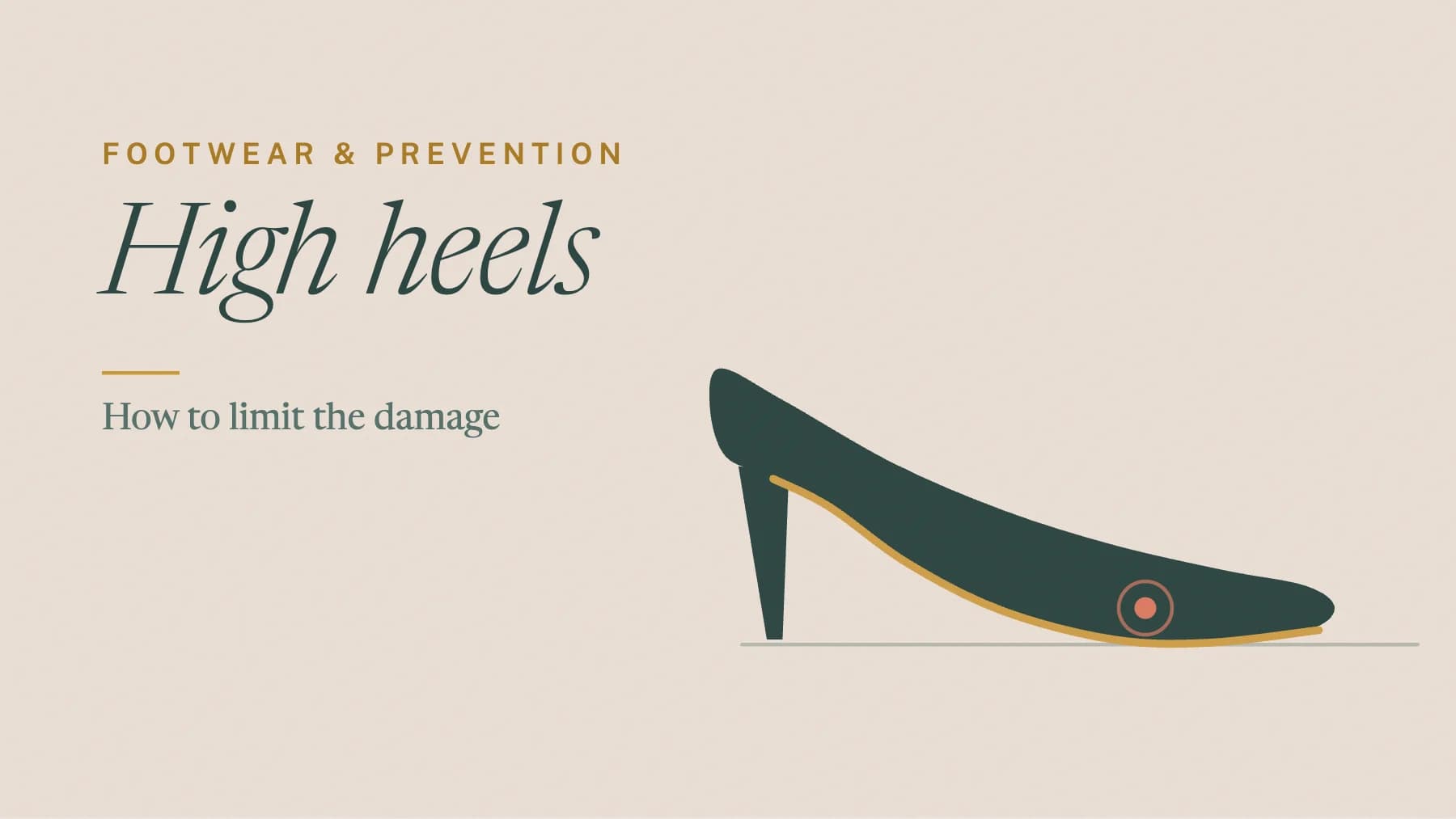
High heels are part of many people’s lives, for work, for events, or because they love them. You don’t need a lecture. Here’s what the research says they do to your feet, and practical ways to wear them with less harm.
What high heels do
Raising the heel tips your body weight forward onto the ball of the foot and the toes. A narrow, pointed toe box then squeezes the toes together. Over time and many hours, that combination can contribute to:
- Bunions: in a systematic review, most studies that looked found an association between high heels and hallux valgus.[1]
- Pain in the ball of the foot (metatarsalgia), from concentrated pressure.
- Hammertoes, corns and calluses, from crowded toes. Ill-fitting shoes in general are linked to toe deformities, corns and calluses.[2]
- A tight calf and Achilles, from spending long hours with the heel raised.
- Ankle sprains and falls: the same review found evidence of a significant injury toll from high-heeled shoes.[1]
Wearing heels with less harm
- Go lower. Each extra inch shifts more weight forward, so save the tallest heels for short occasions.
- Go wider. A block heel is more stable than a stiletto, and a rounded or almond toe gives toes more room than a pointed one.
- Limit the time. Wear comfortable shoes to travel and change into heels when you arrive.
- Pad the ball of the foot with a gel or foam insert.
- Choose the right size, later in the day, and don’t buy a pair that pinches in the store.
- Stretch your calves on days you’ve worn heels.
- Alternate with flat, supportive shoes on other days.
Common questions
Do high heels cause arthritis?
The evidence doesn’t show that. In the systematic review, the studies that looked found no significant link between high heels and osteoarthritis; the associations were with bunions, pain and injuries.[1]
Are flats always better?
Not if they don’t fit. In studies, between 63% and 72% of people were wearing shoes that didn’t match the length or width of their feet, and poor fit, not just heel height, is linked to foot pain, toe deformities, corns and calluses.[2] A flat shoe that is too narrow, too short or too loose to stay on without gripping with your toes causes its own problems.
Do cushioned inserts help?
A gel or foam pad under the ball of the foot can make heels more comfortable by spreading pressure, and it costs little to try. It doesn’t make a narrow, pointed toe box any roomier, so choose the shape of the shoe first.
Signs it’s time to get checked
- Burning or sharp pain in the ball of the foot, or numbness between the toes (possible Morton’s neuroma).
- A bunion that’s getting bigger or more painful.
- Toes that are starting to curl, with corns on top.
- Frequent ankle sprains.
See bunions, hammertoes and how to choose shoes that fit. For burning pain between the toes, see nerve pain in the feet; our Lower Extremity Nerve Institute also explains Morton’s neuroma (external site).
When to see a podiatrist

About the author
Efe Ozturk, DPM
Foot and Ankle Surgeon. Dr. Ozturk is double board certified, as a Diplomate of the American Board of Podiatric Medicine (DABPM) and a Fellow of the Academy of Physicians in Wound Healing (FAPWH), and is a Fellow of the American Society of Podiatric Surgeons (FASPS) and the American Society of Podiatric Medicine (FASPM). Trained in forefoot and rearfoot reconstructive surgery at Morristown Medical Center; sees patients in Lyndhurst, Paramus and Millburn.
References
- 1.Barnish MS, Barnish J. High-heeled shoes and musculoskeletal injuries: a narrative systematic review. BMJ Open. 2016;6(1):e010053. PubMed 26769789 (external site)
- 2.Buldt AK, Menz HB. Incorrectly fitted footwear, foot pain and foot disorders: a systematic search and narrative review of the literature. J Foot Ankle Res. 2018;11:43. PubMed 30065787 (external site)
This is general health information and isn’t a substitute for advice from a clinician who knows your history. Read our medical disclaimer and how we write and review content.
More from the blog
Footwear & prevention
How to choose running shoes: fit, cushioning and when to replace them
What the research says about running shoes, and a practical way to find the right pair.
Footwear & prevention
Who needs a regular foot check-up, and what happens at one
People with diabetes and older adults benefit most. How often to be seen, and what the visit involves.
Footwear & prevention
Five common foot problems and how to prevent them
Five of the most common foot problems, and the everyday habits that prevent most of them.