Big toe arthritis (hallux rigidus): why your big toe is stiff and sore
A stiff, sore big toe is often arthritis. How it differs from a bunion, and what helps.

By Efe Ozturk, DPM
· 4 min read
Medically reviewed by Efe Ozturk, DPM · Last reviewed
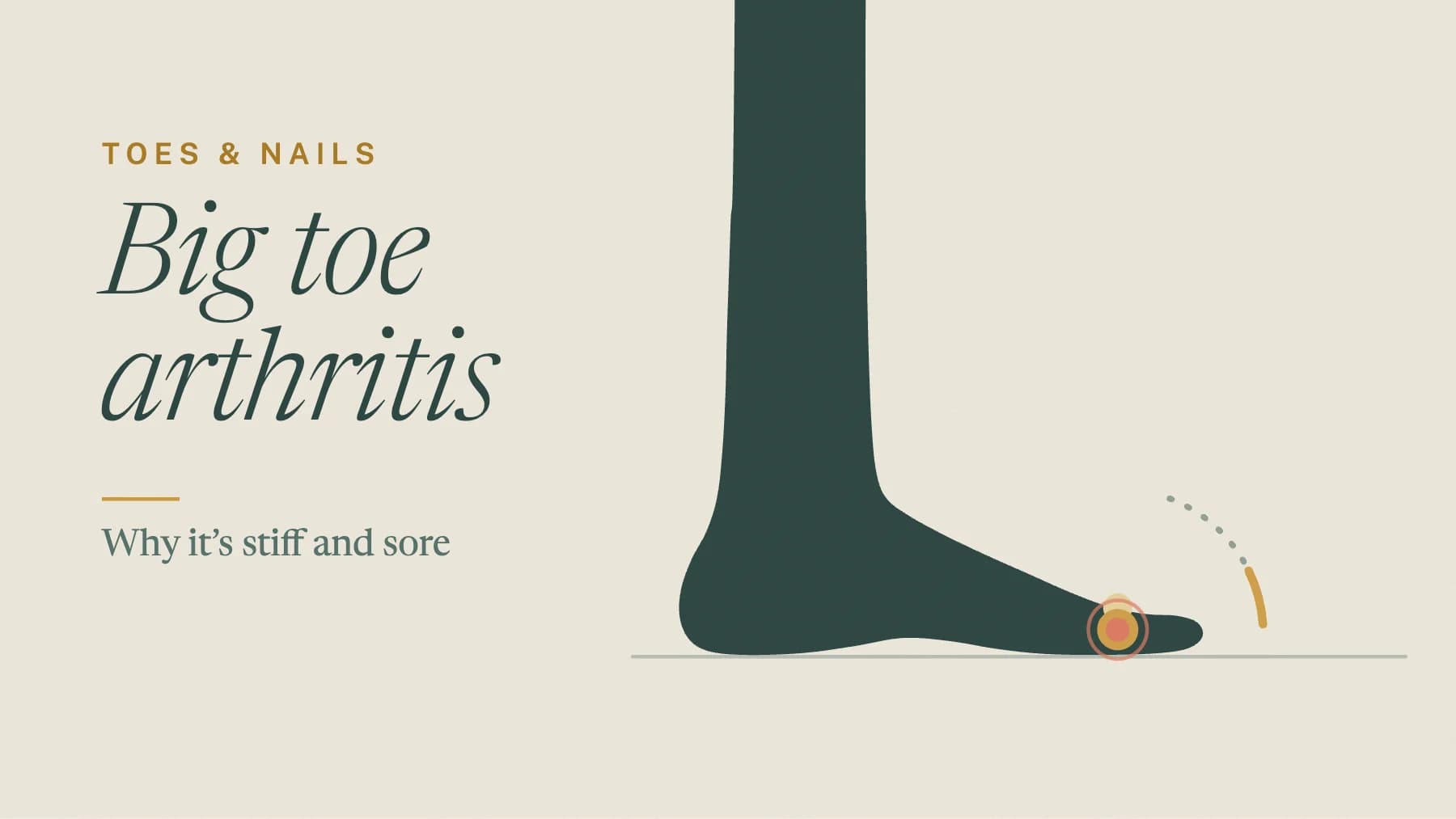
Your big toe does a lot of work. Every time you walk, climb stairs, squat or stand on your toes, it bends upward at the joint where it meets the foot. When that joint becomes arthritic, each of those movements can hurt. The medical name is hallux rigidus, which simply means “stiff big toe.”
What it is
Hallux rigidus is a form of degenerative arthritis, the wear-and-tear kind, in the first metatarsophalangeal (MTP) joint at the base of the big toe.[1] It’s the most common arthritic condition in the foot.[2] In people aged 50 and over, an estimated 20% to 30% have it, though not all of them have symptoms.[3]
It tends to progress. In the early stage, called hallux limitus, the toe’s motion is only somewhat limited. Over time the range shrinks, and in the late stage the joint can become almost frozen.[1]
Why it happens
The exact cause isn’t fully understood.[3] Things linked to it include:[1]
- Foot mechanics, such as fallen arches or feet that roll in, and an inherited foot type that’s prone to it.
- Overuse, especially in jobs or activities that load the big toe, like frequent stooping or squatting.
- An old injury to the joint, such as a badly stubbed toe.
- Inflammatory conditions such as gout or rheumatoid arthritis.
Symptoms
Early on, you may notice:[1]
- Pain and stiffness in the big toe when you walk, stand or bend it.
- Pain that’s worse in cold, damp weather.
- Trouble running or squatting.
- Swelling around the joint.
As it progresses, pain can come on even at rest, and bony bumps on top of the joint can make shoes uncomfortable. Changes in the way you walk can lead to aches in the hip, knee or lower back, and in severe cases a limp.[1]
Not a bunion
Hallux rigidus and bunions affect the same joint, but they’re different problems that need different treatment.[1] A bunion is a bump on the inner side of the joint with the big toe drifting toward the others. Hallux rigidus is a stiff, painful joint, often with a bony bump on top. Our article on bunions covers the other one.
How we diagnose it
We examine the foot and move the toe to measure how far it bends, and take X-rays at the practice to see how much arthritis is present and whether bone spurs have formed.[1] The X-ray grade, along with your symptoms, guides treatment.[2]
Treatment without surgery
For mild and moderate hallux rigidus, the usual first steps are:[1]
- Shoes with a large toe box, and stiff or rocker-bottom soles so the toe doesn’t have to bend as much.
- Inserts or orthotics to improve how the foot works.
- Anti-inflammatory medicine such as ibuprofen, if it’s safe for you.
- Corticosteroid injections into the joint to reduce pain and swelling.
- Physical therapy for temporary relief.
What does the research say? In a trial of 102 people, pain improved with both prefabricated inserts and rocker-sole shoes, by similar amounts, but people wore the inserts more and had fewer side effects with them.[5] However, when arch-contouring inserts, shoe-stiffening inserts, or a single joint injection of hyaluronic acid were each compared with a sham in separate trials, they made little or no real difference.[4] The evidence overall is limited, and results vary from person to person.[4,3]
In practice, that means shoe changes and inserts are low-risk and worth trying, but it’s reasonable to expect relief rather than a fix, and to reassess if they don’t help. Our arthritis page explains our approach.
When surgery is considered
If pain persists despite these measures, or the arthritis is advanced, surgery can help. Options range from joint-preserving procedures, such as cheilectomy (removing the bone spurs to free up motion), to procedures that change the joint itself, such as joint replacement or fusion.[2] Our colleagues at the Center for Lower Extremity Surgery (external site) explain these operations in detail.
Common questions
Will it get worse?
It often does, gradually, but not always quickly, and not everyone with arthritis on an X-ray has much pain.[1,3] Early treatment may postpone the need for surgery.[1]
Can I keep exercising?
Usually, yes, with some adjustments. Cycling and swimming load the big toe less than running or deep squats, and a stiff-soled shoe helps with walking.
When to see a podiatrist

About the author
Efe Ozturk, DPM
Foot and Ankle Surgeon. Dr. Ozturk is double board certified, as a Diplomate of the American Board of Podiatric Medicine (DABPM) and a Fellow of the Academy of Physicians in Wound Healing (FAPWH), and is a Fellow of the American Society of Podiatric Surgeons (FASPS) and the American Society of Podiatric Medicine (FASPM). Trained in forefoot and rearfoot reconstructive surgery at Morristown Medical Center; sees patients in Lyndhurst, Paramus and Millburn.
References
- 1.American College of Foot and Ankle Surgeons. Hallux Rigidus. FootHealthFacts. foothealthfacts.org (external site)
- 2.Hamid KS, Parekh SG. Clinical Presentation and Management of Hallux Rigidus. Foot Ankle Clin. 2015;20(3):391-9. PubMed 26320554 (external site)
- 3.Acker AS, Mendes de Carvalho KA, Hanselman AE. Hallux Rigidus: Update on Conservative Management. Foot Ankle Clin. 2024;29(3):405-415. PubMed 39068017 (external site)
- 4.Munteanu SE, Buldt A, Lithgow MJ, Cotchett M, Landorf KB, Menz HB. Non-surgical interventions for treating osteoarthritis of the big toe joint. Cochrane Database Syst Rev. 2024;6(6):CD007809. PubMed 38884172 (external site)
- 5.Menz HB, Auhl M, Tan JM, Levinger P, Roddy E, Munteanu SE. Effectiveness of Foot Orthoses Versus Rocker-Sole Footwear for First Metatarsophalangeal Joint Osteoarthritis: Randomized Trial. Arthritis Care Res (Hoboken). 2016;68(5):581-9. PubMed 26638878 (external site)
This is general health information and isn’t a substitute for advice from a clinician who knows your history. Read our medical disclaimer and how we write and review content.
More from the blog
Toes & nails
Toenail fungus: treatments that work, and why it takes a year
Why toenail fungus is slow to clear, which treatments work best, and how to keep it from coming back.
Toes & nails
Bunions: what helps, what doesn’t, and when to consider surgery
An honest look at bunion treatments, from shoes and pads to correctors and surgery.
Toes & nails
Hammertoes: why toes curl and what you can do
Why toes curl, why flexible or rigid matters, and what you can do at each stage.