Bunions: what helps, what doesn’t, and when to consider surgery
An honest look at bunion treatments, from shoes and pads to correctors and surgery.

By Efe Ozturk, DPM
· 3 min read
Medically reviewed by Efe Ozturk, DPM · Last reviewed
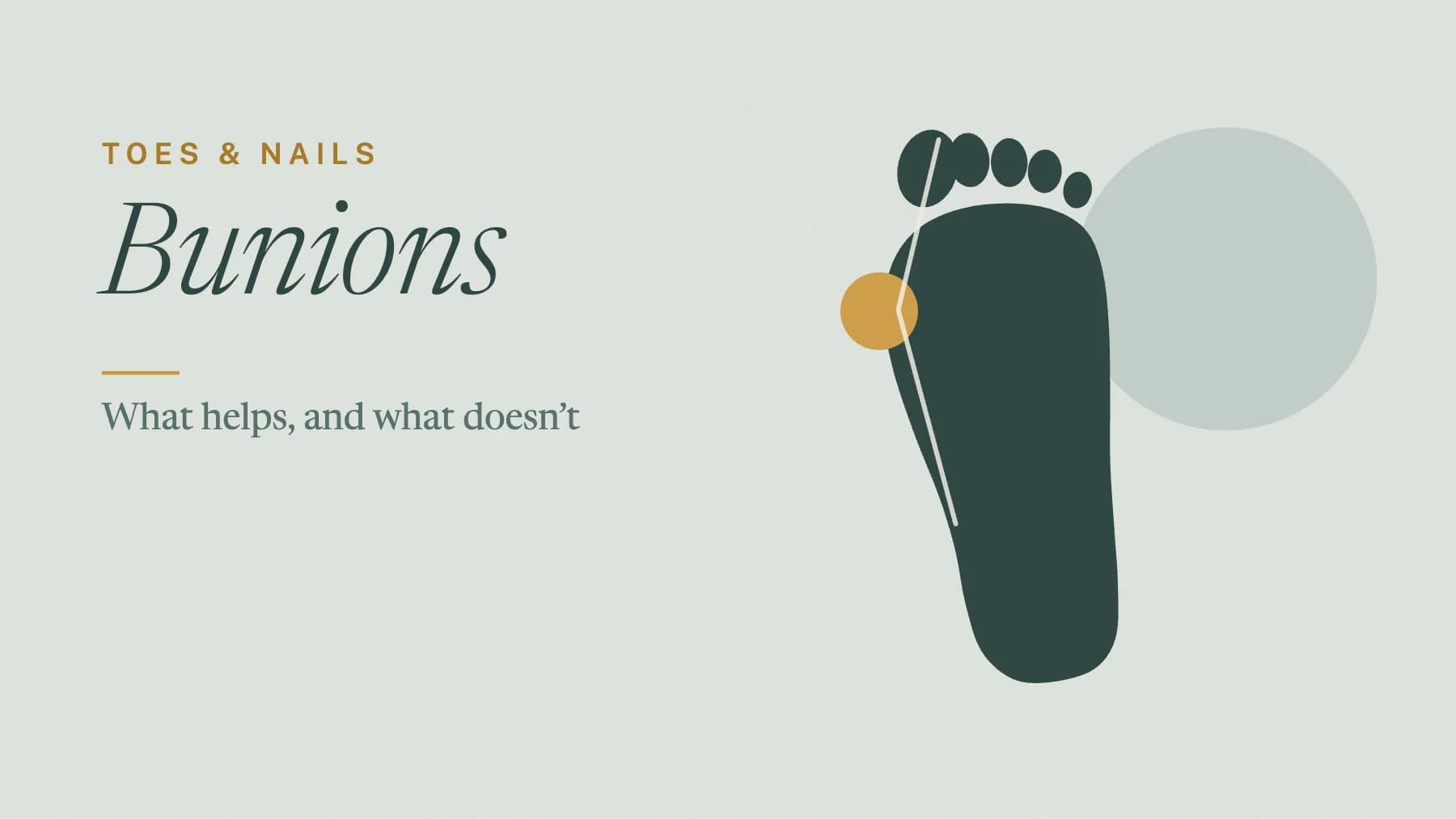
Bunions are among the most common reasons people see a foot specialist, and there’s no shortage of products promising to fix them. Here’s an honest look at what helps, what doesn’t, and when surgery makes sense.
First, why bunions happen
A bunion forms when the big toe drifts toward the second toe and the bone behind it angles outward, creating a bump on the inside of the foot. Inherited foot shape plays a big part, which is why bunions run in families. Footwear makes a difference too: high heels are associated with bunions, and tight, narrow shoes make them hurt.[5,6]
What helps
- The right shoes. Wide, deep toe box, soft upper, low heel. Look for shoes in wider widths, and have your feet measured; many people wear shoes that are too narrow.[7,2]
- Stretching tight shoes over the bump, or choosing styles without a seam there.
- Bunion pads (gel or felt) over the bump to reduce rubbing.
- Toe spacers between the first and second toes, for comfort.
- Inserts or orthotics to rebalance pressure under the ball of the foot.
- Ice and anti-inflammatory medicine for a sore, inflamed joint.[1]
What doesn’t (or isn’t proven)
- Bunion correctors, night splints and braces can hold the toe straighter while you wear them, but there’s little evidence that they change the underlying alignment. A systematic review likewise found insufficient evidence that orthotics slow the progression of a bunion, although they may relieve symptoms.[8] If one feels good, there’s no harm in using it for comfort.
- Exercises alone won’t reverse a bunion, although they can help foot strength and comfort.
- Surgery for looks alone. Operating on a bunion that doesn’t hurt isn’t recommended.[3]
When surgery is worth considering
Surgery is worth discussing when:
- the bunion hurts in most shoes, even wide ones,
- pain limits walking, work or exercise,
- the big toe is pushing the second toe out of place, or
- the joint is becoming stiff or arthritic.[3]
There are many bunion operations, and the right one depends on the size of the deformity and the condition of the joint. Minimally invasive techniques through small incisions are an option for many bunions; a meta-analysis found no clinically important difference in outcomes compared with open surgery.[4] Our Center for Lower Extremity Surgery explains the options in bunion surgery: types, recovery and results (external site).
Common questions
Can anything slow a bunion down?
Unfortunately, no treatment has been shown to slow or stop a bunion from progressing.[5] What you can control is how much it hurts: shoes, padding and inserts keep many bunions comfortable for years.
Why do more women get bunions?
Bunions are more common in women. Exactly why isn’t fully understood; inherited foot shape and footwear, including high heels, both seem to play a part.[5,6] Men get them too, and the same treatments apply.
How long is recovery from bunion surgery?
It depends on the operation. Some people are walking in a surgical shoe within days; more extensive corrections need several weeks of protection, and swelling can take months to settle fully. Our Center for Lower Extremity Surgery goes through recovery for each type of bunion surgery.
The bottom line
For many people, comfortable shoes and simple padding keep a bunion quiet for years. If yours is getting worse or limiting your life, an evaluation, with standing X-rays, will show what’s going on and what your options are. See bunions.
When to see a podiatrist

About the author
Efe Ozturk, DPM
Foot and Ankle Surgeon. Dr. Ozturk is double board certified, as a Diplomate of the American Board of Podiatric Medicine (DABPM) and a Fellow of the Academy of Physicians in Wound Healing (FAPWH), and is a Fellow of the American Society of Podiatric Surgeons (FASPS) and the American Society of Podiatric Medicine (FASPM). Trained in forefoot and rearfoot reconstructive surgery at Morristown Medical Center; sees patients in Lyndhurst, Paramus and Millburn.
References
- 1.American Academy of Orthopaedic Surgeons. Bunions. OrthoInfo. orthoinfo.org (external site)
- 2.Becker BA, Childress MA. Common Foot Problems: Over-the-Counter Treatments and Home Care. Am Fam Physician. 2018;98(5):298-303. PubMed 30216025 (external site)
- 3.American College of Foot and Ankle Surgeons. Bunions. FootHealthFacts. foothealthfacts.org (external site)
- 4.Alimy AR, Polzer H, Ocokoljic A, Ray R, Lewis TL, Rolvien T, et al. Does Minimally Invasive Surgery Provide Better Clinical or Radiographic Outcomes Than Open Surgery in the Treatment of Hallux Valgus Deformity? A Systematic Review and Meta-analysis. Clin Orthop Relat Res. 2023;481(6):1143-1155. PubMed 36332131 (external site)
- 5.Hecht PJ, Lin TJ. Hallux valgus. Med Clin North Am. 2014;98(2):227-32. PubMed 24559871 (external site)
- 6.Barnish MS, Barnish J. High-heeled shoes and musculoskeletal injuries: a narrative systematic review. BMJ Open. 2016;6(1):e010053. PubMed 26769789 (external site)
- 7.Buldt AK, Menz HB. Incorrectly fitted footwear, foot pain and foot disorders: a systematic search and narrative review of the literature. J Foot Ankle Res. 2018;11:43. PubMed 30065787 (external site)
- 8.DeHeer PA, Patel NA, Wolfe W, Badell B, Kirkland M, Wallace B. Orthoses Effect on Radiographic Measurements of Hallux Abducto Valgus: A Systematic Review. J Am Podiatr Med Assoc. 2024;114(4). PubMed 39240758 (external site)
This is general health information and isn’t a substitute for advice from a clinician who knows your history. Read our medical disclaimer and how we write and review content.
More from the blog
Toes & nails
Big toe arthritis (hallux rigidus): why your big toe is stiff and sore
A stiff, sore big toe is often arthritis. How it differs from a bunion, and what helps.
Toes & nails
Toenail fungus: treatments that work, and why it takes a year
Why toenail fungus is slow to clear, which treatments work best, and how to keep it from coming back.
Toes & nails
Hammertoes: why toes curl and what you can do
Why toes curl, why flexible or rigid matters, and what you can do at each stage.