Broken ankle: when you need surgery, and when a cast or boot is enough
Many broken ankles heal without an operation. How stability is judged, what the trials show for casts versus surgery, and what recovery looks like.

By Dr. Efe Ozturk
· 7 min read
Medically reviewed by Dr. Efe Ozturk · Last reviewed
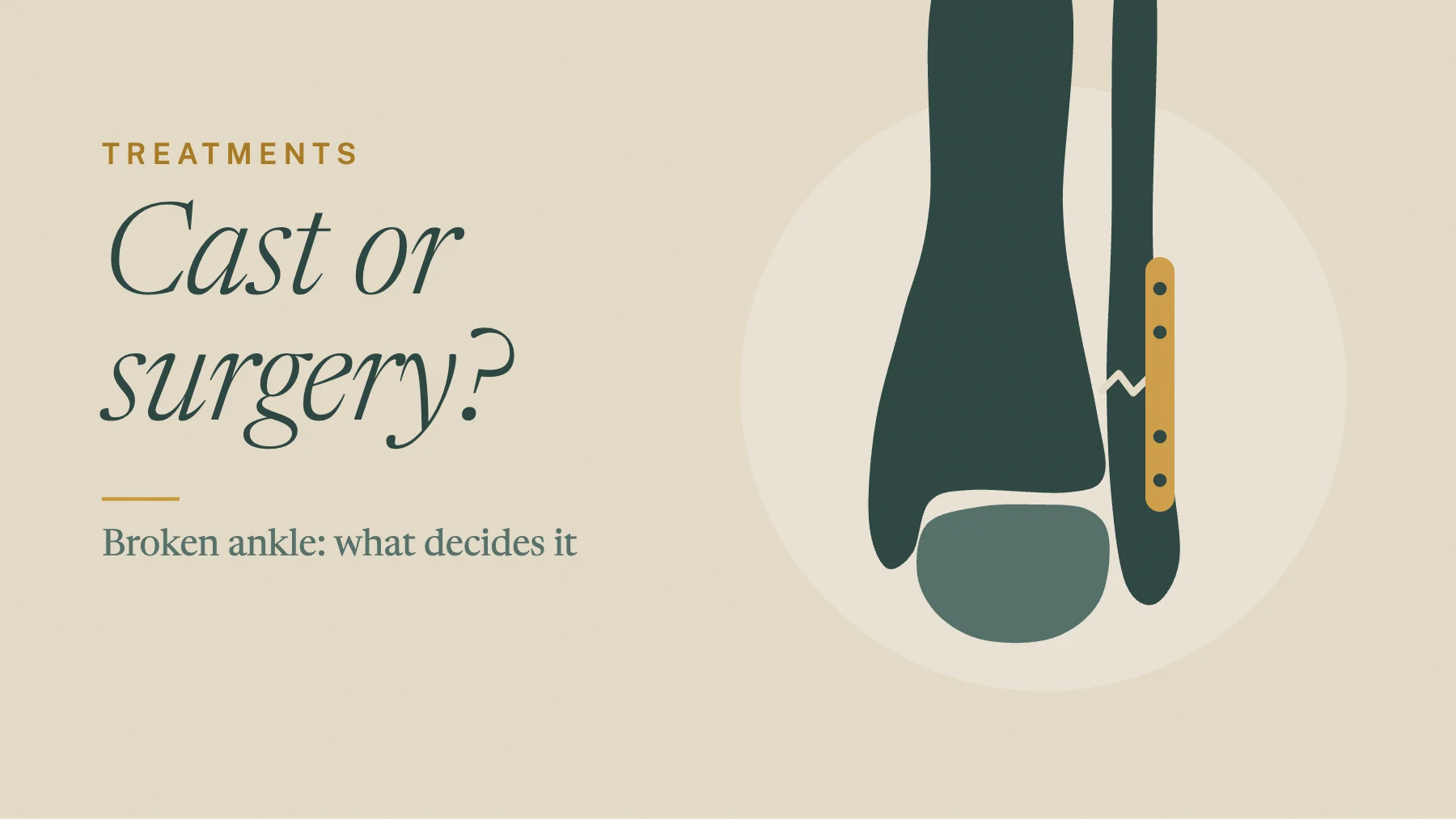
“Will I need surgery?” is usually the first question after a broken ankle. Ankle fractures are the fourth most common fracture in adults,[1] and a Swedish study counted 179 per 100,000 adults a year.[9] Many heal without an operation. Here’s how the decision is made, and what the trials show.
Stable or unstable: the question that decides it
The ankle joint is formed by the shin bone (tibia), the thin outer bone (fibula) and the talus, which sits between them. The bony bumps on each side are the malleoli. A fracture with the bones still in place may not need surgery; most fractures with the ankle dislocated do. Breaks on both sides (bimalleolar fractures) usually need surgery, and so do fractures that come with a torn syndesmosis, the ligament that holds the tibia and fibula together.[1]
The most common break is in the fibula alone.[10] Many of these are stable enough to walk on in a boot or cast; certain types make the joint unstable and need repair.[1] Stable fractures are thought to make up about half of all ankle fractures.[10]
How we tell: the standing X-ray
A German expert review advises confirming stability with X-rays of both ankles taken while standing.[2] That matters because a stress X-ray, where the ankle is pushed or allowed to hang, can make a fracture look worse than it behaves:
- Of 57 patients with a broken fibula, 51 were stable on standing X-rays and treated without surgery; the 47 assessed at follow-up averaged 96 out of 100.[3]
- In 104 patients, those who looked borderline on a stress X-ray but were stable standing did as well as those stable on both; all fractures healed in the correct position.[4]
- In 149 fractures stable on standing X-rays and treated with a brace and walking, results at two years were no worse when a stress X-ray had looked unstable.[5]
When a cast or boot is enough
Two companion Finnish randomized trials tested this directly (the second is called SUPER-FIN):
- Fractures stable on a stress test (247 patients). Three weeks in a cast or a removable brace was no worse at one year than the traditional six weeks in a cast.[10]
- Fractures that looked unstable on a stress X-ray but stayed aligned (126 patients). A six-week cast was no worse than surgery for function at two years (89 versus 87 out of 100). Each group had one bone that didn’t heal. Only the surgery group had wound problems and plates removed (nine removals).[6]
The 2026 trial was run at one specialist hospital and left out people with neuropathy, so its results may not apply to everyone.[6] Over 11 to 13 years of follow-up in the same Finnish region, no patient whose fracture was judged stable needed an operation.[11]
When surgery is the better choice
Displaced and dislocated fractures, most fractures on both sides, and fractures with a syndesmosis injury generally need surgery: usually plates and screws that put the joint back exactly where it belongs.[1] Position matters: in a trial of adults over 60, the 30 ankles that healed out of position scored 59 out of 100 at about three years, against 80 for those that healed well.[8]
Surgery has its own risks. In 57,183 people who had ankle fracture surgery in California hospitals, 1.44% were readmitted for a wound infection within 90 days.[12] In a Norwegian study of 997 patients, 17% later had plates or screws removed.[13]
Recovery after surgery has sped up. In the WAX trial (561 patients), putting weight on the ankle at two weeks after surgery, instead of six, gave slightly better function at four months with a similar complication rate.[14] A 2024 Cochrane review found early weight-bearing probably helps a little, but the difference may not be clinically important.[15]
If you’re over 60
The AIM trial randomized 620 adults over 60 with unstable fractures to surgery or a close contact cast, a closely molded cast put on in the operating room under anesthesia.[7]
- Function was equivalent at six months and still at three years.[7,8]
- Wound problems: infection or wound breakdown in 10% after surgery versus 1% with the cast.[7]
- The trade-off: 15% of cast-treated ankles healed out of position, versus 3% after surgery, and 19% of the cast group were converted to surgery because the fracture slipped.[7]
For adults over 60, a close contact cast applied under anesthesia by a trained surgeon is a reasonable alternative to surgery, but it needs close follow-up X-rays, because about 1 in 5 slip and need an operation.[7]
Diabetes, smoking and age
People who smoke, have diabetes or are elderly have a higher risk of complications after surgery.[1] A meta-analysis found people with diabetes had about twice the risk of complications after an ankle fracture, and more after surgery than after a cast,[16] and in one study those whose diabetes had damaged the nerves, kidneys or circulation had 3.8 times the complications and five times the revision surgery or fusion of those with uncomplicated diabetes.[17] The trials of early walking and of casting left out people with neuropathy.[14,6] With neuropathy, healing is slower, a cast or boot needs careful skin checks because you may not feel a pressure sore, and there is a risk of Charcot foot, so walking on the ankle is usually delayed.
What recovery looks like
Most ankle fractures take at least six weeks to begin healing and 10 to 12 weeks to heal completely. Most people return to normal activities in three to four months, but stiffness and swelling can last for months, and full recovery from some fractures can take up to two years.[1] A review found people scored about 80 out of 100 on function scales by six months, and recovery was still incomplete at two years.[18]
- Exercise. In the EXACT trial, a supervised exercise program after the cast came off was no better at three months than advice alone from a physical therapist.[19]
- Driving. If the right ankle was broken, driving usually resumes at 9 to 12 weeks.[1] After surgery, braking times were close to normal by nine weeks in one small study.[20]
- Arthritis can develop years later.[1] In one study of operated fractures followed for about 18 years, 36% showed advanced arthritis on X-ray, more often after severe fractures.[21]
How we decide
Dr. Efe Ozturk is a Foot and Ankle Surgeon and podiatrist. We examine the ankle and take X-rays at the practice, including standing views when it’s safe. A stable fracture is treated in a boot or cast with planned follow-up X-rays; if you need surgery, it’s handled through our Center for Lower Extremity Surgery (external site). Not sure it’s broken? Read sprain or fracture, and see our fracture care page.
Common questions
Can I walk on a broken ankle?
Sometimes. Many isolated fibula fractures are stable enough to bear weight in a boot or cast, but walking on an unstable fracture too early can shift the bones and stop them healing properly.[1] Wait until you’ve been examined.
Will the plate have to come out?
Usually not. In one large study, 17% of patients later had plates or screws removed, mostly because the hardware bothered them.[13]
Is a cast as good as surgery?
Stable fractures don’t need surgery; a trial found even three weeks in a cast or brace was no worse than six.[10] For outer-ankle fractures that are aligned but look unstable on a stress X-ray, a 2026 trial found a cast was no worse than surgery at two years.[6] For clearly unstable fractures in younger, active people, surgery remains the usual treatment.[1,2]
When to see a podiatrist

About the author
Dr. Efe Ozturk
Foot and Ankle Surgeon. Dr. Ozturk is double board certified, as a Diplomate of the American Board of Podiatric Medicine (DABPM) and a Fellow of the Academy of Physicians in Wound Healing (FAPWH), and is a Fellow of the American Society of Podiatric Surgeons (FASPS) and the American Society of Podiatric Medicine (FASPM). Trained in forefoot and rearfoot reconstructive surgery at Morristown Medical Center; sees patients in Lyndhurst, Paramus and Millburn.
Where to be seen
Dr. Ozturk sees patients at each of these offices, and one phone number reaches all of them.
References
- 1.American Academy of Orthopaedic Surgeons. Ankle Fractures (Broken Ankle). OrthoInfo. orthoinfo.org (external site)
- 2.Baumbach SF, Polzer H, Ochman S, et al. The Diagnosis, Treatment, and Aftercare of Ankle Fractures. Dtsch Arztebl Int. 2026;123(15):405-412. PubMed 42163791 (external site)
- 3.Weber M, Burmeister H, Flueckiger G, Krause FG. The use of weightbearing radiographs to assess the stability of supination-external rotation fractures of the ankle. Arch Orthop Trauma Surg. 2010;130(5):693-698. PubMed 20082083 (external site)
- 4.Seidel A, Krause F, Weber M. Weightbearing vs Gravity Stress Radiographs for Stability Evaluation of Supination-External Rotation Fractures of the Ankle. Foot Ankle Int. 2017;38(7):736-744. PubMed 28511569 (external site)
- 5.Gregersen MG, Robinson HS, Molund M. Concomitant Unstable and Stable Gravity Stress Tests on Weight-Bearing Stable Weber B Ankle Fractures Treated Nonoperatively: A 2-Year Outcome Study. J Bone Joint Surg Am. 2023;105(18):1435-1441. PubMed 37498982 (external site)
- 6.Kortekangas T, Lehtola R, Leskelä HV, et al. Cast immobilisation versus surgery for unstable lateral malleolus fractures (SUPER-FIN): randomised non-inferiority clinical trial. BMJ. 2026;392:e085295. PubMed 41534905 (external site)
- 7.Willett K, Keene DJ, Mistry D, et al. Close Contact Casting vs Surgery for Initial Treatment of Unstable Ankle Fractures in Older Adults: A Randomized Clinical Trial. JAMA. 2016;316(14):1455-1463. PubMed 27727383 (external site)
- 8.Keene DJ, Lamb SE, Mistry D, et al. Three-Year Follow-up of a Trial of Close Contact Casting vs Surgery for Initial Treatment of Unstable Ankle Fractures in Older Adults. JAMA. 2018;319(12):1274-1276. PubMed 29584832 (external site)
- 9.Juto H, Nilsson H, Morberg P. Epidemiology of Adult Ankle Fractures: 1756 cases identified in Norrbotten County during 2009-2013 and classified according to AO/OTA. BMC Musculoskelet Disord. 2018;19(1):441. PubMed 30545314 (external site)
- 10.Kortekangas T, Haapasalo H, Flinkkilä T, et al. Three week versus six week immobilisation for stable Weber B type ankle fractures: randomised, multicentre, non-inferiority clinical trial. BMJ. 2019;364:k5432. PubMed 30674451 (external site)
- 11.Karkkola S, Kortekangas T, Pakarinen H, et al. Stability-Based Classification of Ankle Fractures-The Long-Term Outcome After 11-13 Years of Follow-up. J Orthop Trauma. 2021;35(5):227-233. PubMed 32925451 (external site)
- 12.SooHoo NF, Krenek L, Eagan MJ, et al. Complication rates following open reduction and internal fixation of ankle fractures. J Bone Joint Surg Am. 2009;91(5):1042-1049. PubMed 19411451 (external site)
- 13.Naumann MG, Sigurdsen U, Utvåg SE, Stavem K. Incidence and risk factors for removal of an internal fixation following surgery for ankle fracture: A retrospective cohort study of 997 patients. Injury. 2016;47(8):1783-1788. PubMed 27262772 (external site)
- 14.Bretherton CP, Achten J, Jogarah V, et al. Early versus delayed weight-bearing following operatively treated ankle fracture (WAX): a non-inferiority, multicentre, randomised controlled trial. Lancet. 2024;403(10446):2787-2797. PubMed 38848738 (external site)
- 15.Lewis SR, Pritchard MW, Parker R, Searle HKC, Beckenkamp PR, Keene DJ, et al. Rehabilitation for ankle fractures in adults. Cochrane Database Syst Rev. 2024;9(9):CD005595. PubMed 39312389 (external site)
- 16.Lopez-Capdevila L, Rios-Ruh JM, Fortuño J, Costa AE, Santamaria-Fumas A, Dominguez-Sevilla A, et al. Diabetic ankle fracture complications: a meta-analysis. Foot Ankle Surg. 2021;27(7):832-837. PubMed 33451907 (external site)
- 17.Wukich DK, Joseph A, Ryan M, et al. Outcomes of ankle fractures in patients with uncomplicated versus complicated diabetes. Foot Ankle Int. 2011;32(2):120-130. PubMed 21288410 (external site)
- 18.Beckenkamp PR, Lin CW, Chagpar S, et al. Prognosis of physical function following ankle fracture: a systematic review with meta-analysis. J Orthop Sports Phys Ther. 2014;44(11):841-851. PubMed 25269609 (external site)
- 19.Moseley AM, Beckenkamp PR, Haas M, et al. Rehabilitation After Immobilization for Ankle Fracture: The EXACT Randomized Clinical Trial. JAMA. 2015;314(13):1376-1385. PubMed 26441182 (external site)
- 20.Egol KA, Sheikhazadeh A, Mogatederi S, et al. Lower-extremity function for driving an automobile after operative treatment of ankle fracture. J Bone Joint Surg Am. 2003;85(7):1185-1189. PubMed 12851340 (external site)
- 21.Lübbeke A, Salvo D, Stern R, et al. Risk factors for post-traumatic osteoarthritis of the ankle: an eighteen year follow-up study. Int Orthop. 2012;36(7):1403-1410. PubMed 22249843 (external site)
This is general health information and isn’t a substitute for advice from a clinician who knows your history. Read our medical disclaimer and how we write and review content.
More from the blog
Treatments
Tenex and TenJet: minimally invasive treatment for stubborn plantar fasciitis and Achilles tendinitis
When heel or Achilles pain hasn’t improved after months of good care, the next step doesn’t have to be open surgery. How Tenex and TenJet work, what the studies show, and who they suit.
Treatments
Minimally invasive bunion surgery: what the research says, and who it suits
Studies show less early pain and a smaller scar, similar results at a year, and real trade-offs. What the evidence says, and who it suits.
Treatments
Cortisone shots in the foot and ankle: what to expect
What a steroid injection can and can’t do for foot and ankle pain, what to expect at the visit, and the risks worth knowing.