Minimally invasive bunion surgery: what the research says, and who it suits
Studies show less early pain and a smaller scar, similar results at a year, and real trade-offs. What the evidence says, and who it suits.

By Dr. Efe Ozturk
· 5 min read
Medically reviewed by Dr. Efe Ozturk · Last reviewed
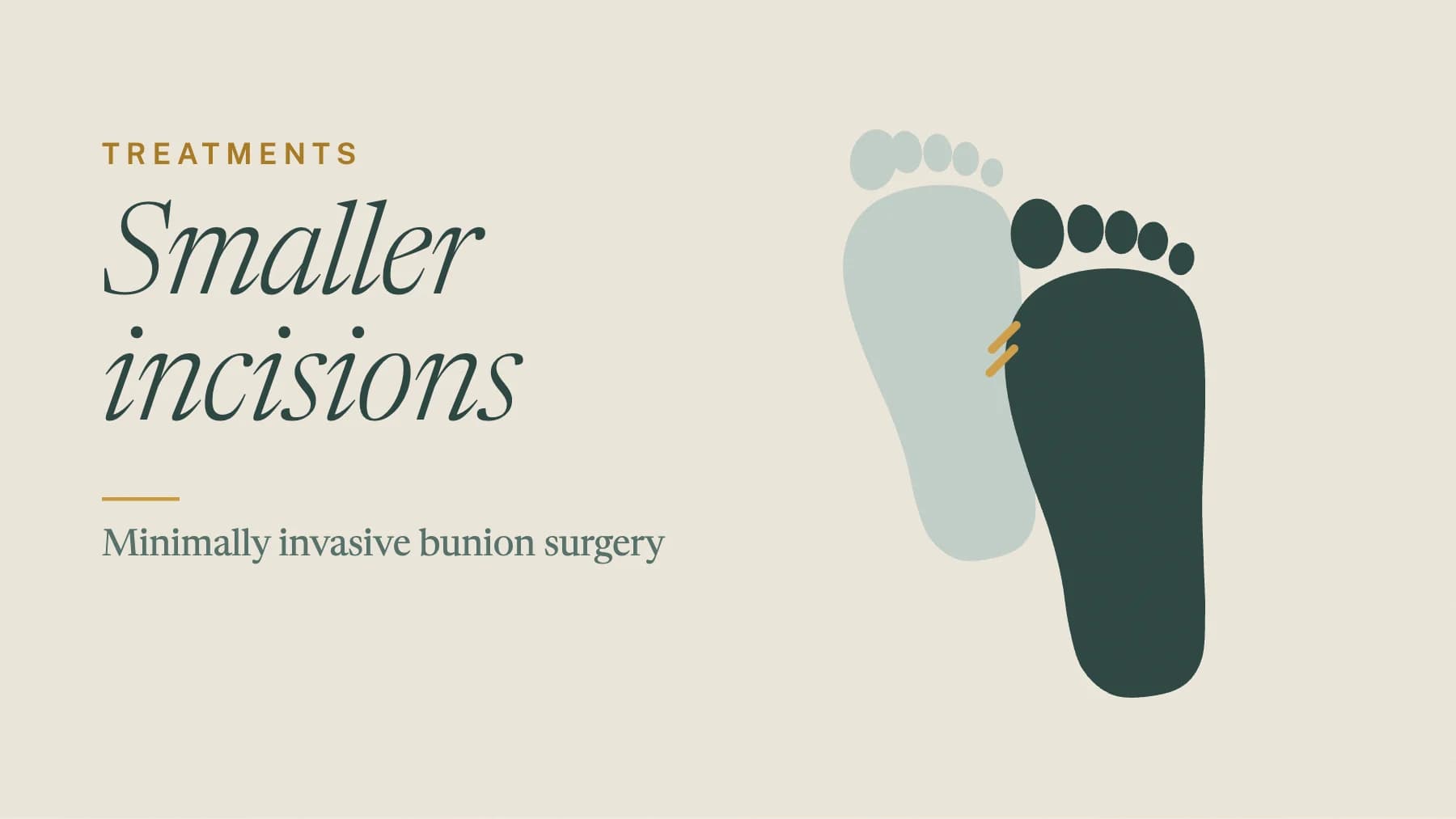
A bunion is a bump at the base of the big toe where the toe drifts toward its neighbor; surgery is worth discussing only when it keeps hurting after a fair trial of wider shoes, pads and inserts.[12,13,3] Here’s what the research shows about the “minimally invasive” version.
What “minimally invasive” means
Open surgery uses one incision long enough to cut the bone in direct view. Minimally invasive (percutaneous) surgery works through incisions researchers define as about 2 cm at most, shifts the bone under live X-ray because it can’t be seen directly, and holds it with one or two screws.[1,2,14,3] The term describes the incisions, not the job. Our Center for Lower Extremity Surgery explains how it’s done (external site).
Where it does better: early pain, the wound and the scar
- Pain. In a randomized study of 50 patients, pain was lower after percutaneous surgery from day one to week six.[4] In another, of 71 patients, day-one pain averaged 4.2 out of 10 versus 5.3 after open surgery.[5]
- Scar and wound. In a non-randomized comparison followed for at least two years, scars were 1.2 cm versus 5 cm.[15] A randomized trial of 40 feet found better wound healing at six weeks.[6]
Where it’s equivalent: a year and beyond
A meta-analysis of seven controlled studies (395 feet) found no clinically important difference in function (88 versus 85 on a 100-point scale), pain, X-ray angles or complications; its authors suspected study weaknesses had inflated the apparent benefits and declined to recommend it over open surgery.[1] A 2026 meta-analysis of the minimally invasive chevron technique (352 feet) found comparable function, pain and correction at every follow-up, with only small differences either way.[16]
Other reviews lean each way: one called the approach more effective, another found better function after open surgery, and a living review found a possible edge for third-generation minimally invasive techniques in straightening the toe angle.[7,8,17] The American Academy of Orthopaedic Surgeons still calls it not widely accepted and needing long-term research.[3]
The trade-offs
- Complications. Neither meta-analysis found a significant difference.[1,16] A review of 766 feet without a comparison group found complications in about 21%, which its authors judged comparable with open surgery.[14]
- Screws. In a review of 1,088 procedures, 6.2% had hardware removed.[10] In the non-randomized comparison above, 27% of minimally invasive feet had a second operation (mostly for protruding screws) versus 8% after open surgery (mostly for stiffness), and 14% were converted to open during surgery.[15]
- Radiation. One trial measured 14 times more X-ray exposure, which its authors called small; a later study found doses within safety limits with a mini C-arm.[2,18]
- The learning curve. One review put the plateau at 27 to 40 operations (about 36 on average); early cases took longer and used more X-ray, though outcomes weren’t clearly worse in those small studies.[11] The meta-analysis above warned that patients may be harmed while surgeons learn.[1]
- Recurrence happens after any bunion operation.[19] In 78 of 126 feet operated on by an experienced surgeon and followed at least five years, 7.7% had drifted back past 15 degrees.[20]
Who it suits, and what recovery looks like
The classic candidate has a mild-to-moderate bunion, no painful arthritis in the big toe joint, and a stable joint at the base of the first metatarsal; arthritis or instability points to a different operation (see big toe arthritis).[9,8] For severe bunions, a review of 676 feet reported good results but few studies, and another says it “may” correct them better, mostly on single-surgeon series.[21,22] Cut-offs between mild, moderate and severe vary between studies, with no agreed standard.[23]
Almost all bunion surgery is same-day, and swelling is common for six months to a year.[3] In one study of one technique (90 feet), median return to driving, work and normal walking was 4 weeks, low-impact sport 8, regular shoes 12, with wide ranges around each.[24] The Center’s recovery timeline (external site) goes stage by stage.
How we decide
Dr. Efe Ozturk is a Foot and Ankle Surgeon and podiatrist who performs minimally invasive bunion surgery through our Center for Lower Extremity Surgery. Non-surgical care comes first (see what helps a bunion). Standing X-rays taken at the practice measure the angles and check for arthritis; with the examination, they guide the choice between small incisions, an open operation, or neither. Ask any surgeon how often they do the technique, whether they might switch to open, and how often their screws come out. A second opinion (external site) before elective surgery is reasonable.
Common questions
Is minimally invasive bunion surgery less painful?
In the first days to weeks, yes, in trials; by six months to a year, pain scores were similar.[4,5,16]
Will the screws need to come out?
Usually not: 6.2% in one review, though one series reported 27% reoperations, mostly for protruding screws.[10,15]
Can the bunion come back?
Yes, after any bunion operation; reported rates depend on the defining angle and the length of follow-up.[19,20]
When to see a podiatrist
About the author
Dr. Efe Ozturk
Foot and Ankle Surgeon. Dr. Ozturk is double board certified, as a Diplomate of the American Board of Podiatric Medicine (DABPM) and a Fellow of the Academy of Physicians in Wound Healing (FAPWH), and is a Fellow of the American Society of Podiatric Surgeons (FASPS) and the American Society of Podiatric Medicine (FASPM). Trained in forefoot and rearfoot reconstructive surgery at Morristown Medical Center; sees patients in Lyndhurst, Paramus and Millburn.
Where to be seen
Dr. Ozturk sees patients at each of these offices, and one phone number reaches all of them.
References
- 1.Alimy AR, Polzer H, Ocokoljic A, Ray R, Lewis TL, Rolvien T, et al. Does Minimally Invasive Surgery Provide Better Clinical or Radiographic Outcomes Than Open Surgery in the Treatment of Hallux Valgus Deformity? A Systematic Review and Meta-analysis. Clin Orthop Relat Res. 2023;481(6):1143-1155. PubMed 36332131 (external site)
- 2.Torrent J, Baduell A, Vega J, Malagelada F, Luna R, Rabat E. Open vs Minimally Invasive Scarf Osteotomy for Hallux Valgus Correction: A Randomized Controlled Trial. Foot Ankle Int. 2021;42(8):982-993. PubMed 34024185 (external site)
- 3.American Academy of Orthopaedic Surgeons. Bunion Surgery. OrthoInfo. orthoinfo.org (external site)
- 4.Lee M, Walsh J, Smith MM, Ling J, Wines A, Lam P. Hallux Valgus Correction Comparing Percutaneous Chevron/Akin (PECA) and Open Scarf/Akin Osteotomies. Foot Ankle Int. 2017;38(8):838-846. PubMed 28476096 (external site)
- 5.Yoon H, Park KH, Jo J, et al. Percutaneous distal chevron osteotomy is associated with lower immediate postoperative pain and a greater range of motion than the open technique: A prospective randomized study. Int Orthop. 2024;48(9):2383-2394. PubMed 38836871 (external site)
- 6.Escudero MI, Escobar F, Albarrán CF, Medina A, Pellegrini MJ. Minimally Invasive vs Open Distal Metatarsal Osteotomy for Hallux Valgus: A Randomized Controlled Trial of Short-term Wound Healing and 1-Year Outcomes. Foot Ankle Int. 2025;46(10):1092-1102. PubMed 40931943 (external site)
- 7.Ji L, Wang K, Ding S, Sun C, Sun S, Zhang M. Minimally Invasive vs. Open Surgery for Hallux Valgus: A Meta-Analysis. Front Surg. 2022;9:843410. PubMed 35388365 (external site)
- 8.Singh MS, Khurana A, Kapoor D, Katekar S, Kumar A, Vishwakarma G. Minimally invasive vs open distal metatarsal osteotomy for hallux valgus - A systematic review and meta-analysis. J Clin Orthop Trauma. 2020;11(3):348-356. PubMed 32405192 (external site)
- 9.Altenberger S, Kriegelstein S, Gottschalk O, et al. [The minimally invasive Chevron and Akin osteotomy (MICA)]. Oper Orthop Traumatol. 2018;30(3):148-160. Article in German. PubMed 29671022 (external site)
- 10.Gonzalez T, Encinas R, Johns W, Benjamin Jackson J 3rd. Minimally Invasive Surgery Using a Shannon Burr for the Treatment of Hallux Valgus Deformity: A Systematic Review. Foot Ankle Orthop. 2023;8(1):24730114221151069. PubMed 36741678 (external site)
- 11.Baumann AN, Walley KC, Anastasio AT, Gong DC, Talusan PG. Learning curve associated with minimally invasive surgery for hallux valgus: A systematic review. Foot Ankle Surg. 2023;29(8):560-565. PubMed 37524619 (external site)
- 12.Hecht PJ, Lin TJ. Hallux valgus. Med Clin North Am. 2014;98(2):227-32. PubMed 24559871 (external site)
- 13.American Academy of Orthopaedic Surgeons. Bunions. OrthoInfo. orthoinfo.org (external site)
- 14.Yang C, Spacek AE, Elliott AD. Complication Rates of Minimally Invasive Chevron Osteotomy for Correction of Hallux Abductovalgus: A Systematic Review. J Am Podiatr Med Assoc. 2024;114(5):22-067. PubMed 39546363 (external site)
- 15.Frigg A, Zaugg S, Maquieira G, Pellegrino A. Stiffness and Range of Motion After Minimally Invasive Chevron-Akin and Open Scarf-Akin Procedures. Foot Ankle Int. 2019;40(5):515-525. PubMed 30688526 (external site)
- 16.Tham A, Rubin J, Lowton E, et al. Minimally invasive chevron osteotomy provides comparable outcomes to open surgery for hallux valgus: A systematic review and meta-analysis. Foot Ankle Surg. 2026;32(4):325-332. PubMed 41330787 (external site)
- 17.Ettinger S, Spindler FT, Savli M, Baumbach SF. Correction potential and outcome of various surgical procedures for hallux valgus surgery: a living systematic review and meta-analysis. Arch Orthop Trauma Surg. 2024;144(11):4725-4736. PubMed 39249135 (external site)
- 18.Bejarano-Pineda L, Aslan L, Beldame J, et al. Intraoperative Radiation Exposure with Percutaneous vs Hybrid Hallux Valgus Correction: A Comparative Study. Foot Ankle Int. 2025;46(8):880-886. PubMed 40514203 (external site)
- 19.Lalevee M, de Cesar Netto C, ReSurg, Boublil D, Coillard JY. Recurrence Rates With Longer-Term Follow-up After Hallux Valgus Surgical Treatment With Distal Metatarsal Osteotomies: A Systematic Review and Meta-analysis. Foot Ankle Int. 2023;44(3):210-222. PubMed 36859795 (external site)
- 20.Lewis TL, Robinson PW, Ray R, et al. Five-Year Follow-up of Third-Generation Percutaneous Chevron and Akin Osteotomies (PECA) for Hallux Valgus. Foot Ankle Int. 2023;44(2):104-117. PubMed 36692121 (external site)
- 21.Ruberto P, Calori S, Bocchino G, et al. Utilisation of the minimally invasive chevron akin (mica) osteotomy for severe hallux valgus: a systematic review. Musculoskelet Surg. 2025;109(2):133-143. PubMed 39432225 (external site)
- 22.Lewis TL, Barakat A, Mangwani J, Ramasamy A, Ray R. Current concepts of fourth-generation minimally invasive and open hallux valgus surgery. Bone Joint J. 2025;107-B(1):10-18. PubMed 39740690 (external site)
- 23.Spindler FT, Ettinger S, Baumbach SF. Classification of hallux valgus deformity-is there a standard? Arch Orthop Trauma Surg. 2024;144(11):4737-4743. PubMed 39259307 (external site)
- 24.Rojas-Toro DE, Protasowicki N, Ruiz RR, et al. Return to daily and sports activities after minimally invasive transverse osteotomy and Akin (META) for Hallux Valgus: setting realistic expectations. J Foot Ankle Surg. 2026. Online ahead of print. PubMed 42235816 (external site)
This is general health information and isn’t a substitute for advice from a clinician who knows your history. Read our medical disclaimer and how we write and review content.
More from the blog
Treatments
Cortisone shots in the foot and ankle: what to expect
What a steroid injection can and can’t do for foot and ankle pain, what to expect at the visit, and the risks worth knowing.
Treatments
Does shockwave therapy work for heel pain? What the studies show
Shockwave therapy has strong evidence for stubborn heel pain. What the studies show, and where it fits.
Treatments
PRP injections for the foot and ankle: what the evidence says
Where PRP helps, where trials show it doesn’t, and what to expect from an injection.