Tenex and TenJet: minimally invasive treatment for stubborn plantar fasciitis and Achilles tendinitis
When heel or Achilles pain hasn’t improved after months of good care, the next step doesn’t have to be open surgery. How Tenex and TenJet work, what the studies show, and who they suit.

By Dr. Efe Ozturk
· 7 min read
Medically reviewed by Dr. Efe Ozturk · Last reviewed
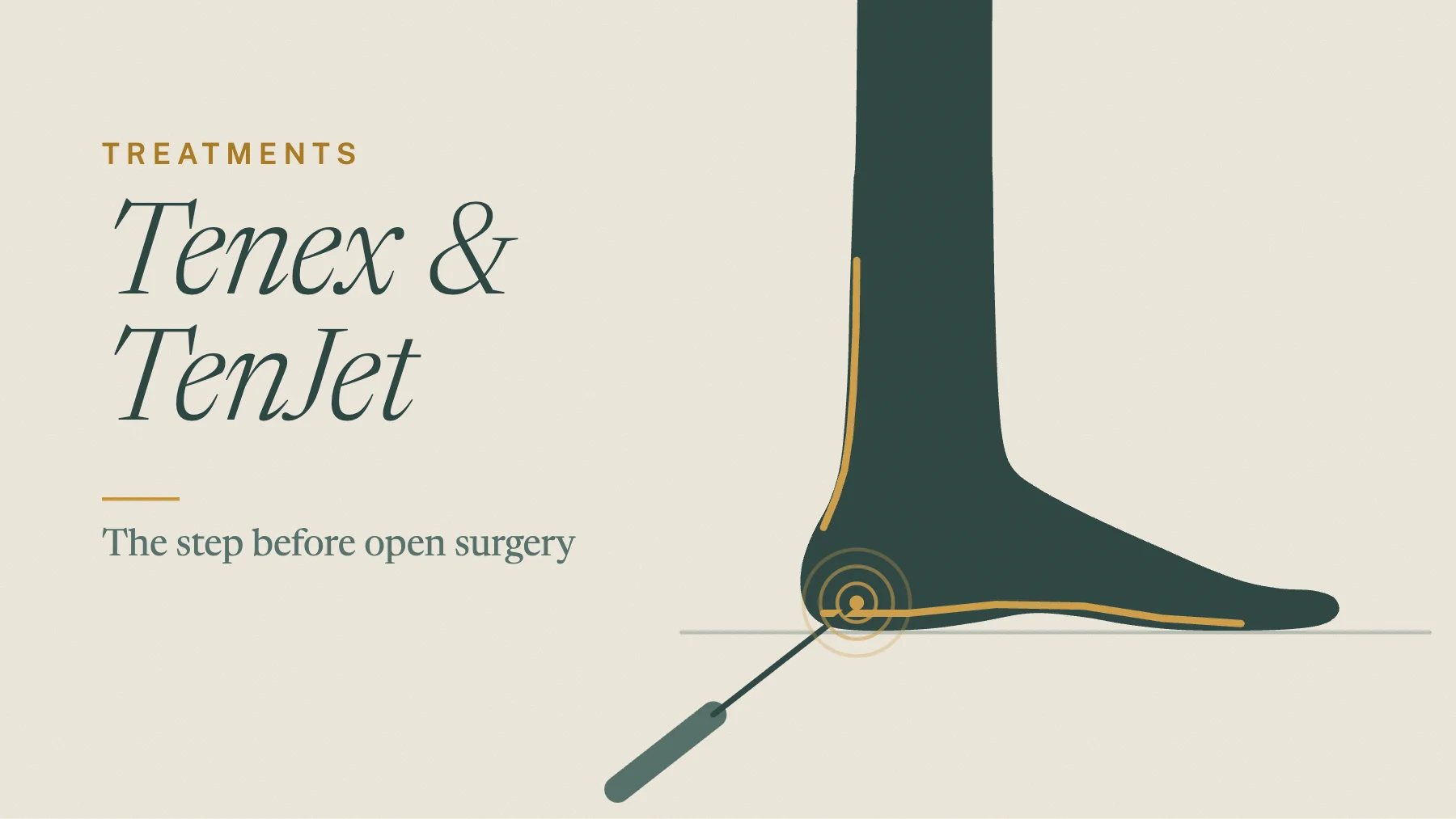
Most heel pain and Achilles pain gets better with stretching, strengthening, the right shoes and time. But not all of it. In a Danish study of 174 people with plantar fasciitis, half still had symptoms five years after it started.[9] In another study, a 12-week calf-strengthening program worked for 89% of painful Achilles tendons in the middle of the tendon, but only 32% where the tendon meets the heel bone.[10] For those people, months of stretching and night splints can feel like a dead end. Minimally invasive tenotomy is designed for exactly that group.
What Tenex and TenJet do
In long-standing plantar fasciitis and Achilles tendinopathy, part of the tissue has degenerated. These procedures find that damaged area with ultrasound and remove it, so the healthy tissue around it can heal.[3,8]
- Tenex passes a needle-sized tip through a cut of about 5 mm, after local anesthetic. The tip vibrates at an ultrasonic frequency, breaking up the damaged tissue and suctioning it away while the surgeon watches on the ultrasound screen.[3,4]
- TenJet works through a similar small incision under ultrasound. A high-pressure stream of saline runs inside the tip, cutting the damaged tissue and carrying it away; the skin is closed with adhesive strips.[5] In a laboratory study on cow tendon with chemically induced damage, it removed the damaged tissue with negligible disruption of the healthy tissue around it.[11]
There’s no large incision, no general anesthesia and, in one series, no opioid prescriptions.[3] Patients typically wear a walking boot for one to two weeks.[7]
Results for plantar fasciitis
The studies of ultrasonic treatment for the plantar fascia report large, lasting drops in pain:
- Mayo Clinic, six years on. 58 procedures, after symptoms lasting about two years on average: pain fell from 6.8 to 0.7 out of 10; 91% of treated feet were rated satisfied and 90% would recommend it, with no complications.[6]
- A prospective study of 67 patients. Pain improved by almost 6 points out of 10, and 94% were satisfied at three months and at one year, with no complications.[12]
- A multicenter study of 56 patients followed for a little over two years found significant gains in pain, physical function and mobility.[13]
- When surgery had already failed. In a small early series of 12 patients, four had already had an open or endoscopic release that didn’t work; all 12 were essentially pain-free at two years.[14]
Results for Achilles tendinitis
- Insertional tendinopathy (pain where the tendon meets the heel bone, the type exercise helps less): in 34 patients, the share with moderate or severe pain fell from 68% to 15% at a median of 1.7 years, and all 14 patients whose work status was recorded were back at work by 12 weeks.[3] In another series of 25 patients (26 procedures), 84.6% had a successful result, including two who needed a second procedure.[15]
- A prospective study of 56 patients with insertional or midportion tendinopathy found function improved by 25 points at one year, about three times the smallest change patients notice. Most were cleared for full activity by three to four months. Of the 39 who answered, about three-quarters rated the result ideal or satisfactory, though about half still considered their symptoms not yet acceptable.[2]
That study also showed who does less well: people with a prominent heel bump (Haglund’s deformity) or calcium deposits in the tendon improved less.[2] In our view, an open operation that removes the bump is often the better choice for them. See Haglund’s deformity.
How it compares with open surgery
Open surgery works well for many people, but it is a bigger undertaking:
- Insertional Achilles surgery. In a review of 465 operations, 89.6% had good or excellent results, but the average complication rate was 18.3%.[16]
- Midportion Achilles surgery. Complications were 5.3% with minimally invasive approaches versus 10.5% with open ones, a trend rather than a statistically firm difference, and some older open-surgery protocols used a cast for more than six weeks.[17]
- Plantar fascia release. Complications averaged 5% with the endoscopic approach and 11% with open surgery.[18]
- Ultrasonic tenotomy. 2 complications in 289 procedures (0.7%) across elbow, knee, Achilles and plantar fascia treatments: one superficial wound infection and one area of skin sensitivity. Rare serious problems, including Achilles tendon rupture and a blood clot, have been reported in other small series.[7] In the insertional Achilles series, 70% were satisfied at 6 to 12 weeks.[3]
These figures come from different studies of different patients, not head-to-head trials, so they show the general picture rather than a precise comparison.
What the evidence can’t tell us yet
We want you to decide with the full picture:
- No randomized trials yet. None of the foot and ankle studies has a comparison group, and reviews call for controlled trials.[8,19] When the American College of Foot and Ankle Surgeons reviewed heel pain treatments in 2018, it rated ultrasonic debridement “uncertain” because adequate peer-reviewed studies weren’t yet available; most of the results above were published after that.[1]
- TenJet’s published results come from other tendons. No study of TenJet met the criteria of a 2025 systematic review,[8] and its published patient results so far come from other parts of the body, such as the elbow and hip. For the heel and Achilles, its use rests on the same principle as Tenex.
- Industry ties. Some of the researchers above have consulted for or advised the company that makes Tenex.[14,3,7]
- Insurance. Some insurers still classify the procedure as investigational and don’t cover it,[20] so we check your benefits before scheduling.
Who it suits
You may be a candidate if:
- Pain has lasted six months or more despite well-run non-surgical care. That’s the point at which the American College of Foot and Ankle Surgeons says surgery can be considered for heel pain.[1]
- Ultrasound shows a thickened, damaged area of the plantar fascia or Achilles tendon that can be targeted.
- You want to avoid, or postpone, a larger open operation.
It is less suited to a large heel bump or heavy calcification,[2] to a tight calf, where calf lengthening may address the cause,[1] and to heel pain from a pinched nerve. Our sister practice, the Lower Extremity Nerve Institute (external site), covers that last one.
What recovery looks like
- The first two weeks: a walking boot, then a gradual return to supportive shoes.[7]
- From about two weeks: guided strengthening, with no heavy loading of the Achilles before six weeks.[3]
- Results build over weeks. In the early plantar fascia series, pain eased between 5 and 13 weeks.[14] After Achilles treatment, most patients were cleared for full activity by three to four months.[2]
How we decide
Dr. Efe Ozturk is a Foot and Ankle Surgeon and podiatrist who offers both Tenex and TenJet. We confirm the diagnosis with an exam and in-office ultrasound, and make sure the non-surgical steps have had a fair trial: stretching and strengthening, footwear and orthotics, and shockwave therapy. If pain persists, we go through the options side by side: Tenex or TenJet, calf lengthening, or open surgery through our Center for Lower Extremity Surgery (external site). See our heel pain and Achilles tendon pages for the full range of care.
Common questions
Is Tenex surgery?
It’s a minimally invasive surgical procedure: it removes tissue through a small incision. It’s done under local anesthetic through a cut of about 5 mm, without general anesthesia.[3]
Does it hurt?
The area is numbed first. In one Achilles series, no patient was prescribed opioid pain medicine afterward.[3]
Can it be repeated?
Yes. In one Achilles series, two patients whose first procedure didn’t fully work did well after a second.[15]
How is TenJet different from Tenex?
Both remove damaged tissue through a small incision under ultrasound. Tenex uses ultrasonic energy; TenJet uses a high-pressure saline jet.[4,5] Tenex has more published foot and ankle results.[8]
When to see a podiatrist
About the author
Dr. Efe Ozturk
Foot and Ankle Surgeon. Dr. Ozturk is double board certified, as a Diplomate of the American Board of Podiatric Medicine (DABPM) and a Fellow of the Academy of Physicians in Wound Healing (FAPWH), and is a Fellow of the American Society of Podiatric Surgeons (FASPS) and the American Society of Podiatric Medicine (FASPM). Trained in forefoot and rearfoot reconstructive surgery at Morristown Medical Center; sees patients in Lyndhurst, Paramus and Millburn.
Where to be seen
Dr. Ozturk sees patients at each of these offices, and one phone number reaches all of them.
References
- 1.Schneider HP, Baca JM, Carpenter BB, Dayton PD, Fleischer AE, Sachs BD. American College of Foot and Ankle Surgeons Clinical Consensus Statement: Diagnosis and Treatment of Adult Acquired Infracalcaneal Heel Pain. J Foot Ankle Surg. 2018;57(2):370-381. PubMed 29284574 (external site)
- 2.Hall MM, Chimenti RL, Danielson JF, Fleagle TR. Effects of Ultrasound-Guided Tenotomy and Debridement on Pain, Function, and Psychological Factors for Achilles Tendinopathy: A Prospective Cohort Study. J Orthop Res. 2026;44(2). PubMed 41015820 (external site)
- 3.Chimenti RL, Stover DW, Fick BS, Hall MM. Percutaneous Ultrasonic Tenotomy Reduces Insertional Achilles Tendinopathy Pain With High Patient Satisfaction and a Low Complication Rate. J Ultrasound Med. 2019;38(6):1629-1635. PubMed 30280399 (external site)
- 4.U.S. Food and Drug Administration. 510(k) Premarket Notification K153299: Tenex Health TX System. Cleared March 3, 2016. accessdata.fda.gov (external site)
- 5.U.S. Food and Drug Administration. 510(k) Premarket Notification K190804: HydroCision TenJet Device. Cleared June 5, 2019. accessdata.fda.gov (external site)
- 6.Ha CT, Romero JM, Gonzalez-Carta K, et al. Ultrasound-Guided Percutaneous Fasciotomy and Debridement for Chronic Plantar Fasciopathy: Six-Year Patient-Reported Outcomes from a Retrospective Case Series. Foot Ankle Int. 2025;46(11):1239-1247. PubMed 41178389 (external site)
- 7.Fick B, Stover DW, Chimenti RL, Hall MM. The Safety of Ultrasound Guided Tenotomy and Debridement for Upper and Lower Extremity Tendinopathies: A Retrospective Study. Iowa Orthop J. 2021;41(2):82-90. PubMed 34924874 (external site)
- 8.Maag L, Linder S, Hackett L, et al. Effectiveness of Percutaneous Needle Tenotomy for Tendinopathies: A Systematic Review. Sports Health. 2025;17(4):834-842. PubMed 39238190 (external site)
- 9.Hansen L, Krogh TP, Ellingsen T, Bolvig L, Fredberg U. Long-Term Prognosis of Plantar Fasciitis: A 5- to 15-Year Follow-up Study of 174 Patients With Ultrasound Examination. Orthop J Sports Med. 2018;6(3):2325967118757983. PubMed 29536022 (external site)
- 10.Fahlström M, Jonsson P, Lorentzon R, Alfredson H. Chronic Achilles tendon pain treated with eccentric calf-muscle training. Knee Surg Sports Traumatol Arthrosc. 2003;11(5):327-333. PubMed 12942235 (external site)
- 11.Wong AK, Swami PN, Reed TF, Bitterman A, Grande DA. Efficacy and Safety of a Percutaneous Tenotomy System for Debridement of Tendinopathic Tissues. J Long Term Eff Med Implants. 2018;28(3):199-203. PubMed 30806277 (external site)
- 12.Kruse RC, Volfson E. Ultrasonic Fasciotomy for the Treatment of Chronic Plantar Fasciopathy: A Prospective Study. Clin J Sport Med. 2024;34(4):335-340. PubMed 38407211 (external site)
- 13.Encinas R, Hall S, Gauthier C, et al. Minimally invasive ultrasound-guided percutaneous plantar fasciotomy on chronic plantar fasciitis: A retrospective analysis. Foot Ankle Surg. 2025;31(8):737-741. PubMed 40399170 (external site)
- 14.Patel MM. A novel treatment for refractory plantar fasciitis. Am J Orthop (Belle Mead NJ). 2015;44(3):107-110. PubMed 25750942 (external site)
- 15.Freed L, Ellis MB, Johnson K, Haddon TB. Fasciotomy and Surgical Tenotomy for Chronic Achilles Insertional Tendinopathy (A Retrospective Study Using Ultrasound-Guided Percutaneous Microresection). J Am Podiatr Med Assoc. 2019;109(1):1-8. PubMed 30964321 (external site)
- 16.Traina F, Perna F, Ruffilli A, et al. Surgical treatment of insertional Achilles tendinopathy: a systematic review. J Biol Regul Homeost Agents. 2016;30(4 Suppl 1):131-138. PubMed 28002910 (external site)
- 17.Lohrer H, David S, Nauck T. Surgical treatment for achilles tendinopathy - a systematic review. BMC Musculoskelet Disord. 2016;17:207. PubMed 27165287 (external site)
- 18.Saghir MA, Bashandy AS, Kholeif AM. Endoscopic plantar fasciotomy versus open plantar fasciotomy for treatment of plantar fasciitis: a systematic review and meta-analysis. J Orthop Surg Res. 2026;21(1):449. PubMed 42204579 (external site)
- 19.Vajapey S, Ghenbot S, Baria MR, Magnussen RA, Vasileff WK. Utility of Percutaneous Ultrasonic Tenotomy for Tendinopathies: A Systematic Review. Sports Health. 2021;13(3):258-264. PubMed 33252310 (external site)
- 20.Wellmark Blue Cross and Blue Shield. Medical Policy 02.01.68: Percutaneous Ultrasonic Tenotomy and Fasciotomy. Reviewed November 2025. digital-assets.wellmark.com (external site)
This is general health information and isn’t a substitute for advice from a clinician who knows your history. Read our medical disclaimer and how we write and review content.
More from the blog
Treatments
Broken ankle: when you need surgery, and when a cast or boot is enough
Many broken ankles heal without an operation. How stability is judged, what the trials show for casts versus surgery, and what recovery looks like.
Treatments
Minimally invasive bunion surgery: what the research says, and who it suits
Studies show less early pain and a smaller scar, similar results at a year, and real trade-offs. What the evidence says, and who it suits.
Treatments
Cortisone shots in the foot and ankle: what to expect
What a steroid injection can and can’t do for foot and ankle pain, what to expect at the visit, and the risks worth knowing.