Hammertoes: why toes curl and what you can do
Why toes curl, why flexible or rigid matters, and what you can do at each stage.

By Efe Ozturk, DPM
· 3 min read
Medically reviewed by Efe Ozturk, DPM · Last reviewed
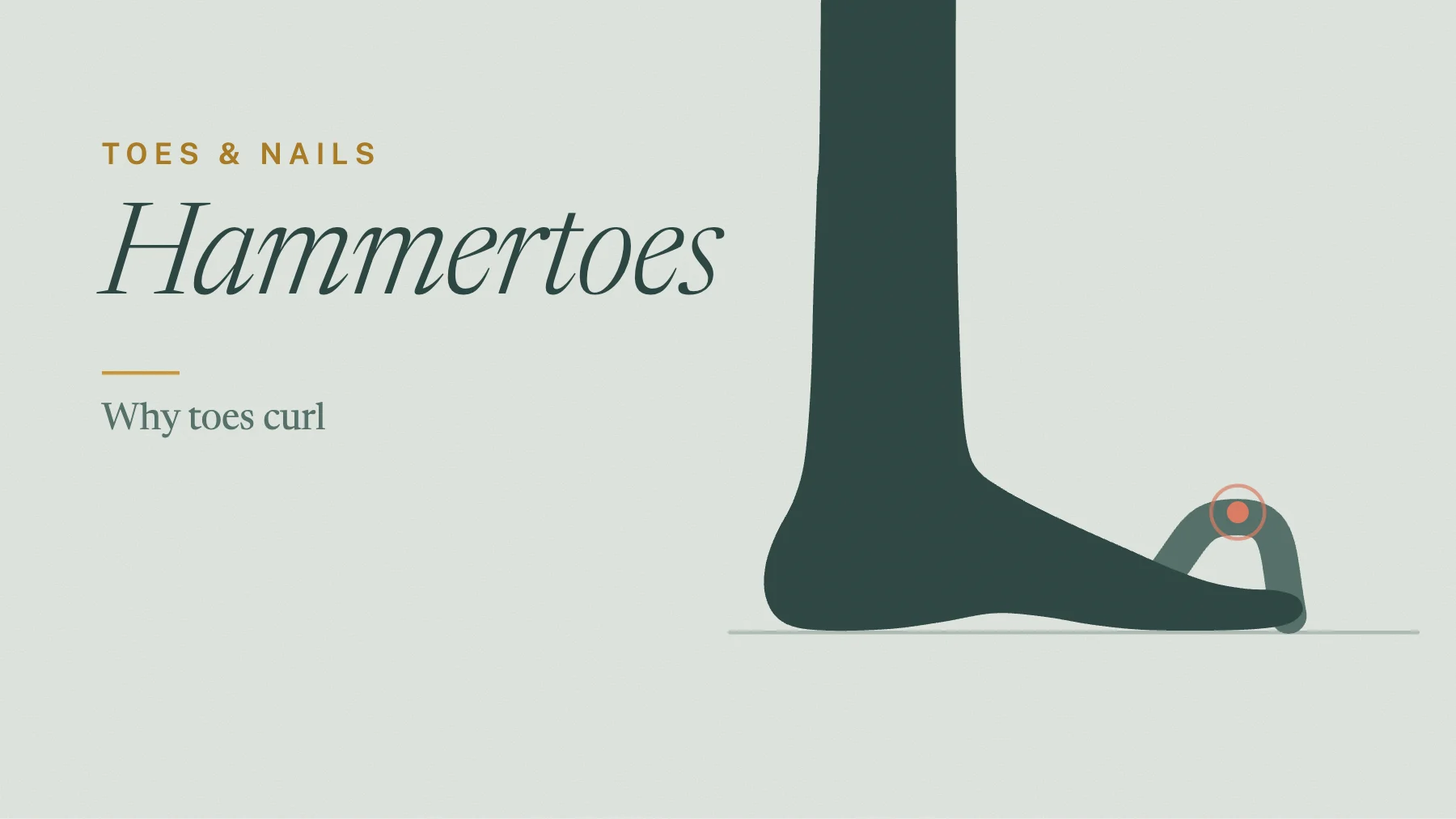
It starts with a toe that looks a little bent, and a corn on top of the knuckle that rubs in certain shoes. Over the years the bend becomes more permanent. Here’s why toes curl, and what you can do about it at each stage.
Hammertoe, mallet toe or claw toe?
- Hammertoe: bent at the middle joint of the toe.
- Mallet toe: bent at the joint nearest the tip.
- Claw toe: the base joint is bent upward and the joints beyond it bent downward.[3]
They usually affect the second, third or fourth toes.[2]
Why toes curl
Each toe is balanced by small muscles in the foot and longer tendons from the leg. When that balance is lost, the toe buckles. Things that tip the balance include:
- Shoes that are too short, narrow or high-heeled, which force the toes to bend. Poorly fitting shoes are linked to lesser toe deformities, corns and calluses.[4]
- A bunion, which pushes the big toe into the second toe.
- Inherited foot shape, including a long second toe or a high arch.
- Arthritis and nerve conditions such as diabetic neuropathy.
- Injury to the toe.[1,2]
Flexible or rigid?
The single most important question is whether you can straighten the toe with your fingers. A flexible toe can be managed without surgery. A rigid toe that can’t be straightened is harder to accommodate and more likely to need an operation.[2]
What you can do now
- Choose shoes with a deep, roomy toe box and a low heel, with at least a thumb’s width beyond your longest toe.[2]
- Use pads and sleeves to protect the corn on top of the toe.
- Try a toe strap or splint for a flexible toe.
- Exercise your toes: pick up marbles or scrunch a towel with your toes a few minutes a day.[2]
- Don’t cut corns yourself, especially if you have diabetes or poor circulation.
Common questions
Do toe straighteners and spacers fix a hammertoe?
They can make a toe more comfortable, but they don’t permanently correct it. A review of shoe changes and orthoses for bent toes found they often relieve symptoms, especially pressure under the ball of the foot, but none is a permanent solution to the deformity.[5] Footwear with a wide toe box, enough length, a lower heel and a cushioned or rocker sole is the foundation.[5]
Will hammertoe surgery leave my toe stiff?
Often a little, by design. For a rigid toe, the operation either removes a small piece of bone at the bent joint or fuses the joint straight. In a randomized trial, both approaches gave good to excellent results for pain and activity at a year, with fusion holding the toe straighter.[6]
Are hammertoes hereditary?
Partly. Foot shape runs in families, and features such as a long second toe or a high arch make toes more likely to buckle.[1] Shoes, bunions and other conditions add to that.
When a toe needs more
If the toe becomes rigid or keeps hurting despite these measures, surgery can straighten it: releasing or lengthening a tendon for a flexible toe, or removing a small piece of bone or fusing the joint for a rigid one.[2,3] See hammertoes, and our Center for Lower Extremity Surgery’s guide to hammertoe surgery (external site).
When to see a podiatrist

About the author
Efe Ozturk, DPM
Foot and Ankle Surgeon. Dr. Ozturk is double board certified, as a Diplomate of the American Board of Podiatric Medicine (DABPM) and a Fellow of the Academy of Physicians in Wound Healing (FAPWH), and is a Fellow of the American Society of Podiatric Surgeons (FASPS) and the American Society of Podiatric Medicine (FASPM). Trained in forefoot and rearfoot reconstructive surgery at Morristown Medical Center; sees patients in Lyndhurst, Paramus and Millburn.
References
- 1.Shirzad K, Kiesau CD, DeOrio JK, Parekh SG. Lesser toe deformities. J Am Acad Orthop Surg. 2011;19(8):505-14. PubMed 21807918 (external site)
- 2.American Academy of Orthopaedic Surgeons. Hammer Toe. OrthoInfo. orthoinfo.org (external site)
- 3.Goransson M, Dixon M. Hammertoe. In: StatPearls. StatPearls Publishing; updated 2026. PubMed 32644694 (external site)
- 4.Buldt AK, Menz HB. Incorrectly fitted footwear, foot pain and foot disorders: a systematic search and narrative review of the literature. J Foot Ankle Res. 2018;11:43. PubMed 30065787 (external site)
- 5.Colò G, Fusini F, Melato M, De Tullio V, Logrieco G, Leigheb M, et al. The effectiveness of shoe modifications and foot orthoses in conservative treatment of lesser toe deformities: a review of literature. Musculoskelet Surg. 2025;109(3):225-232. PubMed 39500821 (external site)
- 6.Schrier JC, Keijsers NL, Matricali GA, Louwerens JW, Verheyen CC. Lesser Toe PIP Joint Resection Versus PIP Joint Fusion: A Randomized Clinical Trial. Foot Ankle Int. 2016;37(6):569-75. PubMed 26843544 (external site)
This is general health information and isn’t a substitute for advice from a clinician who knows your history. Read our medical disclaimer and how we write and review content.
More from the blog
Toes & nails
Big toe arthritis (hallux rigidus): why your big toe is stiff and sore
A stiff, sore big toe is often arthritis. How it differs from a bunion, and what helps.
Toes & nails
Toenail fungus: treatments that work, and why it takes a year
Why toenail fungus is slow to clear, which treatments work best, and how to keep it from coming back.
Toes & nails
Bunions: what helps, what doesn’t, and when to consider surgery
An honest look at bunion treatments, from shoes and pads to correctors and surgery.