Plantar fasciitis treatment: what it is, why it lingers, and when a small-incision procedure helps
What plantar fasciitis is, why it can last for years, and how Tenex, TenJet and surgery compare when stretching and other conservative care have not worked.

By Dr. Efe Ozturk
· 8 min read
Medically reviewed by Dr. Efe Ozturk · Last reviewed
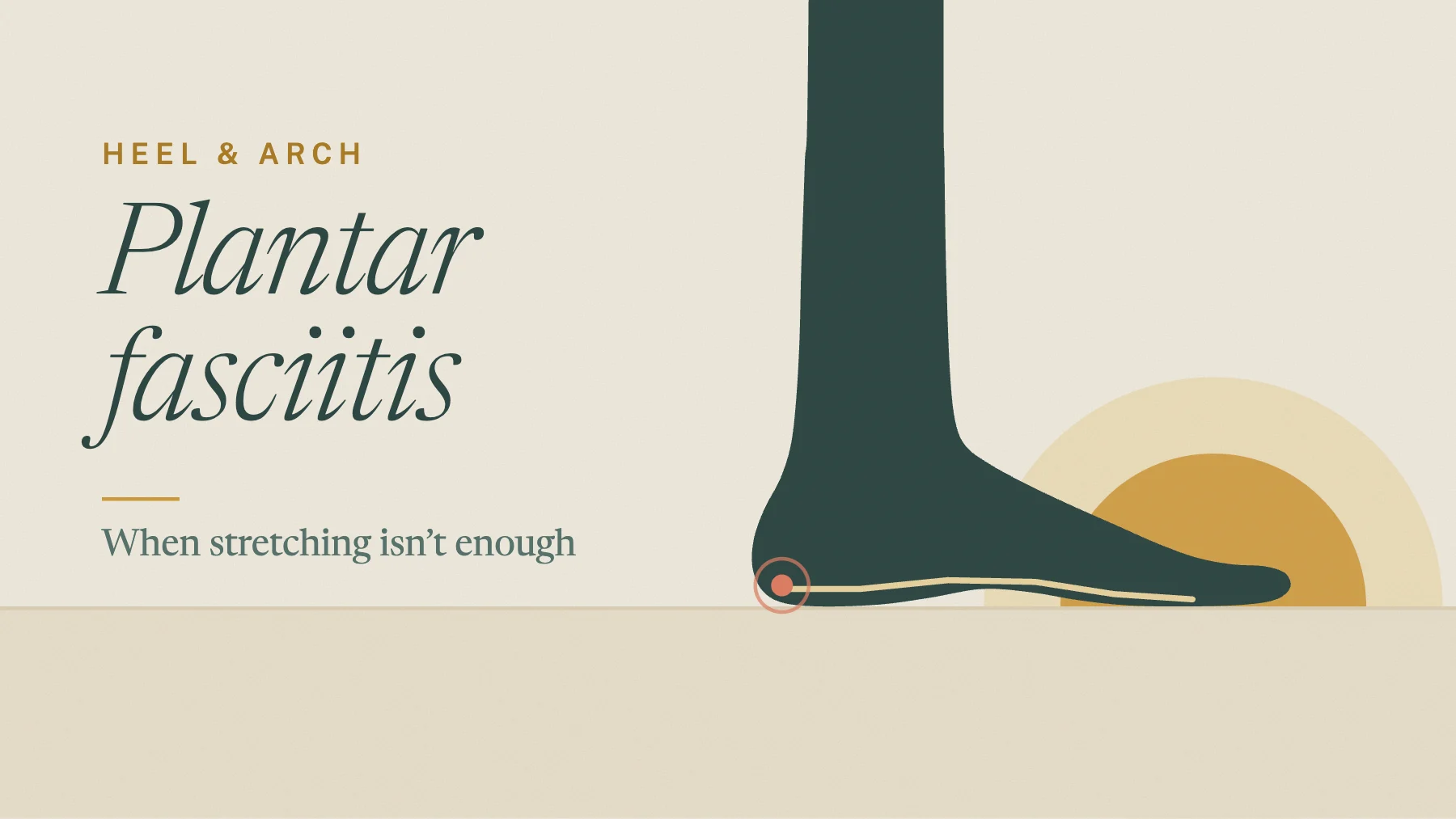
You’ve stretched. You bought the inserts. Maybe you had a cortisone shot. Your heel still hurts with every first step. This guide explains what plantar fasciitis is, why it can linger, and where plantar fasciitis treatment goes next. That next step may be a procedure, and it may not need to be a large open operation.
What is plantar fasciitis?
The plantar fascia is a long band of tissue that supports your arch.[1] In plantar fasciitis, it hurts near the heel. The name suggests inflammation, and that is how OrthoInfo describes the pain.[1]
Long-standing cases can look different. Researchers studied tissue from 50 heel operations for chronic plantar fasciitis. They found the fascia breaking down, without inflammation, and argued for the name fasciosis, a degenerative condition.[2] That’s why we think of stubborn heel pain as damaged tissue, not just swelling waiting to settle. Even years later, only 24% of people whose pain had gone had a normal-looking fascia on ultrasound.[3]
What does plantar fasciitis feel like?
These are the classic plantar fasciitis symptoms:
- pain on the bottom of the foot, near the heel,
- pain that’s worst with your first steps after waking or after a long rest,
- pain that eases after a few minutes of walking,
- pain that’s often worse after activity than during it.[1]
Burning, tingling or numbness points to a nerve instead, such as Baxter’s nerve entrapment (external site).
What causes plantar fasciitis?
Repeated stress can damage the fascia, though most cases have no single cause. Sudden jumps in activity, long hours on hard floors, flat feet or high arches, tight calves, obesity and age all play a part.[1]
In one matched study, people whose ankle could not bend upward past neutral had 23 times the odds of plantar fasciitis, compared with people who had good motion. A body mass index over 30 carried 5.6 times the odds, and a workday mostly on your feet 3.6 times.[8] A tight calf matters, and an operation can address it.
What happens if plantar fasciitis doesn’t heal?
It can last for years. In that Danish study, the risk of still having plantar fasciitis was 80.5% at one year, 50% at five years and 44% at 15 years. Those who recovered took about two years on average.[3]
Repeating the same care may not change that:
- Exercise. After 12 weeks of heavy heel raises, only 4 of 70 people felt no need for more treatment.[9] In a trial of 180 adults, neither exercise nor exercise plus cortisone added a clinically meaningful gain over advice and a heel cup at 12 weeks.[10]
- Cortisone. A Cochrane review found injections may slightly reduce heel pain for up to a month, but not after that. Across 21 trials, two plantar fascia ruptures were reported in 699 people.[11] See cortisone shots in the foot.
What is the first plantar fasciitis treatment?
Conservative care is the right start. Begin with our plantar fasciitis exercises, with videos and exact doses. Supportive shoes and inserts come next. Shockwave therapy was the one treatment that improved pain in the medium and long term in a large review.[12] If six months of this hasn’t worked, you have refractory plantar fasciitis, and surgery can be considered.[4] OrthoInfo uses 12 months.[1]
When does surgery beat more conservative care?
Randomized trials answer this best.
| Study | Compared | Result |
|---|---|---|
| Johannsen 2020, 30 patients[5] | Endoscopic release vs cortisone shots, both with strength training | Foot function was better with surgery at 1 year. At 2 years, activity pain was better, but function no longer differed significantly. More returned to running and jumping |
| Riiser 2024, 40 patients with tight calves[6] | Calf lengthening plus stretching vs stretching alone | At 6 years, excluding crossovers, pain was 2.5 vs 5.5 out of 10 and function 88.9 vs 78.6. Seven of 20 on stretching crossed over to surgery |
| Møller 2025, 8 studies[13] | Minimally invasive care vs non-surgical care or placebo | Needle-based treatments did better on pain in 5 studies; endoscopic release in 1 of 3. Risk of bias was high |
Neither trial tested Tenex or TenJet, and the review’s needle treatments appear to be other techniques. They do show that, for the right patient, a procedure can beat staying on non-surgical care. A 2026 review of five randomized trials also found calf lengthening improved function and pain.[14]
What do Tenex and TenJet do differently?
They go straight to the damaged area seen on ultrasound, under local anesthetic. Tenex breaks up and suctions out the tissue with ultrasonic energy through a probe the size of an 18-gauge needle.[15] TenJet uses high-pressure saline.[16] Both devices are FDA-cleared.[17,18] Our Tenex and TenJet article explains each one.
What is the Tenex plantar fasciitis success rate?
| Series | Patients | Follow-up | Result |
|---|---|---|---|
| Mayo Clinic 2025[7] | 58 procedures | 6.6 years | Pain 6.8 to 0.7; 91% successful; 90% would recommend it |
| Kruse 2024[19] | 67 | 1 year | Pain improved 5.87 points; 94% satisfied |
| Patel 2015[15] | 12, four after a failed release | 2 years | All 12 reported being essentially pain-free |
| Encinas 2025[20] | 56 (Tenex) | 27 months | Better pain, function and mobility scores |
| Fick 2021[21] | 80 | 6 or 12 weeks | 36 of 57 who answered were satisfied |
Encinas, Fick and Patel used Tenex. The Mayo and Kruse abstracts don’t name their device.
What is the Tenex plantar fasciitis recovery time?
In the Iowa series, patients could walk as tolerated in a boot for one to two weeks. They avoided running and jumping from weeks two to six. Full activity came at six weeks at the earliest, and most people returning to sport or manual work needed about 12 weeks.[21] In the early series, pain relief came between 5 and 13 weeks.[15]
How does Tenex compare with open or endoscopic release?
We found no study in the foot that compares them head to head. The figures below come from different patients, so they show the general picture only:
| Approach | Published complication rate |
|---|---|
| Open release | 11%[22] |
| Endoscopic release | 5% in one review, 8.9% in another[22,23] |
| Ultrasonic tenotomy | 0.7% across 289 procedures at several body sites; none reported in the Mayo or Kruse series[21,7,19] |
Pain along the outer foot is a reported problem after release.[22] In a randomized trial of calf release versus open release, results matched, but its authors chose calf release first to avoid the biomechanical problems linked to open release.[24]
The closest direct test of Tenex against an open operation comes from the elbow, where outcomes were similar in 33 people.[25] That doesn’t show it is better.
How we decide
Dr. Efe Ozturk is a Foot and Ankle Surgeon and podiatrist who offers Tenex and TenJet. We confirm the diagnosis with an exam and in-office ultrasound, and we check your calf. A tight calf may do better with calf lengthening, and nerve pain needs a different plan. If the damaged area can be targeted, a small-incision procedure comes before an open release. Open surgery is handled through our Center for Lower Extremity Surgery (external site). See our heel pain page.
The limits. No randomized trial has tested Tenex or TenJet for plantar fasciitis.[26] The series above had no comparison group, and we found no study comparing these devices with injections, PRP, shockwave, or open or endoscopic release in the foot. A 2026 network review of 21 studies found endoscopic surgery improved scores more than open or percutaneous techniques, and calf lengthening gave better pain scores, though the evidence had moderate to high risk of bias.[27] In a trial for stubborn heel pain, shockwave and endoscopic release did not differ significantly.[28] In 2018, the American College of Foot and Ankle Surgeons rated ultrasonic debridement “uncertain.”[4] The Patel study’s author advised Tenex’s maker.[15] We found no published TenJet results in the foot. Its evidence is lab work on cow tendon, 100 elbows, and an industry-sponsored hip study.[16,29,30] Some insurers call Tenex investigational.[31,32] Please call our office at 908-215-5953 to inquire about your insurance.
Common questions
Can plantar fasciitis go away on its own?
Often, but it can take a long time. In the Danish study, about half had recovered by five years, and those who recovered took about two years.[3]
Is Tenex better than open surgery for plantar fasciitis?
We can’t say that yet, because no foot study has compared them. Tenex has low published complication rates.[21]
Does TenJet work for plantar fasciitis?
It works on the same idea, but we found no published patient results in the foot. A 2025 review found no TenJet study that met its criteria.[26]
When to see a Foot and Ankle Surgeon or podiatrist
About the author
Dr. Efe Ozturk
Foot and Ankle Surgeon. Dr. Ozturk is double board certified, as a Diplomate of the American Board of Podiatric Medicine (DABPM) and a Fellow of the Academy of Physicians in Wound Healing (FAPWH), and is a Fellow of the American Society of Podiatric Surgeons (FASPS) and the American Society of Podiatric Medicine (FASPM). Trained in forefoot and rearfoot reconstructive surgery at Morristown Medical Center; sees patients in Lyndhurst, Paramus and Millburn.
Where to be seen
Dr. Ozturk sees patients at each of these offices, and one phone number reaches all of them.
References
- 1.American Academy of Orthopaedic Surgeons. Plantar Fasciitis and Bone Spurs. OrthoInfo. orthoinfo.org (external site)
- 2.Lemont H, Ammirati KM, Usen N. Plantar fasciitis: a degenerative process (fasciosis) without inflammation. J Am Podiatr Med Assoc. 2003;93(3):234-7. PubMed 12756315 (external site)
- 3.Hansen L, Krogh TP, Ellingsen T, Bolvig L, Fredberg U. Long-Term Prognosis of Plantar Fasciitis: A 5- to 15-Year Follow-up Study of 174 Patients With Ultrasound Examination. Orthop J Sports Med. 2018;6(3):2325967118757983. PubMed 29536022 (external site)
- 4.Schneider HP, Baca JM, Carpenter BB, Dayton PD, Fleischer AE, Sachs BD. American College of Foot and Ankle Surgeons Clinical Consensus Statement: Diagnosis and Treatment of Adult Acquired Infracalcaneal Heel Pain. J Foot Ankle Surg. 2018;57(2):370-381. PubMed 29284574 (external site)
- 5.Johannsen F, Konradsen L, Herzog R, Krogsgaard MR. Endoscopic fasciotomy for plantar fasciitis provides superior results when compared to a controlled non-operative treatment protocol: a randomized controlled trial. Knee Surg Sports Traumatol Arthrosc. 2020;28(10):3301-3308. PubMed 32006073 (external site)
- 6.Riiser MO, Husebye EE, Hellesnes J, Molund M. Outcomes After Proximal Medial Gastrocnemius Recession and Stretching vs Stretching as Treatment of Chronic Plantar Fasciitis at 6-Year Follow-up. Foot Ankle Int. 2024;45(1):1-9. PubMed 37902240 (external site)
- 7.Ha CT, Romero JM, Gonzalez-Carta K, et al. Ultrasound-Guided Percutaneous Fasciotomy and Debridement for Chronic Plantar Fasciopathy: Six-Year Patient-Reported Outcomes from a Retrospective Case Series. Foot Ankle Int. 2025;46(11):1239-1247. PubMed 41178389 (external site)
- 8.Riddle DL, Pulisic M, Pidcoe P, Johnson RE. Risk factors for Plantar fasciitis: a matched case-control study. J Bone Joint Surg Am. 2003;85(5):872-7. PubMed 12728038 (external site)
- 9.Riel H, Jensen MB, Olesen JL, Vicenzino B, Rathleff MS. Self-dosed and pre-determined progressive heavy-slow resistance training have similar effects in people with plantar fasciopathy: a randomised trial. J Physiother. 2019;65(3):144-151. PubMed 31204294 (external site)
- 10.Riel H, Vicenzino B, Olesen JL, Jensen MB, Ehlers LH, Rathleff MS. Does a corticosteroid injection plus exercise or exercise alone add to the effect of patient advice and a heel cup for patients with plantar fasciopathy? A randomised clinical trial. Br J Sports Med. 2023;57(18):1180-1186. PubMed 37414460 (external site)
- 11.David JA, Sankarapandian V, Christopher PR, Chatterjee A, Macaden AS. Injected corticosteroids for treating plantar heel pain in adults. Cochrane Database Syst Rev. 2017;6(6):CD009348. PubMed 28602048 (external site)
- 12.Guimarães JS, Arcanjo FL, Leporace G, et al. Effects of therapeutic interventions on pain due to plantar fasciitis: A systematic review and meta-analysis. Clin Rehabil. 2023;37(6):727-746. PubMed 36571559 (external site)
- 13.Møller S, Ipsen JA, Aunass HJ, Aagaard P, Viberg B, Simony A, Riel H. Minimally invasive surgical treatments versus non-surgical treatments or placebo for plantar fasciopathy: A systematic review. Foot Ankle Surg. 2025;31(8):672-683. PubMed 40348713 (external site)
- 14.Pérez González A, Sanz-Perez A, Moroni S, Razzano C, Vicente-Mampel J, Ferrer-Torregrosa J. Gastrocnemius Recession in Recalcitrant Plantar Fasciitis: A Systematic Review and Meta-Analysis of Randomized Controlled Trials. J Clin Med. 2026;15(2):616. PubMed 41598555 (external site)
- 15.Patel MM. A novel treatment for refractory plantar fasciitis. Am J Orthop (Belle Mead NJ). 2015;44(3):107-110. PubMed 25750942 (external site)
- 16.Wong AK, Swami PN, Reed TF, Bitterman A, Grande DA. Efficacy and Safety of a Percutaneous Tenotomy System for Debridement of Tendinopathic Tissues. J Long Term Eff Med Implants. 2018;28(3):199-203. PubMed 30806277 (external site)
- 17.U.S. Food and Drug Administration. 510(k) Premarket Notification K153299: Tenex Health TX System. Decision date March 3, 2016. accessdata.fda.gov (external site)
- 18.U.S. Food and Drug Administration. 510(k) Premarket Notification K190804: HydroCision TenJet Device. Decision date June 5, 2019. accessdata.fda.gov (external site)
- 19.Kruse RC, Volfson E. Ultrasonic Fasciotomy for the Treatment of Chronic Plantar Fasciopathy: A Prospective Study. Clin J Sport Med. 2024;34(4):335-340. PubMed 38407211 (external site)
- 20.Encinas R, Hall S, Gauthier C, et al. Minimally invasive ultrasound-guided percutaneous plantar fasciotomy on chronic plantar fasciitis: A retrospective analysis. Foot Ankle Surg. 2025;31(8):737-741. PubMed 40399170 (external site)
- 21.Fick B, Stover DW, Chimenti RL, Hall MM. The Safety of Ultrasound Guided Tenotomy and Debridement for Upper and Lower Extremity Tendinopathies: A Retrospective Study. Iowa Orthop J. 2021;41(2):82-90. PubMed 34924874 (external site)
- 22.Saghir MA, Bashandy AS, Kholeif AM. Endoscopic plantar fasciotomy versus open plantar fasciotomy for treatment of plantar fasciitis: a systematic review and meta-analysis. J Orthop Surg Res. 2026;21(1):449. PubMed 42204579 (external site)
- 23.Ward L, Mercer NP, Azam MT, et al. Outcomes of Endoscopic Treatment for Plantar Fasciitis: A Systematic Review. Foot Ankle Spec. 2025;18(2):193-201. PubMed 36342049 (external site)
- 24.Gamba C, Serrano-Chinchilla P, Ares-Vidal J, Solano-Lopez A, Gonzalez-Lucena G, Ginés-Cespedosa A. Proximal Medial Gastrocnemius Release Versus Open Plantar Fasciotomy for the Surgical Treatment in Recalcitrant Plantar Fasciitis. Foot Ankle Int. 2020;41(3):267-274. PubMed 31808359 (external site)
- 25.Altahawi F, Li X, Demarest B, Forney MC. Percutaneous ultrasonic tenotomy with the TX-1 device versus surgical tenotomy for the treatment of common extensor tendinosis. Skeletal Radiol. 2021;50(1):115-124. PubMed 32647907 (external site)
- 26.Maag L, Linder S, Hackett L, et al. Effectiveness of Percutaneous Needle Tenotomy for Tendinopathies: A Systematic Review. Sports Health. 2025;17(4):834-842. PubMed 39238190 (external site)
- 27.Tan AKS, Lee DMX, Mai AS, Toh RX, Li ZX, Mohamed Buhary KS, et al. Comparative effectiveness of surgical interventions for recalcitrant plantar fasciitis: A systematic review and network meta-analysis. J Foot Ankle Surg. 2026. PubMed 42604712 (external site)
- 28.Radwan YA, Mansour AM, Badawy WS. Resistant plantar fasciopathy: shock wave versus endoscopic plantar fascial release. Int Orthop. 2012;36(10):2147-56. PubMed 22782376 (external site)
- 29.Dakkak M, Patel V, King D, Genin J. Ultrasound-guided tenotomy for lateral epicondylitis with TenJet improves physical functional and decreased pain outcomes at 1 year: a case series review. JSES Int. 2023;7(5):872-876. PubMed 37719823 (external site)
- 30.Dakkak M, Furey G, Rosero E, et al. Ultrasound-Guided Minimally Invasive Tenotomy Utilizing TenJet for Recalcitrant Gluteal Tendinopathy: A Six-Month Interim Analysis From a Prospective Multicenter Study. Cureus. 2026;18(9):e115717. PubMed 42829688 (external site)
- 31.Anthem. Medical Policy SURG.00149: Percutaneous Ultrasonic Ablation of Soft Tissue. Last review February 19, 2026. anthem.com (external site)
- 32.Blue Cross Blue Shield of Michigan and Blue Care Network. Medical Policy: Percutaneous Ultrasonic Ablation as Treatment of Chronic Pain due to Tendonitis and Fasciitis (Tenex Health TX). Effective January 1, 2026. bcbsm.com (external site)
This is general health information and isn’t a substitute for advice from a clinician who knows your history. Read our medical disclaimer and how we write and review content.
More from the blog
Heel & arch
Posterior tibial tendonitis stretches: the exact trial doses, and when surgery rebuilds the arch
The calf stretches, band work and heel raises drawn from trials, with exact doses, plus the heel rise test and how surgery rebuilds the arch when bracing and exercise stop working.
Heel & arch
Plantar fasciitis exercises and stretches backed by research: exactly how to do each one
The plantar fasciitis stretches and heel raise that research supports, with video, the exact dose each trial used, and what each trial found.
Heel & arch
Achilles tendonitis stretches: what the research supports, step by step
Only the stretches tested in published trials, with each study’s exact dose and a short video, plus what to change if your pain is at the heel bone.