Sever’s disease: heel pain in active kids
The most common cause of heel pain in active children, and the simple treatments that help it settle.

By Efe Ozturk, DPM
· 3 min read
Medically reviewed by Efe Ozturk, DPM · Last reviewed
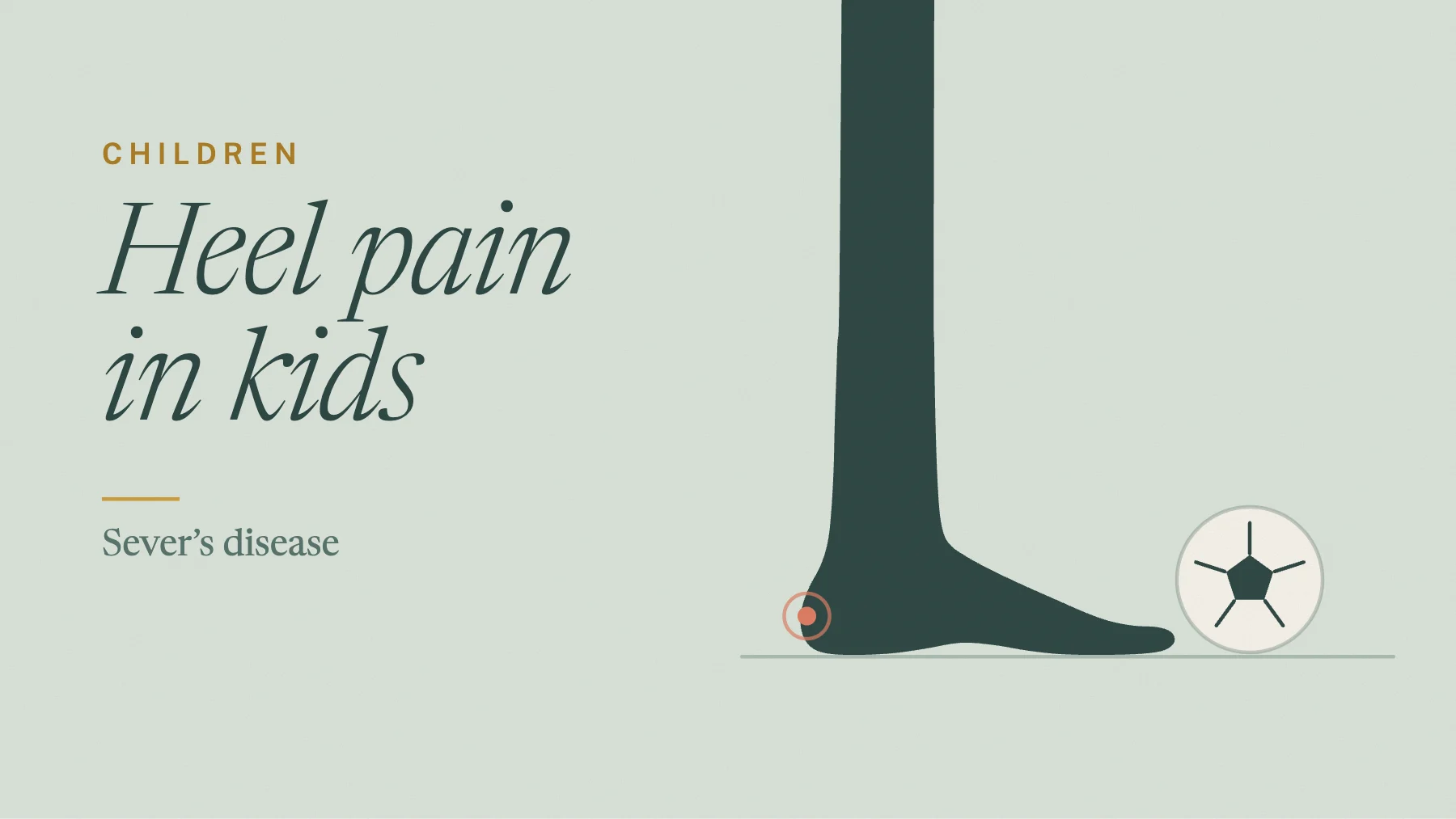
Your child comes off the field limping, complains that their heels hurt, and maybe walks on their toes to avoid pressing down. The next morning they’re fine, until the next practice. That pattern is classic for Sever’s disease.
What it is
Despite the name, Sever’s disease isn’t a disease. It’s irritation of the growth plate (apophysis) at the back of the heel bone, where the Achilles tendon pulls and where the heel strikes the ground. In growing children that area is softer than mature bone, and repeated running and jumping can make it sore.[1]
It’s the most common cause of heel pain in children and adolescents, and it’s often linked to sports like soccer and basketball.[1]
Signs of Sever’s disease
- Heel pain during or after sports, especially running and jumping.
- Pain when the sides of the heel are squeezed.
- Limping or walking on the toes at the end of the day.
- One or both heels.
- Usually in children aged about 8 to 14.
Who gets it
A systematic review of the factors associated with Sever’s disease found that limited ankle flexibility (a tight calf) was the most frequently studied, followed by high pressures under the heel and foot alignment. Body mass, age and the amount of sport also played a part.[2]
Growth spurts matter too: bones can grow faster than the muscles and tendons around them, so the calf gets relatively tight.
What helps
A systematic review of randomized trials found conservative treatment effective for relieving symptoms.[1] The approaches used include:
- Heel cups, heel lifts or inserts that cushion the heel and reduce the pull of the Achilles. One comparison found orthoses gave more short-term pain relief than heel raises, although the evidence is limited.[3]
- Calf stretching and strengthening exercises.
- Supportive, cushioned shoes, including for sport. Avoid going barefoot on hard surfaces and wearing flat, thin-soled cleats all day.
- Easing off running and jumping for a while, with ice after activity. Complete rest is rarely needed; the goal is to keep your child active at a level that doesn’t make it worse.
- Taping in some cases.[1]
Sever’s disease goes away on its own once the growth plate fuses, usually in the mid-teens.
Common questions
Does my child need an X-ray?
Usually not. Sever’s disease is diagnosed from the story and the examination: heel pain with activity in a growing child, and tenderness when the back of the heel is squeezed. An X-ray is taken when something doesn’t fit, such as pain at rest, swelling, or pain after an injury.
Can it come back?
Yes. It can flare again with a new season, a growth spurt or a jump in training, until the growth plate matures. Keeping up calf stretches and using heel cups during busy seasons helps many children.[1,2]
Is it caused by flat feet?
Foot alignment is one of several factors linked to Sever’s disease, along with a tight calf, high pressure under the heel, body weight and the amount of sport.[2] Flat feet on their own don’t mean a child will get it.
When it might be something else
Heel pain that is constant, present at rest or at night, comes with swelling, redness or fever, or follows an injury isn’t typical of Sever’s disease and should be checked, sometimes with an X-ray. See children’s foot care.
When to see a podiatrist
About the author
Efe Ozturk, DPM
Foot and Ankle Surgeon. Dr. Ozturk is double board certified, as a Diplomate of the American Board of Podiatric Medicine (DABPM) and a Fellow of the Academy of Physicians in Wound Healing (FAPWH), and is a Fellow of the American Society of Podiatric Surgeons (FASPS) and the American Society of Podiatric Medicine (FASPM). Trained in forefoot and rearfoot reconstructive surgery at Morristown Medical Center; sees patients in Lyndhurst, Paramus and Millburn.
References
- 1.Hernandez-Lucas P, Leirós-Rodríguez R, García-Liñeira J, Diez-Buil H. Conservative Treatment of Sever's Disease: A Systematic Review. J Clin Med. 2024;13(5). PubMed 38592198 (external site)
- 2.Nieto-Gil P, Marco-Lledó J, García-Campos J, Ruiz-Muñoz M, Gijon-Nogueron G, Ramos-Petersen L. Risk factors and associated factors for calcaneal apophysitis (Sever's disease): a systematic review. BMJ Open. 2023;13(6):e064903. PubMed 37280033 (external site)
- 3.James AM, Williams CM, Haines TP. "Effectiveness of interventions in reducing pain and maintaining physical activity in children and adolescents with calcaneal apophysitis (Sever's disease): a systematic review". J Foot Ankle Res. 2013;6(1):16. PubMed 23641779 (external site)
This is general health information and isn’t a substitute for advice from a clinician who knows your history. Read our medical disclaimer and how we write and review content.
More from the blog
Sports & running
Pain on the outside of the ankle: peroneal tendon problems
Ankle pain that won’t settle after a sprain may be the peroneal tendons. The signs, and how they’re treated.
Heel & arch
Heel spurs: are they really the cause of your heel pain?
Most people with heel spurs have no heel pain. Where the pain really comes from, and what helps.
Toes & nails
Big toe arthritis (hallux rigidus): why your big toe is stiff and sore
A stiff, sore big toe is often arthritis. How it differs from a bunion, and what helps.