Does shockwave therapy work for heel pain? What the studies show
Shockwave therapy has strong evidence for stubborn heel pain. What the studies show, and where it fits.

By Efe Ozturk, DPM
· 3 min read
Medically reviewed by Efe Ozturk, DPM · Last reviewed
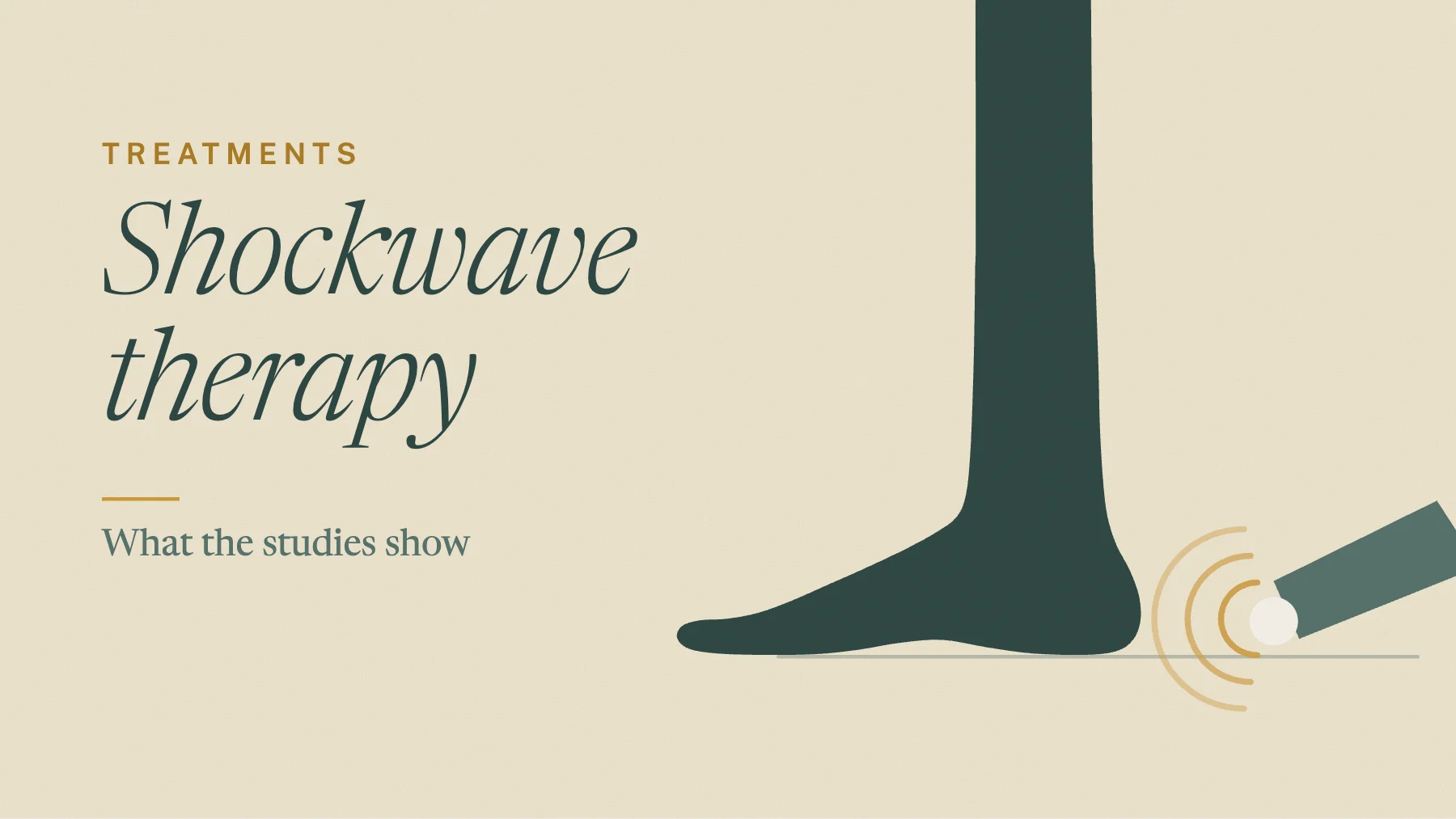
Extracorporeal shockwave therapy (ESWT) sounds dramatic, but the treatment itself is simple: a handpiece placed on your heel or tendon delivers a series of rapid pressure pulses through the skin. No needles, no incision, no anesthesia. You walk out afterward. The question most people ask is the right one: does it actually work?
What the research shows for plantar fasciitis
Plantar fasciitis is where shockwave has been studied most, and the results are consistently positive.
- A 2023 systematic review and meta-analysis across plantar fasciitis, Achilles and patellar tendon problems found high-quality evidence that shockwave has a large effect on pain and function for plantar fasciitis, in both the short and long term.[1]
- A 2024 meta-analysis of 16 studies compared shockwave with corticosteroid injections, the traditional next step for stubborn heel pain. Shockwave was better at three months and at six months for pain and foot function, and it reduced thickening of the plantar fascia. The most common side effects were local pain and slight redness.[2]
- In a large meta-analysis of all the treatments used for plantar fasciitis, shockwave was the one that improved pain in the medium and long term.[6]
And for the Achilles?
The picture is more mixed. For insertional Achilles tendinopathy, where the tendon attaches to the heel, the evidence favors shockwave, alone or combined with eccentric exercise.[3] For pain in the middle of the tendon, the added benefit over a good exercise program is small or unclear.[1] A review of foot and ankle uses found shockwave safe, with a favorable complication profile, and called for more research on uses beyond plantar fasciitis.[7]
Why exercise still comes first
Two trials put shockwave in perspective. In one, a plantar-fascia stretching program did better than low-energy radial shockwave as the very first treatment, with no difference by 15 months.[4] In a 2026 trial, adding shockwave (or high-intensity laser) to a structured home exercise program didn’t improve results over exercise alone at 12 weeks.[5]
That fits how we use it: stretching, strengthening, better shoes and inserts first. Shockwave comes in when heel or tendon pain has lingered despite those, which is exactly the group where it has shown the most benefit.
What a treatment is like
- Before: we confirm the diagnosis and check there’s no reason to avoid it, such as pregnancy, an open growth plate in a child, infection or some bleeding disorders.
- During: the pulses feel like a firm, rapid tapping. We adjust the intensity to what you can tolerate. A session takes a few minutes.
- After: mild soreness or redness for a day or two is common. Most people go straight back to normal activities.
- Over the following weeks: improvement builds gradually. Treatments are usually given as a short series.
Is it right for you?
Shockwave is a good option if you’ve had heel pain for months, have given stretching, footwear and inserts a fair trial, and want a non-surgical, needle-free next step. We offer it in the office; see shockwave therapy (ESWT) and our heel pain page.
When to see a podiatrist
About the author
Efe Ozturk, DPM
Foot and Ankle Surgeon. Dr. Ozturk is double board certified, as a Diplomate of the American Board of Podiatric Medicine (DABPM) and a Fellow of the Academy of Physicians in Wound Healing (FAPWH), and is a Fellow of the American Society of Podiatric Surgeons (FASPS) and the American Society of Podiatric Medicine (FASPM). Trained in forefoot and rearfoot reconstructive surgery at Morristown Medical Center; sees patients in Lyndhurst, Paramus and Millburn.
References
- 1.Charles R, Fang L, Zhu R, Wang J. The effectiveness of shockwave therapy on patellar tendinopathy, Achilles tendinopathy, and plantar fasciitis: a systematic review and meta-analysis. Front Immunol. 2023;14:1193835. PubMed 37662911 (external site)
- 2.Cortés-Pérez I, Moreno-Montilla L, Ibáñez-Vera AJ, Díaz-Fernández Á, Obrero-Gaitán E, Lomas-Vega R. Efficacy of extracorporeal shockwave therapy, compared to corticosteroid injections, on pain, plantar fascia thickness and foot function in patients with plantar fasciitis: A systematic review and meta-analysis. Clin Rehabil. 2024;38(8):1023-1043. PubMed 38738305 (external site)
- 3.Zhi X, Liu X, Han J, Xiang Y, Wu H, Wei S, et al. Nonoperative treatment of insertional Achilles tendinopathy: a systematic review. J Orthop Surg Res. 2021;16(1):233. PubMed 33785026 (external site)
- 4.Rompe JD, Cacchio A, Weil L Jr, et al. Plantar fascia-specific stretching versus radial shock-wave therapy as initial treatment of plantar fasciopathy. J Bone Joint Surg Am. 2010;92(15):2514-22. PubMed 21048171 (external site)
- 5.Kosehasanogullari M, Büyükvural Şen S, Okur Yılmaz N, Aygün Bilecik N, Koçyiğit BF. Home Exercise With or Without High-Intensity Laser or Radial Shockwave Therapy for Plantar Fasciitis: A Randomized Controlled Trial. Foot Ankle Int. 2026;47(3):386-397. PubMed 41664959 (external site)
- 6.Guimarães JS, Arcanjo FL, Leporace G, Metsavaht LF, Conceição CS, Moreno MVMG, et al. Effects of therapeutic interventions on pain due to plantar fasciitis: A systematic review and meta-analysis. Clin Rehabil. 2023;37(6):727-746. PubMed 36571559 (external site)
- 7.Nazim B Tengku Yusof T, Seow D, Vig KS. Extracorporeal Shockwave Therapy for Foot and Ankle Disorders: A Systematic Review and Meta-Analysis. J Am Podiatr Med Assoc. 2022;112(3). PubMed 34878537 (external site)
This is general health information and isn’t a substitute for advice from a clinician who knows your history. Read our medical disclaimer and how we write and review content.
More from the blog
Treatments
PRP injections for the foot and ankle: what the evidence says
Where PRP helps, where trials show it doesn’t, and what to expect from an injection.
Treatments
Custom vs. store-bought orthotics: what the research says
Custom orthotics aren’t automatically better. When store-bought works, and when custom is worth it.
Treatments
Class IV laser therapy for foot pain: what a session is like and what the research says
What a Class IV laser session is like, and an honest look at what the research shows.