Can flat feet be corrected? What insoles do, and what surgery changes
Why insoles, braces and exercises ease flatfoot pain without reshaping the foot, which operations correct the alignment, the long-term results, and what changes for children.

By Dr. Efe Ozturk
· 5 min read
Medically reviewed by Dr. Efe Ozturk · Last reviewed
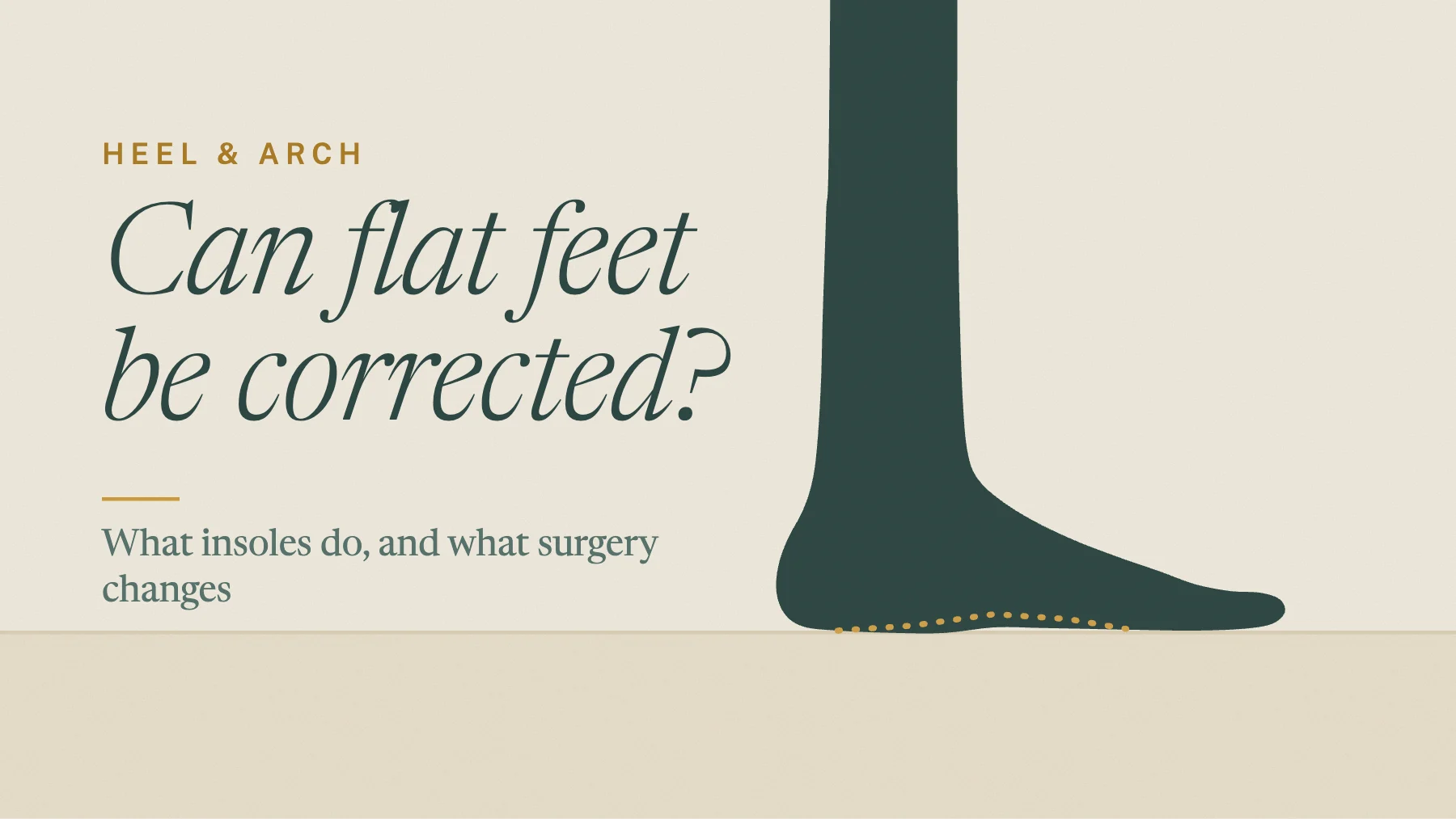
“Can flat feet be corrected?” is one of the most common questions we hear. The honest answer depends on what you mean by corrected. Making a flat foot stop hurting and making it a different shape are two different jobs, and only one treatment does the second.
Can you fix flat feet without surgery?
You can often fix the pain. There is little evidence it changes the shape.
For early adult flatfoot caused by a weakening posterior tibial tendon (the tendon that holds up the arch from the inside of the ankle), a brace or insole plus a structured exercise program worked well. In 47 people, 83% had a successful result after about four months, and 5 (11%) went on to surgery.[3]
What exercise may not do is repair the tendon. In a small 10-week study of slow-lowering strength work, calf stretches and orthotics, pain and function improved, but the tendon still looked abnormal on ultrasound afterward.[4]
Insoles have even less evidence. A 2021 review of 12 studies found a lack of evidence on what foot orthoses do for adults with flatfoot at all.[5] We still use them, as part of a plan. See custom orthotics.
Which surgery corrects flat feet?
Flatfoot reconstruction is usually a combination of procedures, chosen for your foot.[6] The building blocks:
- Tendon transfer. A neighboring tendon, the flexor digitorum longus, takes over the failing posterior tibial tendon.[2]
- Heel-bone shift (calcaneal osteotomy). The heel bone is cut and moved inward, back under the leg.[2,6]
- Other bone cuts and calf lengthening, added when the foot needs them.[6]
- Subtalar arthroereisis. A small implant placed between two bones of the back of the foot to limit the collapse, in selected flexible feet.[7]
- Fusion (arthrodesis). For a stiff, arthritic flatfoot, two or three joints of the back of the foot are joined in a corrected position.[8,9]
Swipe sideways to see the whole drawing.
How well does flatfoot surgery work?
For a flexible flatfoot, the results can last. In 31 patients followed for an average of 15 years after a tendon transfer and heel-bone shift, average pain fell from 7.3 to 1.3 out of 10, and 27 (87%) were pain free and functioning well.[2]
Surgery also changes how you walk. A review of gait studies found that stride length, step rate and walking speed all improved after reconstruction.[10]
The shape matters, too. A 2024 review found that restoring alignment may go with better results as patients report them.[11]
Arthroereisis improved both symptom scores and X-ray measures in a review of 190 procedures, with a low rate of complications.[7] It works best combined with other procedures.[12]
For a stiff flatfoot, fusion corrects what an insole never can. In a study of 23 young patients, every fusion healed by four months, foot scores improved, and the X-ray angles of the arch improved.[8] Triple fusion has a long record of reliable deformity correction and good results.[9]
Why timing matters: flexible vs rigid
Establishing the diagnosis early is one of the most important factors in treating adult flatfoot.[1] While the foot is still flexible, surgery aims to correct it and keep as much motion as possible.[1] Once it turns stiff and arthritic, correction usually means fusion.[9] An early visit to a Foot and Ankle Surgeon keeps the motion-sparing options open. Read flat feet in adults for the warning signs of a collapsing arch, and posterior tibial tendonitis stretches for the exercise doses from the trials.
Can flat feet be corrected in children?
Most children with flexible flat feet have no symptoms and need no treatment.[13] A Cochrane review found no supporting evidence for costly custom insoles in healthy children without pain.[14] In one long-term study, arches improved slightly whether or not children wore arch supports, and heel alignment stayed the same either way.[15]
For a child whose flat foot is painful or stiff, options include orthotics, bone cuts (osteotomies) or fusion, and arthroereisis has also been studied.[13] See children’s foot care.
The limits. One review found a high complication rate with arthroereisis, mostly pain over the implant, and it is rarely done on its own.[12] After a triple fusion, many people develop arthritis in the neighboring ankle or midfoot joints over time, and early problems include wound trouble and bones that fail to heal.[9] Which combination of procedures is best is still debated, especially for severe flexible feet.[1] Most of this evidence comes from case series rather than randomized trials.
How we decide
Dr. Efe Ozturk is a Foot and Ankle Surgeon and podiatrist. We watch you stand and walk, test the tendon with a single-leg heel rise, check how flexible the foot is, and take standing X-rays at the practice. If bracing and exercise have stopped working, we talk through the reconstruction that fits your foot. See flat feet. We see patients in Lyndhurst, Paramus and Millburn, NJ.
Common questions
Can you fix flat feet as an adult?
Yes. When non-surgical care fails, surgery aims to restore proper alignment.[1] Insoles and exercises can ease the pain, but there is little evidence that they change the foot itself.[4,5]
How do you correct flat feet without surgery?
You can relieve symptoms with a brace or insole and a structured strengthening program, which worked for most people with early tendon problems.[3] It eases symptoms, but in one study the tendon itself still looked abnormal after 10 weeks of exercise.[4]
Is having flat feet bad?
Not by itself. Many flat feet never hurt. Adult-acquired flatfoot affects about 3% of adults and can cause serious problems, which is why prompt treatment matters.[7]
When to see a Foot and Ankle Surgeon or podiatrist
About the author
Dr. Efe Ozturk
Foot and Ankle Surgeon. Dr. Ozturk is double board certified, as a Diplomate of the American Board of Podiatric Medicine (DABPM) and a Fellow of the Academy of Physicians in Wound Healing (FAPWH), and is a Fellow of the American Society of Podiatric Surgeons (FASPS) and the American Society of Podiatric Medicine (FASPM). Trained in forefoot and rearfoot reconstructive surgery at Morristown Medical Center; sees patients in Lyndhurst, Paramus and Millburn.
Where to be seen
Dr. Ozturk sees patients at each of these offices, and one phone number reaches all of them.
References
- 1.Deland JT. Adult-acquired flatfoot deformity. J Am Acad Orthop Surg. 2008;16(7):399-406. PubMed 18611997 (external site)
- 2.Chadwick C, Whitehouse SL, Saxby TS. Long-term follow-up of flexor digitorum longus transfer and calcaneal osteotomy for stage II posterior tibial tendon dysfunction. Bone Joint J. 2015;97-B(3):346-52. PubMed 25737518 (external site)
- 3.Alvarez RG, Marini A, Schmitt C, Saltzman CL. Stage I and II posterior tibial tendon dysfunction treated by a structured nonoperative management protocol: an orthosis and exercise program. Foot Ankle Int. 2006;27(1):2-8. PubMed 16442022 (external site)
- 4.Kulig K, Reischl SF, Pomrantz AB, et al. Nonsurgical management of posterior tibial tendon dysfunction with orthoses and resistive exercise: a randomized controlled trial. Phys Ther. 2009;89(1):26-37. PubMed 19022863 (external site)
- 5.Herchenröder M, Wilfling D, Steinhäuser J. Evidence for foot orthoses for adults with flatfoot: a systematic review. J Foot Ankle Res. 2021;14(1):57. PubMed 34844639 (external site)
- 6.Conti MS, Garfinkel JH, Ellis SJ. Outcomes of Reconstruction of the Flexible Adult-acquired Flatfoot Deformity. Orthop Clin North Am. 2020;51(1):109-120. PubMed 31739874 (external site)
- 7.Baryeh KW, Ismail H, Sobti A, Harb Z. Outcomes Following the Use of Subtalar Arthroereisis in the Correction of Adult Acquired Flatfoot: A Systematic Review. Foot Ankle Spec. 2022;15(4):384-393. PubMed 33511862 (external site)
- 8.Fadle AA, El-Adly W, Attia AK, Mohamed MM, Mohamadean A, Osman AE. Double versus triple arthrodesis for adult-acquired flatfoot deformity due to stage III posterior tibial tendon insufficiency: a prospective comparative study of two cohorts. Int Orthop. 2021;45(9):2219-2229. PubMed 33895880 (external site)
- 9.Ahmad J, Pedowitz D. Management of the rigid arthritic flatfoot in adults: triple arthrodesis. Foot Ankle Clin. 2012;17(2):309-22. PubMed 22541528 (external site)
- 10.Estes W, Syal A, Latt LD. Biomechanical Effects of Surgical Reconstruction for Flexible Progressive Collapsing Foot Deformity: A Systematic Review. Foot Ankle Spec. 2025;18(4):352-358. PubMed 36510833 (external site)
- 11.Poutoglidou F, Marsland D, Elliot R. Does foot shape really matter? Correlation of patient reported outcomes with radiographic assessment in progressive collapsing foot deformity reconstruction: A systematic review. Foot Ankle Surg. 2024;30(6):441-449. PubMed 38514277 (external site)
- 12.Mattesi L, Ancelin D, Severyns MP. Is subtalar arthroereisis a good procedure in adult-acquired flatfoot? A systematic review of the literature. Orthop Traumatol Surg Res. 2021;107(6):103002. PubMed 34216843 (external site)
- 13.Dare DM, Dodwell ER. Pediatric flatfoot: cause, epidemiology, assessment, and treatment. Curr Opin Pediatr. 2014;26(1):93-100. PubMed 24346183 (external site)
- 14.Evans AM, Rome K, Carroll M, Hawke F. Foot orthoses for treating paediatric flat feet. Cochrane Database Syst Rev. 2022;1(1):CD006311. PubMed 35080267 (external site)
- 15.Choi JY, Lee DJ, Kim SJ, Suh JS. Does the long-term use of medial arch support insole induce the radiographic structural changes for pediatric flexible flat foot? A prospective comparative study. Foot Ankle Surg. 2020;26(4):449-456. PubMed 31201010 (external site)
This is general health information and isn’t a substitute for advice from a clinician who knows your history. Read our medical disclaimer and how we write and review content.
More from the blog
Heel & arch
Posterior tibial tendonitis stretches: the exact trial doses, and when surgery rebuilds the arch
The calf stretches, band work and heel raises drawn from trials, with exact doses, plus the heel rise test and how surgery rebuilds the arch when bracing and exercise stop working.
Heel & arch
Plantar fasciitis treatment: what it is, why it lingers, and when a small-incision procedure helps
What plantar fasciitis is, why it can last for years, and how Tenex, TenJet and surgery compare when stretching and other conservative care have not worked.
Heel & arch
Plantar fasciitis exercises and stretches backed by research: exactly how to do each one
The plantar fasciitis stretches and heel raise that research supports, with video, the exact dose each trial used, and what each trial found.