Flat feet in adults: when they matter and what helps
Most flat feet are harmless. The warning signs of an arch that’s collapsing, and why early treatment matters.

By Efe Ozturk, DPM
· 3 min read
Medically reviewed by Efe Ozturk, DPM · Last reviewed
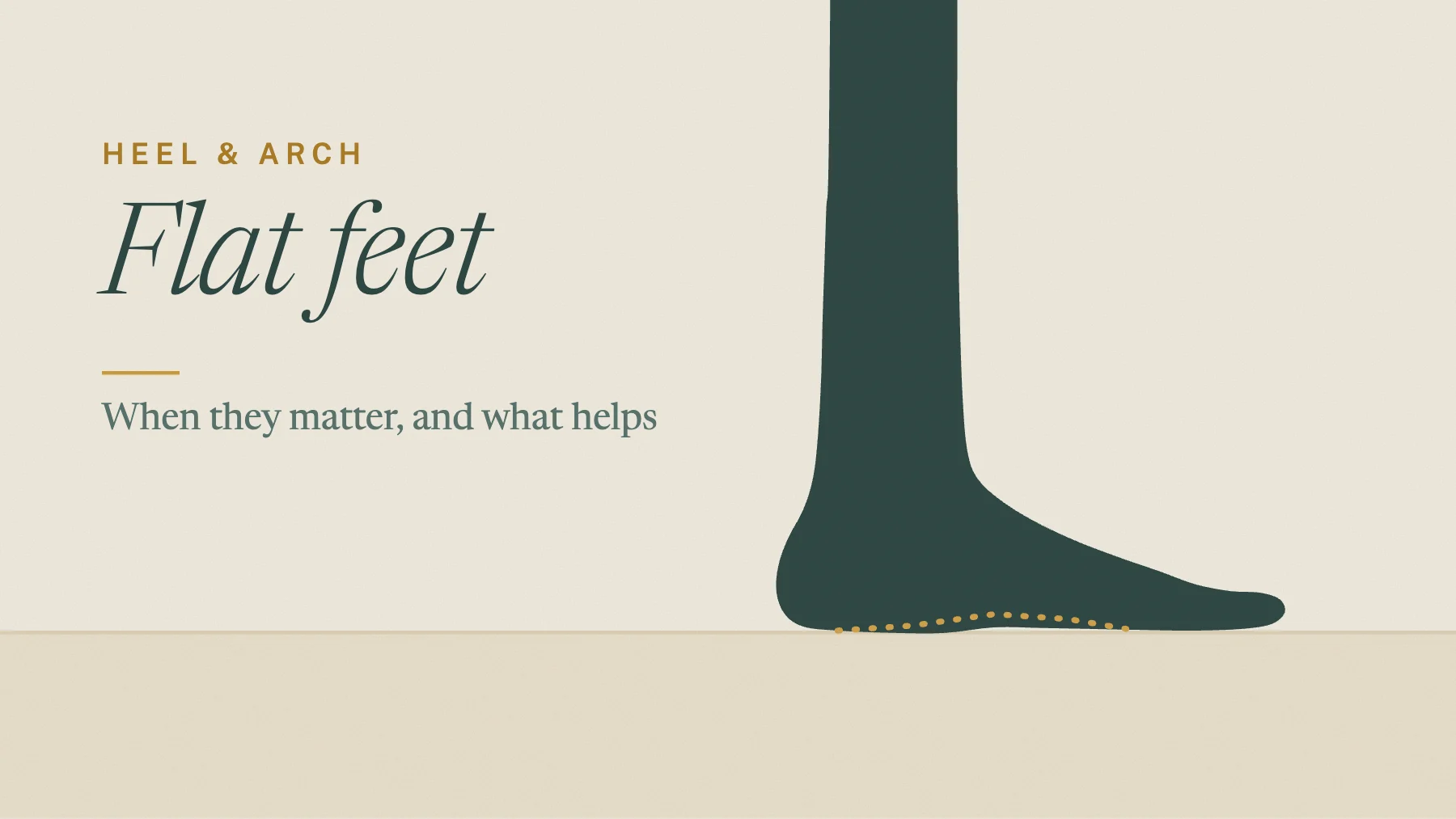
“I have flat feet” is something people say with a shrug, and usually that’s the right response. But a flat foot that hurts, or one that is flatter than it used to be, deserves a closer look.
Flat feet that are fine
Plenty of adults have low arches that they’ve had their whole lives. If the arch appears when you sit or stand on your toes, both feet look the same, and nothing hurts, there’s usually nothing to fix. Supportive shoes are all most people need.
Flat feet that aren’t
The concern is an arch that collapses in adulthood, now called progressive collapsing foot deformity (and also known as adult-acquired flatfoot or posterior tibial tendon dysfunction). The posterior tibial tendon runs behind the inner ankle bone and holds up the arch. When it becomes inflamed, stretched or torn, the arch gradually falls.[1,4]
Warning signs:
- pain and swelling along the inside of the ankle,
- one arch flatter than the other,
- the heel tilting outward and the toes pointing out (“too many toes” seen from behind),
- difficulty standing on tiptoe on that foot,
- later, pain on the outside of the ankle.[1,2]
It’s more common in women over 40, and in people with higher body weight, high blood pressure or diabetes.[1]
Why early matters
In its early stages the foot is still flexible, and non-surgical treatment works well. As it progresses, the deformity can become rigid and arthritis can develop, which is harder to treat. Early diagnosis is one of the most important factors in the outcome.[4]
What helps
- Supportive shoes with a firm heel counter.
- Orthotics or a brace to support the arch and take strain off the tendon.[4,5] Evidence for orthotics alone in adult flatfoot is limited, so they’re best used as part of a plan.[6]
- Strengthening. In a structured program for early tendon dysfunction, an orthosis plus high-repetition exercises over about four months led to a successful result in most patients.[3]
- Calf stretching if a tight calf is adding to the load.
- A short period in a walking boot for a flare-up.
Common questions
Why is only one foot getting flatter?
That pattern is typical of a struggling posterior tibial tendon, which usually affects one side, and it is one of the clearest reasons to have the foot examined.[1,2] Lifelong flat feet, by contrast, usually look the same on both sides.
Can the tendon recover?
In the early stages, often yes. Taking strain off the tendon with supportive shoes, an orthosis or a brace, sometimes after a short spell in a boot, and then strengthening it, relieves symptoms for most people with early tendon dysfunction.[3,4]
What shoes should I look for?
A firm heel counter that doesn’t collapse when you squeeze it, a midsole that bends at the ball of the foot but doesn’t twist easily, and enough depth for an insert if you use one. Very flexible, unsupportive shoes and worn-out sneakers leave the tendon doing all the work.
When surgery comes in
If pain continues after several months of good treatment, or the deformity is progressing, surgery can restore alignment.[1,4] Our Center for Lower Extremity Surgery explains the options in adult-acquired flatfoot (external site).
See also flat feet and custom orthotics.
When to see a podiatrist
About the author
Efe Ozturk, DPM
Foot and Ankle Surgeon. Dr. Ozturk is double board certified, as a Diplomate of the American Board of Podiatric Medicine (DABPM) and a Fellow of the Academy of Physicians in Wound Healing (FAPWH), and is a Fellow of the American Society of Podiatric Surgeons (FASPS) and the American Society of Podiatric Medicine (FASPM). Trained in forefoot and rearfoot reconstructive surgery at Morristown Medical Center; sees patients in Lyndhurst, Paramus and Millburn.
References
- 1.American Academy of Orthopaedic Surgeons. Progressive Collapsing Foot Deformity. OrthoInfo. orthoinfo.org (external site)
- 2.American College of Foot and Ankle Surgeons. Posterior Tibial Tendon Dysfunction (PTTD). FootHealthFacts. foothealthfacts.org (external site)
- 3.Alvarez RG, Marini A, Schmitt C, Saltzman CL. Stage I and II posterior tibial tendon dysfunction treated by a structured nonoperative management protocol: an orthosis and exercise program. Foot Ankle Int. 2006;27(1):2-8. PubMed 16442022 (external site)
- 4.Deland JT. Adult-acquired flatfoot deformity. J Am Acad Orthop Surg. 2008;16(7):399-406. PubMed 18611997 (external site)
- 5.Henry JK, Shakked R, Ellis SJ. Adult-Acquired Flatfoot Deformity. Foot Ankle Orthop. 2019;4(1):2473011418820847. PubMed 35097314 (external site)
- 6.Herchenröder M, Wilfling D, Steinhäuser J. Evidence for foot orthoses for adults with flatfoot: a systematic review. J Foot Ankle Res. 2021;14(1):57. PubMed 34844639 (external site)
This is general health information and isn’t a substitute for advice from a clinician who knows your history. Read our medical disclaimer and how we write and review content.
More from the blog
Heel & arch
Heel spurs: are they really the cause of your heel pain?
Most people with heel spurs have no heel pain. Where the pain really comes from, and what helps.
Heel & arch
Why does my heel hurt in the morning? Plantar fasciitis explained
That stab of pain with your first steps out of bed is the classic sign of plantar fasciitis. Here’s why it happens and what helps.
Heel & arch
Plantar fasciitis stretches and exercises that are backed by evidence
The heel pain exercises that have actually been tested in trials, and how to do them properly.