Ankles that keep rolling: chronic ankle instability
An ankle that keeps rolling after a sprain is more than bad luck. Why it happens, and what helps.

By Efe Ozturk, DPM
· 4 min read
Medically reviewed by Efe Ozturk, DPM · Last reviewed
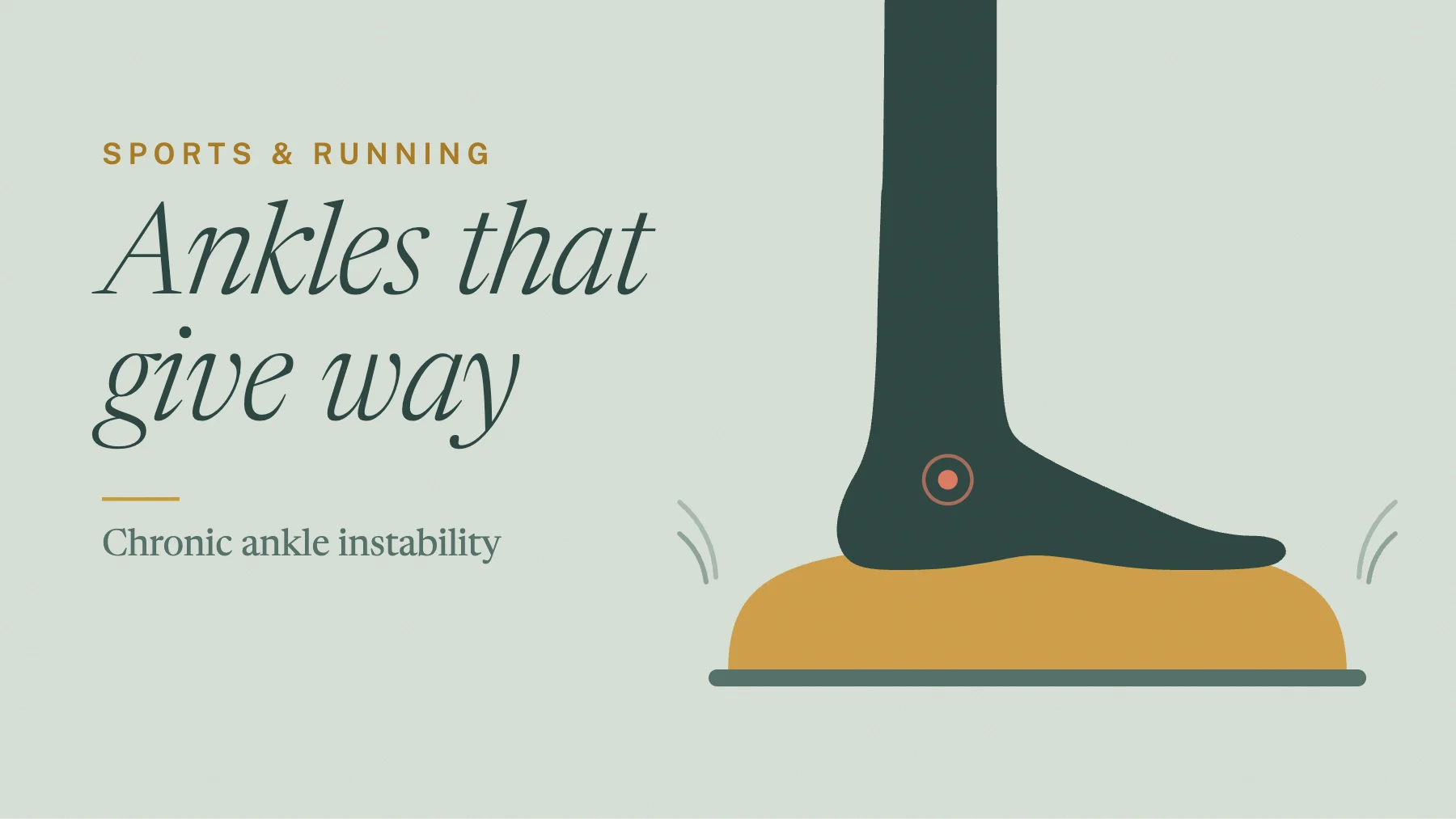
You sprained your ankle last year, or five years ago. Now it rolls on a curb, a tree root or a quick sideways step. If that sounds familiar, you may have chronic ankle instability. It’s common, it can be treated, and it deserves more than a brace and crossed fingers.
What “giving way” really means
Chronic ankle instability is a recurring giving way of the outer side of the ankle, often after repeated sprains. Typical signs:
- the ankle turning again and again, especially on uneven ground or during sport
- ongoing discomfort and swelling
- pain or tenderness
- an ankle that feels wobbly or unstable[1]
The most common risk factor for a sprain is a previous sprain.[2] Each new sprain weakens or stretches the ligaments further, making the ankle less stable.[1]
Two kinds of instability
Specialists describe two types. Instability most likely comes from a mix of both.[2]
Mechanical instability is a problem with the joint itself. The ligaments may be too loose, the joint may move abnormally, the joint lining may be irritated, or the joint may show wear.[2]
Functional instability is a problem with control. It comes from shortfalls in proprioception, your sense of where your foot is, and in neuromuscular control, the quick muscle responses that catch the ankle as it starts to roll.[2]
Exercise works on control. It isn’t meant to tighten a ligament that healed loose, which is why some ankles eventually need more.
How common is it?
Chronic instability develops in about 10% to 20% of people after an acute ankle sprain.[6]
In a review of studies following people after a first sprain, the share who felt their ankle was unstable fell from about 38% at three months to 16% at six months and 8% at a year. About 16% had sprained the ankle again within a year.[7] The authors suggest that, after a first sprain, a longer period of non-surgical treatment may be warranted before surgery.[7]
Still, repeated sprains can lead to long-term ankle pain, arthritis and instability.[8]
How we assess an unstable ankle
We start with your story: how you hurt the ankle and how often it gives way. Then we examine it for tender spots, swelling and signs of instability. X-rays or other imaging may be used to look further.[1] We have X-ray and ultrasound at the practice.
A sprain can come with injuries to nearby cartilage and tendons, so lingering pain isn’t always instability alone.[8] See peroneal tendon problems and cartilage injuries.
What helps: rebuild control first
Treatment starts without surgery.[6] It may include physical therapy for strength and balance, a brace for support, and anti-inflammatory medicine for pain and inflammation.[1] An evidence-based guideline prefers supervised, exercise-based programs over passive treatments.[3]
Balance training. Poor balance often leads to repeat sprains and instability.[8] In a review of 15 randomized trials in people with chronic instability, balance training improved function, instability and dynamic balance more than regular exercise did.[4] An older Cochrane review found that neuromuscular training appears to help in the short term; whether that lasts is unknown.[6] Good programs get harder as you improve:
- from a steady floor to a cushion or wobble board
- from eyes open to eyes closed
- from standing still to reaching, catching and hopping
- from slow, careful moves to the speed of your sport
Strength. Resistance exercises and toe raises strengthen the muscles and tendons that help steady the ankle.[8] In that review of 15 trials, balance and strength training showed no clear difference for instability or balance; balance training did better for function.[4]
Braces and tape: a seatbelt, not the engine. There is strong evidence that bracing helps prevent another ankle sprain, and moderate evidence for neuromuscular training.[5]
In a network meta-analysis of randomized trials in people with ankle instability, taping, bracing and insoles were no better than no treatment at improving dynamic balance. The authors concluded that, on their own, they don’t appear to be a viable main treatment.[9] That’s why a brace works alongside the exercises, not instead of them. Our sports medicine team builds that plan around your sport. See also ankle sprains and instability.
When surgery is considered
Surgery is reserved for ankles that stay unstable and painful after months of thorough, exercise-based rehabilitation, particularly when the ligaments are loose.[3,8,6] It usually means repairing or reconstructing the damaged ligaments.[1] Our colleagues at the Center for Lower Extremity Surgery explain chronic ankle instability (external site) and ankle ligament reconstruction (external site).
Common questions
Will it get better with time?
It might. In studies of people after a first sprain, pain and the feeling of instability kept easing for up to a year.[7] But waiting while the ankle keeps rolling isn’t a plan, because each sprain can leave the ligaments weaker.[1]
Do I have to wear a brace forever?
Not necessarily. A brace supports the ankle and helps prevent more sprains while you rebuild balance and strength.[1] How long you need it depends on your sport and your ankle.
When to see a podiatrist

About the author
Efe Ozturk, DPM
Foot and Ankle Surgeon. Dr. Ozturk is double board certified, as a Diplomate of the American Board of Podiatric Medicine (DABPM) and a Fellow of the Academy of Physicians in Wound Healing (FAPWH), and is a Fellow of the American Society of Podiatric Surgeons (FASPS) and the American Society of Podiatric Medicine (FASPM). Trained in forefoot and rearfoot reconstructive surgery at Morristown Medical Center; sees patients in Lyndhurst, Paramus and Millburn.
References
- 1.American College of Foot and Ankle Surgeons. Chronic Ankle Instability. FootHealthFacts. foothealthfacts.org (external site)
- 2.Hertel J. Functional Anatomy, Pathomechanics, and Pathophysiology of Lateral Ankle Instability. J Athl Train. 2002;37(4):364-375. PubMed 12937557 (external site)
- 3.Vuurberg G, Hoorntje A, Wink LM, van der Doelen BFW, van den Bekerom MP, Dekker R, et al. Diagnosis, treatment and prevention of ankle sprains: update of an evidence-based clinical guideline. Br J Sports Med. 2018;52(15):956. PubMed 29514819 (external site)
- 4.Mollà-Casanova S, Inglés M, Serra-Añó P. Effects of balance training on functionality, ankle instability, and dynamic balance outcomes in people with chronic ankle instability: Systematic review and meta-analysis. Clin Rehabil. 2021;35(12):1694-1709. PubMed 34058832 (external site)
- 5.Doherty C, Bleakley C, Delahunt E, Holden S. Treatment and prevention of acute and recurrent ankle sprain: an overview of systematic reviews with meta-analysis. Br J Sports Med. 2017;51(2):113-125. PubMed 28053200 (external site)
- 6.de Vries JS, Krips R, Sierevelt IN, Blankevoort L, van Dijk CN. Interventions for treating chronic ankle instability. Cochrane Database Syst Rev. 2011;2011(8):CD004124. PubMed 21833947 (external site)
- 7.Michels F, Wastyn H, Pottel H, Stockmans F, Vereecke E, Matricali G. The presence of persistent symptoms 12 months following a first lateral ankle sprain: A systematic review and meta-analysis. Foot Ankle Surg. 2022;28(7):817-826. PubMed 34961654 (external site)
- 8.American Academy of Orthopaedic Surgeons. Sprained Ankle. OrthoInfo. orthoinfo.org (external site)
- 9.Tsikopoulos K, Sidiropoulos K, Kitridis D, Cain SM, Metaxiotis D, Ali A. Do External Supports Improve Dynamic Balance in Patients with Chronic Ankle Instability? A Network Meta-analysis. Clin Orthop Relat Res. 2020;478(2):359-377. PubMed 31625960 (external site)
This is general health information and isn’t a substitute for advice from a clinician who knows your history. Read our medical disclaimer and how we write and review content.
More from the blog
Sports & running
Pain on the outside of the ankle: peroneal tendon problems
Ankle pain that won’t settle after a sprain may be the peroneal tendons. The signs, and how they’re treated.
Sports & running
Pickleball foot and ankle injuries: how to play longer and hurt less
Pickleball injuries are rising fast. The foot and ankle injuries to know, and how to keep playing without them.
Sports & running
Sprained ankle recovery: the first 72 hours and getting back to sport
A week-by-week plan for a sprained ankle, from the first days to getting back to your sport.