Pain on the outside of the ankle: peroneal tendon problems
Ankle pain that won’t settle after a sprain may be the peroneal tendons. The signs, and how they’re treated.

By Efe Ozturk, DPM
· 4 min read
Medically reviewed by Efe Ozturk, DPM · Last reviewed
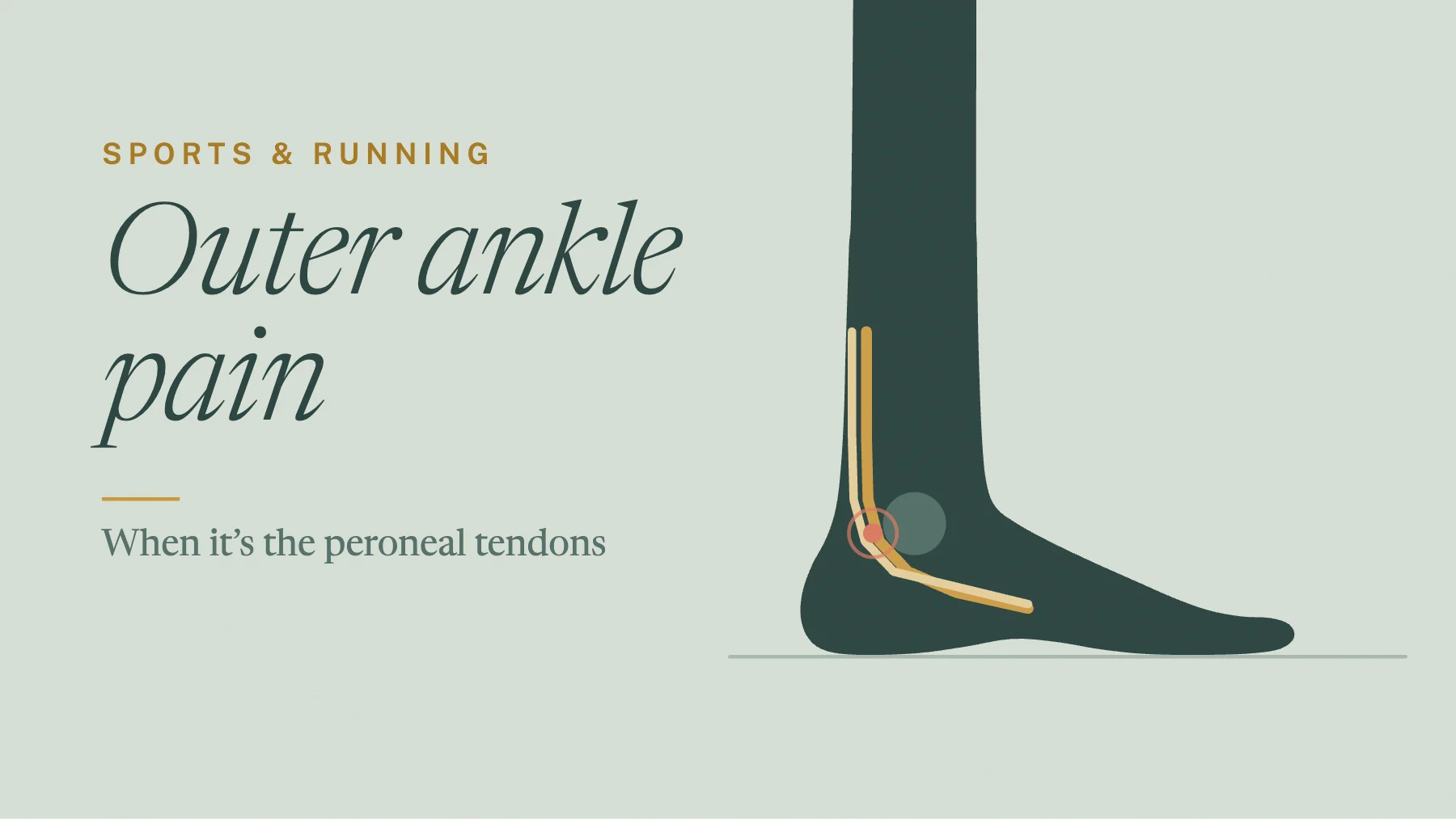
You rolled your ankle months ago, or you’ve been running more than usual, and the outside of your ankle still aches. Many people assume it’s an old sprain that never quite healed. Sometimes it is. But often the problem is a pair of tendons that sit right next to those ligaments: the peroneal tendons.
What the peroneal tendons do
Two peroneal tendons run side by side in a groove behind the bony bump on the outside of your ankle (the fibula). One attaches to the outer edge of the midfoot. The other runs under the foot to the inner side of the arch.[1] Their muscles turn the foot outward, and they act as stabilizers on the outside of the ankle.[2] When they’re sore, weak or damaged, the ankle can feel less steady.
The three kinds of problems
Tendinitis. The tendon is irritated from repetitive use, overuse, or an injury such as a sprain. It causes pain, swelling and warmth along the outside of the ankle.[1] In athletes, tendinopathy is usually an overuse problem.[3]
Tears. A tendon can tear suddenly from an injury, or fray slowly over years, like taffy stretched until it thins. Tears cause pain, swelling, and weakness or a feeling that the ankle gives way. Over time, some people notice their arch getting higher.[1]
Subluxation. The tendons slip out of their groove and snap over the ankle bone. This can happen after an ankle sprain damages the tissue that holds the tendons in place, or from a strong muscle contraction when landing or stopping suddenly.[1,3] Some people are born with a groove or muscle shape that makes it more likely.[1]
Who gets them
Peroneal tendon injuries are most common in people who play sports with lots of repetitive ankle motion. People with high arches are at higher risk, including for slow, degenerative tears.[1] They also tend to go along with ankle instability and certain foot shapes.[2] If you have high arches, our high-arched feet page explains why that foot type puts extra load on the outside of the ankle.
Signs it may be your tendons, not the ligaments
- Pain and swelling behind or just below the bone on the outside of the ankle, rather than in front of it.
- Pain that comes on during or after activity, especially on uneven ground or when pushing off.
- A snapping or popping feeling behind the outer ankle bone.
- Weakness turning the foot outward, or an ankle that keeps feeling unstable.
Because these symptoms overlap with a sprain, peroneal tendon problems are sometimes missed. Pain that lingers after what seemed like a simple sprain is worth a closer look.[1,2] Our guide to sprained ankle recovery describes what normal progress looks like.
How we find out
We examine the foot and ankle: where it’s tender, how strong the tendons are when you push against resistance, whether they slip out of place, how stable the ligaments are, and the shape of your foot and arch.[2] X-rays and ultrasound, both available at the practice, help sort out the cause, and an MRI can add more detail.[2]
Treatment
Treatment depends on which problem you have.[1] For tendinitis and many mild problems it usually starts without surgery:
- Rest and protection. A cast or splint for a short time keeps the foot and ankle still so the injury can heal.
- Anti-inflammatory medicine, by mouth or sometimes by injection, to ease pain and swelling.
- Physical therapy. As the pain settles, exercises rebuild strength, range of motion and balance.
- Bracing for sport or other activities with a lot of repetitive ankle motion.[1]
For athletes with tendinopathy, this conservative care is the first step.[3] Supportive custom orthotics can help when foot shape adds strain. Honestly, most of the treatment advice here comes from case series and expert experience rather than large trials, so your plan is fitted to your injury and your goals.[2]
Surgery is considered for tears that don’t settle and for tendons that keep slipping out of place. For a tendon that repeatedly dislocates and causes symptoms, surgery is often recommended early, and most procedures have a high success rate.[3] Our colleagues at the Center for Lower Extremity Surgery (external site) explain the surgical options.
Common questions
Can I keep running on it?
Not through pain. Running on an irritated tendon keeps it irritated, and a partly torn tendon can get worse. Switching to cycling or swimming while it settles keeps you fit without loading the outside of the ankle.
Why does the snapping matter if it doesn’t hurt much?
A tendon that keeps slipping out of position is more likely to tear or rupture over time, so early treatment matters.[1]
When to see a podiatrist

About the author
Efe Ozturk, DPM
Foot and Ankle Surgeon. Dr. Ozturk is double board certified, as a Diplomate of the American Board of Podiatric Medicine (DABPM) and a Fellow of the Academy of Physicians in Wound Healing (FAPWH), and is a Fellow of the American Society of Podiatric Surgeons (FASPS) and the American Society of Podiatric Medicine (FASPM). Trained in forefoot and rearfoot reconstructive surgery at Morristown Medical Center; sees patients in Lyndhurst, Paramus and Millburn.
References
- 1.American College of Foot and Ankle Surgeons. Peroneal Tendon Injuries. FootHealthFacts. foothealthfacts.org (external site)
- 2.Davda K, Malhotra K, O'Donnell P, Singh D, Cullen N. Peroneal tendon disorders. EFORT Open Rev. 2017;2(6):281-292. PubMed 28736620 (external site)
- 3.Lugo-Pico JG, Kaiser JT, Sanchez RA, Aiyer AA. Peroneal Tendinosis and Subluxation. Clin Sports Med. 2020;39(4):845-858. PubMed 32892971 (external site)
This is general health information and isn’t a substitute for advice from a clinician who knows your history. Read our medical disclaimer and how we write and review content.
More from the blog
Sports & running
Pickleball foot and ankle injuries: how to play longer and hurt less
Pickleball injuries are rising fast. The foot and ankle injuries to know, and how to keep playing without them.
Sports & running
Sprained ankle recovery: the first 72 hours and getting back to sport
A week-by-week plan for a sprained ankle, from the first days to getting back to your sport.
Sports & running
Achilles pain in runners: load, rest and recovery
Why runners get Achilles pain, why rest isn’t the answer, and how to recover without losing your season.