Class IV laser therapy for foot pain: what a session is like and what the research says
What a Class IV laser session is like, and an honest look at what the research shows.

By Efe Ozturk, DPM
· 3 min read
Medically reviewed by Efe Ozturk, DPM · Last reviewed
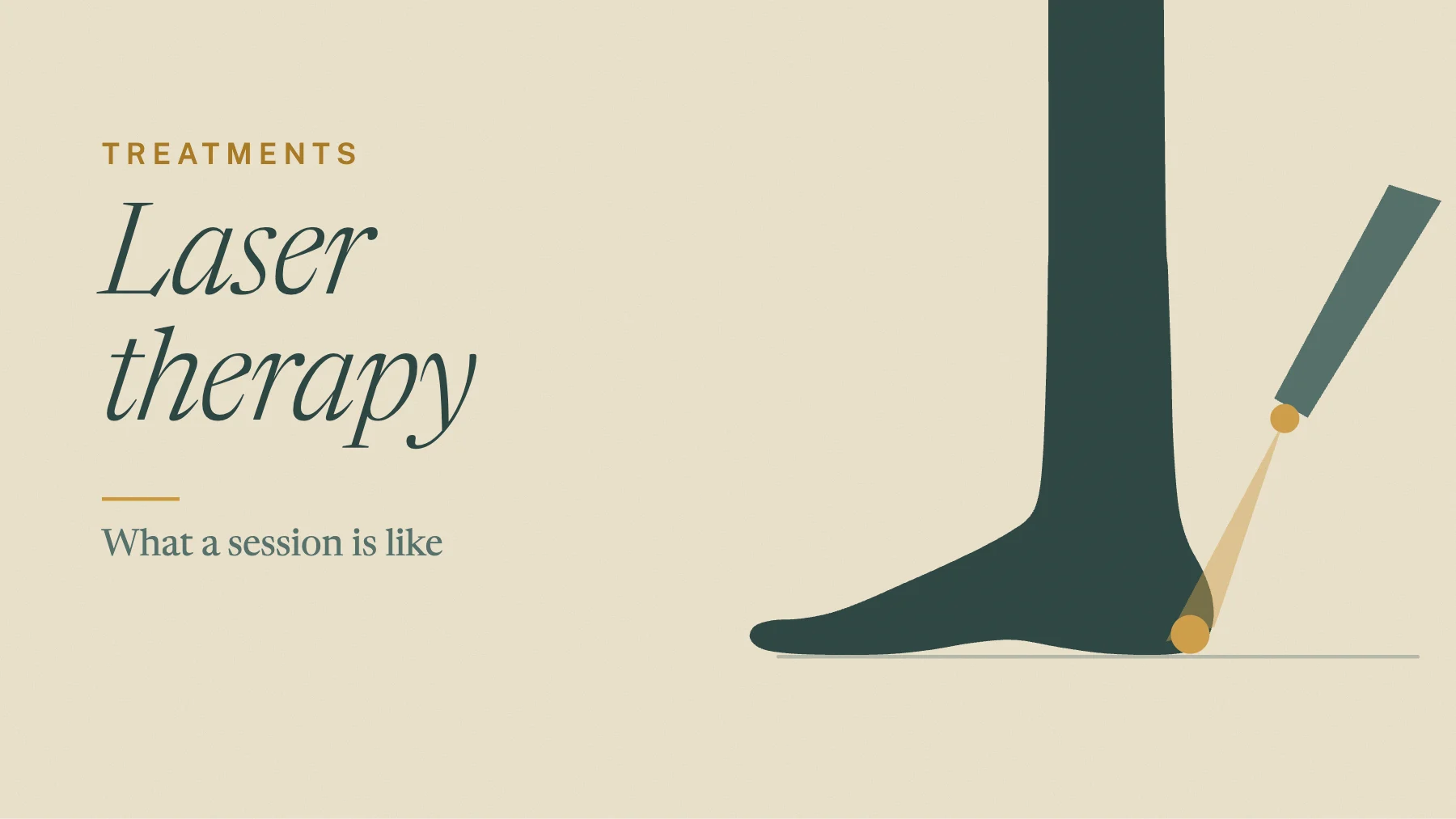
“Laser therapy” covers a wide range of devices. The one used for pain in the foot and ankle, Class IV or high-intensity laser therapy, isn’t a cutting laser. It delivers light energy into tissue to ease pain and inflammation. Here’s what a session is like, and what the research does and doesn’t show.
How it works
Light at specific wavelengths is absorbed by tissue, where it is thought to affect cell metabolism, local circulation and pain signaling (the broader field is called photobiomodulation). Class IV devices are higher-powered than older, low-level lasers, so they reach deeper tissue in a shorter time.
What a session is like
- You and the clinician wear protective glasses.
- The handpiece is moved over the painful area, sometimes in contact with the skin.
- You feel a pleasant warmth; it shouldn’t feel hot or painful.
- Each area takes a few minutes.
- There’s no downtime: you can walk out and go back to your day.
- Treatment is typically a series of sessions over a few weeks.
What the research shows
For plantar fasciitis:
- A meta-analysis of randomized trials found that low-level laser therapy reduced heel pain, with the improvement lasting up to three months after treatment.[1]
- A randomized trial comparing high-intensity and low-level laser found similar improvement with both, though patients rated the high-intensity treatment more favorably.[4]
- A 2026 meta-analysis comparing high-intensity laser with shockwave found no significant difference in pain, with foot function favoring shockwave in some analyses.[2]
- A 2026 randomized trial found that adding high-intensity laser or shockwave to a structured home exercise program didn’t add benefit at 12 weeks; all three groups improved.[3]
The honest summary: laser therapy can help some people with heel and soft-tissue pain, but it isn’t a substitute for stretching, strengthening, good shoes and time. It’s a reasonable option if you want an in-office, needle-free treatment alongside your exercises.
Who it may suit
- Heel pain or tendon pain that hasn’t settled with home care.
- People who want to avoid injections.
- Soft-tissue pain during rehabilitation after a sprain or overuse injury.
It isn’t used over the eyes, over a pregnancy, over cancerous tissue, or with light-sensitizing medication, and we check your history first.
Common questions
Is Class IV laser the same as a “cold laser”?
No. “Cold laser” usually means low-level laser, which uses much less power. Class IV devices deliver more energy in a shorter time. In a head-to-head trial for plantar fasciitis, both reduced pain to a similar degree over three weeks, although more patients rated the high-intensity treatment as effective.[4]
How many sessions does it take?
Laser is given as a series. In that trial, for example, patients had eight sessions over three weeks.[4] We tell you how many we recommend for your problem, and reassess partway through.
When will I notice a difference?
Usually gradually, over the course of treatment and the weeks after it. In the pooled trials of laser for plantar fasciitis, the improvement in heel pain lasted up to three months after treatment.[1]
Laser, shockwave or something else?
For chronic plantar fasciitis, shockwave has the larger body of evidence, including trials against corticosteroid injections.[5,6] See does shockwave therapy work? We’ll recommend the option that best fits your diagnosis and preferences. See Class IV laser therapy.
When to see a podiatrist
About the author
Efe Ozturk, DPM
Foot and Ankle Surgeon. Dr. Ozturk is double board certified, as a Diplomate of the American Board of Podiatric Medicine (DABPM) and a Fellow of the Academy of Physicians in Wound Healing (FAPWH), and is a Fellow of the American Society of Podiatric Surgeons (FASPS) and the American Society of Podiatric Medicine (FASPM). Trained in forefoot and rearfoot reconstructive surgery at Morristown Medical Center; sees patients in Lyndhurst, Paramus and Millburn.
References
- 1.Wang W, Jiang W, Tang C, Zhang X, Xiang J. Clinical efficacy of low-level laser therapy in plantar fasciitis: A systematic review and meta-analysis. Medicine (Baltimore). 2019;98(3):e14088. PubMed 30653125 (external site)
- 2.Wu PC, Liu DH, Cheng YS, Lin CS, Yang FA. High-Intensity Laser Therapy Versus Extracorporeal Shockwave Therapy for Plantar Fasciitis: A Systematic Review and Meta-Analysis. Bioengineering (Basel). 2026;13(1). PubMed 41596021 (external site)
- 3.Kosehasanogullari M, Büyükvural Şen S, Okur Yılmaz N, Aygün Bilecik N, Koçyiğit BF. Home Exercise With or Without High-Intensity Laser or Radial Shockwave Therapy for Plantar Fasciitis: A Randomized Controlled Trial. Foot Ankle Int. 2026;47(3):386-397. PubMed 41664959 (external site)
- 4.Naruseviciute D, Kubilius R. The effect of high-intensity versus low-level laser therapy in the management of plantar fasciitis: randomized participant blind controlled trial. Clin Rehabil. 2020;34(8):1072-1082. PubMed 32513018 (external site)
- 5.Charles R, Fang L, Zhu R, Wang J. The effectiveness of shockwave therapy on patellar tendinopathy, Achilles tendinopathy, and plantar fasciitis: a systematic review and meta-analysis. Front Immunol. 2023;14:1193835. PubMed 37662911 (external site)
- 6.Cortés-Pérez I, Moreno-Montilla L, Ibáñez-Vera AJ, Díaz-Fernández Á, Obrero-Gaitán E, Lomas-Vega R. Efficacy of extracorporeal shockwave therapy, compared to corticosteroid injections, on pain, plantar fascia thickness and foot function in patients with plantar fasciitis: A systematic review and meta-analysis. Clin Rehabil. 2024;38(8):1023-1043. PubMed 38738305 (external site)
This is general health information and isn’t a substitute for advice from a clinician who knows your history. Read our medical disclaimer and how we write and review content.
More from the blog
Treatments
Does shockwave therapy work for heel pain? What the studies show
Shockwave therapy has strong evidence for stubborn heel pain. What the studies show, and where it fits.
Treatments
PRP injections for the foot and ankle: what the evidence says
Where PRP helps, where trials show it doesn’t, and what to expect from an injection.
Treatments
Custom vs. store-bought orthotics: what the research says
Custom orthotics aren’t automatically better. When store-bought works, and when custom is worth it.