High ankle sprain recovery time: by grade, and when surgery is needed
Why a high ankle sprain can take two weeks or three months, how a Foot and Ankle Surgeon tells a stable injury from an unstable one, and what suture-button (TightRope) surgery adds, with this week’s college football ankle news.

By Dr. Efe Ozturk
· 7 min read
Medically reviewed by Dr. Efe Ozturk · Last reviewed
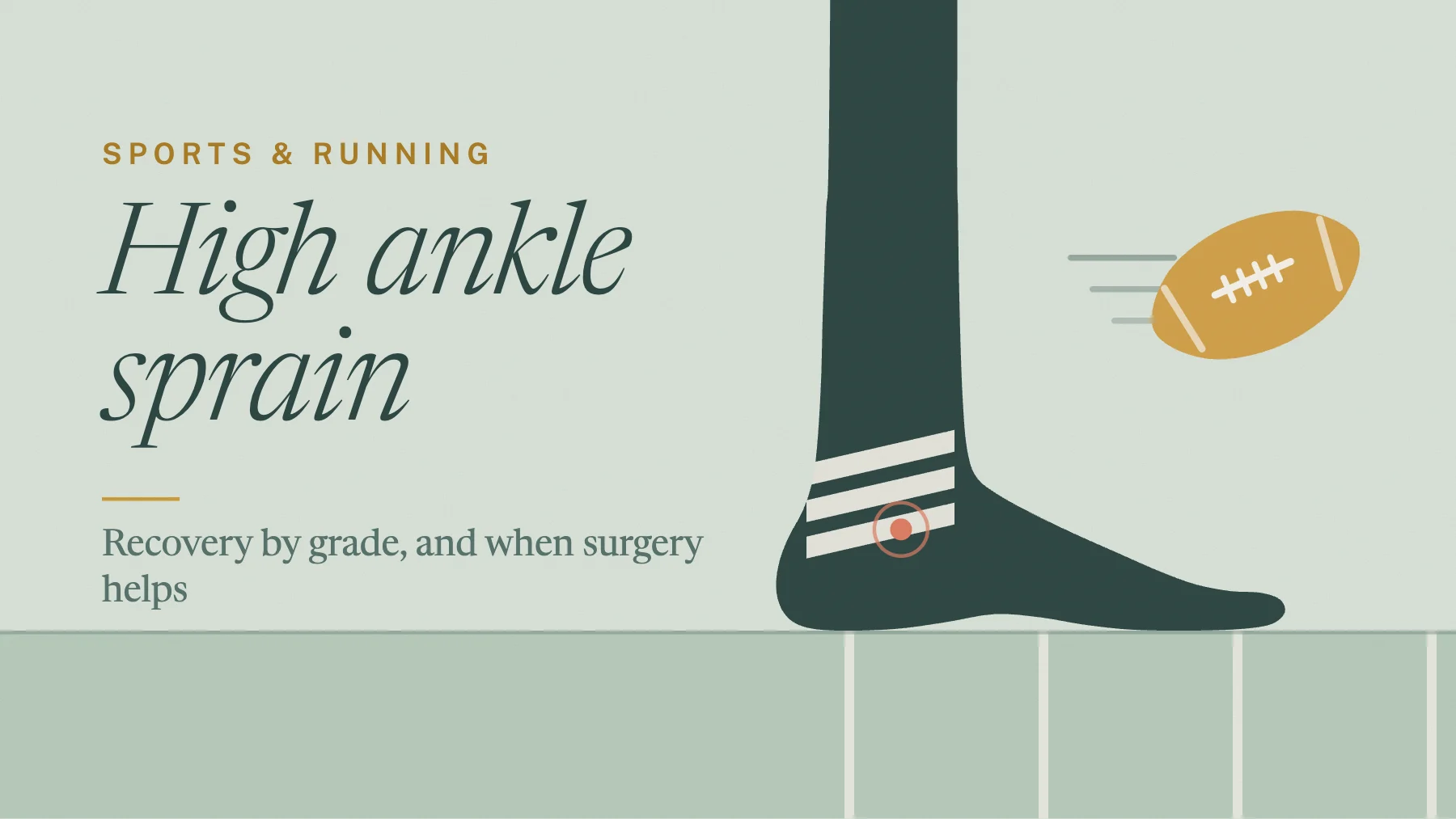
Three college football stars made ankle news this week. Here’s what was reported, and what recovery looks like for everyone else.
A note first: we have no connection with these athletes or teams and haven’t examined them. Details about them come from public reports as of November 7, 2026.
What was reported about Toney, Simmons and Martin
Malachi Toney, Miami. Toney was hurt in practice on Wednesday, November 4.[12] Sources told ESPN he had a high ankle sprain, would have surgery and would miss Saturday’s game at Notre Dame. ESPN noted that return from this injury typically takes at least four weeks, with the College Football Playoff about six weeks away.[6] On3 reported that he would have TightRope surgery on Thursday, with a typical recovery of four to six weeks.[7]
Colin Simmons, Texas. Simmons, who leads FBS in sacks, hurt his ankle in the fourth quarter of Texas’s October 17 loss to Florida.[13,9] ESPN’s Pete Thamel reported a high ankle sprain and called him week to week.[8] He returned at Missouri on November 7 after missing two games.[9]
LJ Martin, BYU. Martin hurt his ankle in an October 3 win at TCU and was expected to miss four to six weeks. ESPN reported his return against No. 3 Utah on November 7.[10] ESPN called it an ankle injury, not a high ankle sprain, so we do too.
High ankle sprain vs regular ankle sprain
A regular sprain tears ligaments on the outside of the ankle. A high ankle sprain injures the syndesmosis, the ligaments that tie the two lower-leg bones, the tibia and fibula, together just above the ankle.[11] It often comes from the foot being forced to twist outward, and it is common in collision sports.[14] In European pro soccer, these injuries were 7% of ankle ligament injuries, and 74% came from contact.[15]
Why it matters: high ankle sprains are often missed and cause lasting pain after a “sprain.” An unstable syndesmosis left untreated can lead to ankle arthritis, and one review advises that unstable injuries be treated with surgery.[16] Our Justin Jefferson article compares how often each kind of sprain costs players weeks.
High ankle sprain recovery time by grade
The key question in grading is whether the joint is stable or unstable.[3]
| Grade | What it means | Usual treatment | Reported return to sport |
|---|---|---|---|
| Grade I | Sprained ligaments, no widening of the joint | Rehab, then functional tests | 13.4 days on average in college athletes with no widening[1] |
| Grade IIa | Partial tear, joint stable | Boot and rehab | About 45 days (23 to 63)[2] |
| Grade IIb | Partial tear, joint unstable | Surgical stabilization | About 64 days (27 to 104)[2] |
| Grade III | Complete tear, unstable | Surgical stabilization | First match about 103 days after surgery for IIb and III together; III took longer[17] |
Across 18 studies and 1,133 high ankle sprains in athletes, 99% returned to play: surgically treated athletes at about 71 days and the others at about 39.[18] Part of that gap is the injury itself, since surgery is the treatment for unstable ones.[3] These are averages for athletes with daily rehab, not a forecast for any one person, including the players above.
When is high ankle sprain surgery needed?
When the joint is unstable.[3] A positive squeeze test and an injured deltoid ligament on the inside of the ankle help pick out athletes who may benefit from early keyhole (arthroscopic) assessment and stabilization.[2]
Stabilizing an unstable joint gets athletes back. In 110 professional soccer players who had surgery for an unstable high ankle sprain, on-field rehab began at about 37 days, team training at 72 and the first match at about 103.[17]
Suture button or screws? A suture button, often called a TightRope, is a strong cord passed through a small drill hole across the fibula and tibia and held by a small metal button on each side.[19] The older method is a screw across the same two bones. In a review of five randomized trials with 285 patients, suture-button patients had higher ankle function scores (95.3 vs 86.7 out of 100). None of their implants broke, compared with 25.4% of screws. Hardware came out in 6% versus 22.4%, and the joint was set out of position in 0.8% versus 11.5%.[5]
In elite athletes, 96% returned to sport after a high ankle sprain, on average in about 58 days, including 98% after suture-button fixation.[4]
High ankle sprain symptoms
Look for tenderness at the front of the ankle over the ligament joining the two leg bones, sometimes higher up the leg,[1] and pain when the foot is turned outward.[20] Being unable to hop on that leg was present in 89% of injuries, and pain out of proportion to how the injury looks is another clue.[21]
How is a high ankle sprain diagnosed?
The squeeze test. We squeeze the leg bones together at mid-calf; pain down at the ankle points to the syndesmosis. Across four studies, the test was negative in 85% of people without the injury, so it rarely flags a healthy ankle. No single test is enough, and the exam can’t tell stable from unstable, so imaging or arthroscopy is needed.[22]
X-rays measure the space between the two bones.[3] A subtle unstable injury may not show on X-rays taken at rest, which delays diagnosis. MRI and weight-bearing CT (a scan taken while you stand) can help guide treatment, but looking inside the joint with a small camera remains the benchmark.[14] See ankle arthroscopy.
The limits. Stable injuries do well without surgery: elite athletes treated without an operation also returned 98% of the time, and that review found signs of publication bias.[4] Ten years out, suture-button and screw patients scored about the same.[23] In one series, eight elite athletes later broke the fibula next to the button’s drill hole, at a mean of 14 months, and most had surgery to heal it.[19] One of the main trials enrolled adults 18 to 70, some with a broken ankle bone too, so results in athletes may differ.[24]
How we treat a high ankle sprain
Dr. Efe Ozturk is a Foot and Ankle Surgeon and podiatrist. We examine both ankles and take X-rays and ultrasound at the practice, with an MRI arranged when needed. A stable sprain gets a boot and a rehab plan through our sports medicine team. An unstable one gets a frank talk about stabilizing it early. See ankle sprains and fractures and trauma. We see patients in Lyndhurst, Paramus and Millburn, NJ.
Common questions
How long is high ankle sprain recovery time without surgery?
In athletes with a stable injury, about two weeks when the joint hasn’t widened and about six weeks for a stable partial tear.[1,2]
What is TightRope surgery for a high ankle sprain?
It holds the tibia and fibula together with a strong cord and two small buttons.[19] In trials it gave higher function scores and fewer broken implants than screws.[5] After surgery in one trial, patients were allowed partial weight at two weeks and full weight at six.[24]
Is a high ankle sprain worse than a regular ankle sprain?
It is a different injury, usually from contact, and often missed. Left unstable, it can lead to arthritis.[15,16]
When to see a Foot and Ankle Surgeon or podiatrist
About the author
Dr. Efe Ozturk
Foot and Ankle Surgeon. Dr. Ozturk is double board certified, as a Diplomate of the American Board of Podiatric Medicine (DABPM) and a Fellow of the Academy of Physicians in Wound Healing (FAPWH), and is a Fellow of the American Society of Podiatric Surgeons (FASPS) and the American Society of Podiatric Medicine (FASPM). Trained in forefoot and rearfoot reconstructive surgery at Morristown Medical Center; sees patients in Lyndhurst, Paramus and Millburn.
Where to be seen
Dr. Ozturk sees patients at each of these offices, and one phone number reaches all of them.
References
- 1.Nussbaum ED, Hosea TM, Sieler SD, Incremona BR, Kessler DE. Prospective evaluation of syndesmotic ankle sprains without diastasis. Am J Sports Med. 2001;29(1):31-35. PubMed 11206253 (external site)
- 2.Calder JD, Bamford R, Petrie A, McCollum GA. Stable Versus Unstable Grade II High Ankle Sprains: A Prospective Study Predicting the Need for Surgical Stabilization and Time to Return to Sports. Arthroscopy. 2016;32(4):634-642. PubMed 26725452 (external site)
- 3.van Dijk PA, Gianakos AL, Kerkhoffs GM, Kennedy JG. Return to sports and clinical outcomes in patients treated for peroneal tendon dislocation: a systematic review. Knee Surg Sports Traumatol Arthrosc. 2016;24(4):1155-64. PubMed 26519186 (external site)
- 4.Li R, Sun C, Qi P, Xu Z. Return-to-sport rate and time in elite athletes after ankle syndesmosis injuries: a systematic review and meta-analysis. J Orthop Surg Res. 2025;21(1):69. PubMed 41476226 (external site)
- 5.Shimozono Y, Hurley ET, Myerson CL, Murawski CD, Kennedy JG. Suture Button Versus Syndesmotic Screw for Syndesmosis Injuries: A Meta-analysis of Randomized Controlled Trials. Am J Sports Med. 2019;47(11):2764-2771. PubMed 30475639 (external site)
- 6.ESPN (Pete Thamel). Sources: Miami star WR Malachi Toney to have surgery for high ankle sprain. Published November 4, 2026. espn.com (external site)
- 7.ClutchPoints (Bryan Logan). Miami star Malachi Toney set for surgery on injured ankle, but there’s a silver lining (citing On3’s Pete Nakos). Published November 5, 2026. clutchpoints.com (external site)
- 8.ESPN (Pete Thamel). Per ESPN sources, Texas’ Colin Simmons is dealing with a high-ankle sprain. Posted October 19, 2026. espn.com (external site)
- 9.ESPN (Max Olson). Texas DE Colin Simmons, FBS sack leader, returns vs. Missouri. Published November 7, 2026. espn.com (external site)
- 10.ESPN. BYU star RB LJ Martin returns, plays vs. No. 3 Utah. Published November 7, 2026. espn.com (external site)
- 11.American Academy of Orthopaedic Surgeons. Sprained Ankle. OrthoInfo. orthoinfo.org (external site)
- 12.Associated Press (Tim Reynolds). Miami star WR Malachi Toney has a high ankle sprain and needs surgery, AP source says. Published November 4, 2026. ajc.com (external site)
- 13.ESPN (Dave Wilson). Texas rules out Colin Simmons for Ole Miss clash. Published October 22, 2026. espn.com (external site)
- 14.Ryan PM, Eakin JL, Goodrum JT. Subtle Syndesmotic Instability. J Am Acad Orthop Surg. 2024;32(16):719-727. PubMed 38295390 (external site)
- 15.Lubberts B, D’Hooghe P, Bengtsson H, DiGiovanni CW, Calder J, Ekstrand J. Epidemiology and return to play following isolated syndesmotic injuries of the ankle: a prospective cohort study of 3677 male professional footballers in the UEFA Elite Club Injury Study. Br J Sports Med. 2019;53(15):959-964. PubMed 29269487 (external site)
- 16.Corte-Real N, Caetano J. Ankle and syndesmosis instability: consensus and controversies. EFORT Open Rev. 2021;6(6):420-431. PubMed 34267932 (external site)
- 17.D’Hooghe P, Grassi A, Alkhelaifi K, et al. Return to play after surgery for isolated unstable syndesmotic ankle injuries (West Point grade IIB and III) in 110 male professional football players: a retrospective cohort study. Br J Sports Med. 2020;54(19):1168-1173. PubMed 31473593 (external site)
- 18.Salameh M, Hantouly AT, Rayyan A, et al. Return to Play After Isolated Syndesmotic Ligamentous Injury in Athletes: A Systematic Review and Meta-analysis. Foot Ankle Orthop. 2022;7(2):24730114221096482. PubMed 35601091 (external site)
- 19.Hong CC, Harrison WD, Clough T, Calder J. Association of Periprosthetic Fibula Fracture With Knotless Suture Button (TightRope) Fixation for Ankle Syndesmosis in Elite Athletes. Orthop J Sports Med. 2023;11(11):23259671231206185. PubMed 37927967 (external site)
- 20.Lin CF, Gross ML, Weinhold P. Ankle syndesmosis injuries: anatomy, biomechanics, mechanism of injury, and clinical guidelines for diagnosis and intervention. J Orthop Sports Phys Ther. 2006;36(6):372-384. PubMed 16776487 (external site)
- 21.Sman AD, Hiller CE, Rae K, et al. Diagnostic accuracy of clinical tests for ankle syndesmosis injury. Br J Sports Med. 2015;49(5):323-329. PubMed 24255766 (external site)
- 22.Netterström-Wedin F, Bleakley C. Diagnostic accuracy of clinical tests assessing ligamentous injury of the ankle syndesmosis: A systematic review with meta-analysis. Phys Ther Sport. 2021;49:214-226. PubMed 33774464 (external site)
- 23.Altmeppen JN, Colcuc C, Balser C, et al. A 10-Year Follow-Up of Ankle Syndesmotic Injuries: Prospective Comparison of Knotless Suture-Button Fixation and Syndesmotic Screw Fixation. J Clin Med. 2022;11(9):2524. PubMed 35566650 (external site)
- 24.Andersen MR, Frihagen F, Hellund JC, Madsen JE, Figved W. Randomized Trial Comparing Suture Button with Single Syndesmotic Screw for Syndesmosis Injury. J Bone Joint Surg Am. 2018;100(1):2-12. PubMed 29298255 (external site)
This is general health information and isn’t a substitute for advice from a clinician who knows your history. Read our medical disclaimer and how we write and review content.
More from the blog
Sports & running
Biggest sports injuries this week: Victor Osimhen, Brandon Ingram, Quenton Nelson and more across the NFL, NBA, NHL, MLB and soccer
The new board: the biggest sports injuries across the NFL, NBA, NHL, MLB and the big soccer leagues as of November 7, 2026, weighted to the ankle and foot. At least 6 of 14 athletes reportedly had surgery, and each league has a lesson for everyday athletes.
Sports & running
Rhabdomyolysis in runners: the warning signs every marathoner should know
After a first-time runner’s death at the New York City Marathon was attributed to rhabdomyolysis, here are the warning signs every runner should know, what raises the risk, how hospitals treat it, and why a tight, numb leg needs a surgeon fast.
Sports & running
Biggest sports injuries this week: Jaylin Noel, Kevin De Bruyne, Bukayo Saka and more across the NFL, NBA, NHL, MLB and soccer
The new board: the biggest sports injuries across the NFL, NBA, NHL, MLB and the big soccer leagues as of November 2, 2026, weighted to toes, feet and ankles. At least 7 of 21 athletes reportedly had surgery, and each league has a lesson for everyday athletes.