Ankle arthroscopy: keyhole surgery for an ankle that never settled
An ankle that still hurts, swells or gives way months after a sprain often has a treatable problem inside the joint. How keyhole surgery finds and fixes it.

By Dr. Efe Ozturk
· 6 min read
Medically reviewed by Dr. Efe Ozturk · Last reviewed
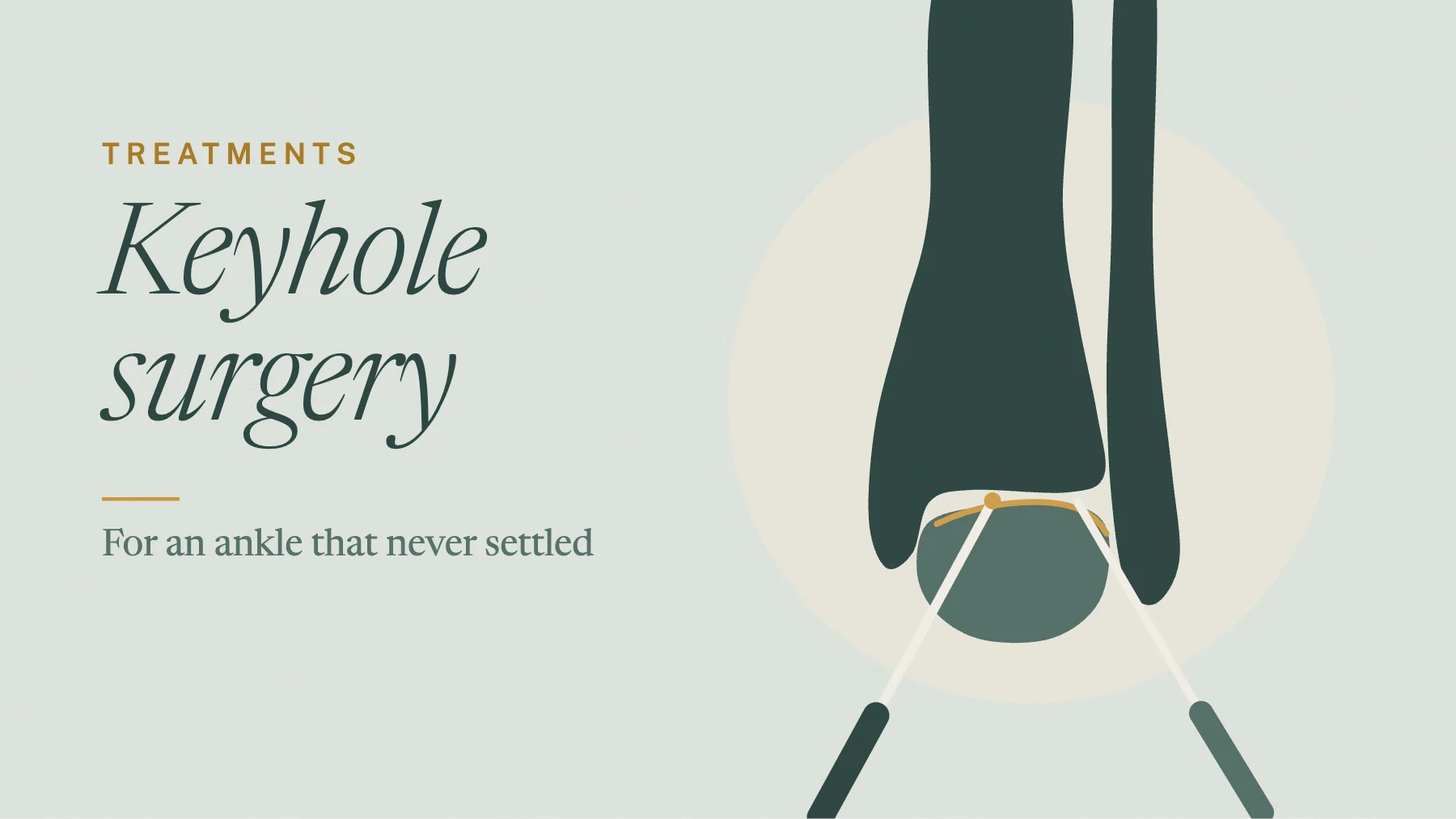
You rolled your ankle months ago. The swelling went down, but the ankle never felt right: it aches at the front when you squat or climb stairs, swells after sport, catches, or gives way on uneven ground. In a classic 1991 study, surgeons argued that the vague label “chronic sprain pain” should be dropped, because lingering pain after a sprain has several distinct causes, some of which can be found and treated inside the joint.[9]
Why some ankles never settle
Most sprains heal well, but not all. A review of 31 studies found that 5% to 33% of people still had pain a year after a sprain, and only 36% to 85% reported a full recovery within three years.[1]
When the ankle keeps giving way, the damage often goes beyond the ligament:
- Cartilage injuries. A meta-analysis of 2,170 ankles with chronic instability found a cartilage lesion in 32.2%, most of them on the talus, the bone at the bottom of the ankle joint.[2] In an earlier series of 148 patients, 66% of ankles with an outer ligament injury had cartilage damage.[10]
- Problems imaging can miss. In a 2026 series of 179 patients, more than half had another problem inside the joint, most often inflamed or scarred soft tissue catching in the joint (43.6%), and the diagnosis before surgery matched what the camera found in only about a quarter of cases.[11]
What ankle arthroscopy is
The surgeon usually makes two small incisions at the front of the ankle, passes in a slim camera and fine instruments, and works while watching a screen. Because the incisions are small, there is less damage to the surrounding soft tissue than with an open operation, and the camera can show cartilage damage and inflamed tissue that an MRI or CT may not.[3] Most patients go home a few hours after surgery.[4]
What it treats, and how well
Bone spurs and scar tissue pinching the front of the ankle
This is called anterior impingement, and it causes pain at the front of the ankle when the foot bends upward, as in squatting, climbing or running uphill.
- Across 28 studies (1,506 patients), 81% had good or excellent results, and every study that measured function found it improved.[5] In an earlier review, 94% to 98% of patients said they would have the procedure again.[12]
- Without arthritis, results last. Followed for five to eight years, every patient without arthritis had a good or excellent result.[13]
- Athletes return. In 29 procedures on National Football League players, all returned to the same level of play, after an average of 8.4 weeks.[14]
- Scar tissue after a sprain. In 31 patients with pain lasting about two years after an injury, 26 had good or excellent results after the scar tissue was removed, and athletes returned to sport after about six weeks on average.[9]
Spurs can regrow on X-ray, but in a five-year study function stayed improved even when they did.[15]
Cartilage injuries of the talus
For small cartilage injuries, the surgeon removes the damaged cartilage and makes tiny channels in the bone beneath it, so that marrow cells can form a repair tissue. This can be done through the arthroscope.
- About 85% success across the studies of this technique in a systematic review, which called it the treatment of choice for a first operation.[6]
- Return to sport: 88% returned to sport, and 79% to their previous level.[7]
- Return to work: 96% after arthroscopic procedures.[16]
Size matters. In one study, lesions smaller than 150 mm² failed in 10.5%, against 80% for larger ones.[17] A later review suggests the technique suits lesions under about 1 cm² best.[18] Larger lesions call for other techniques; see the Center’s page on ankle cartilage repair (external site).
An ankle that keeps giving way
When the outer ligaments have stretched out, they can be tightened and repaired (the Broström repair), and arthroscopy now lets surgeons do this through small incisions too:
- Same stability, fewer wound problems. A meta-analysis found arthroscopic and open repair gave the same stability, with fewer wound complications after arthroscopy.[19] A 2026 meta-analysis of 1,426 patients found slightly better pain and function scores and a shorter return to work with arthroscopic repair.[20] A randomized trial found the two gave the same results at one year or more.[21]
- A quicker recovery. In a randomized trial of ligament reconstruction using a tendon graft (a larger operation than the Broström repair), patients treated arthroscopically were walking fully weight-bearing at 8.9 weeks, against 11.7 weeks after open surgery, and back to recreational sport at 22.4 weeks, against 26.5.[22]
- Nothing missed. Because more than half of these ankles have another problem inside the joint, looking in with the camera during the repair lets the surgeon find it and, where needed, treat it in the same operation.[11]
Our article on ankles that keep rolling covers balance training and bracing, which come first.
How safe it is
A 2023 review of 7,942 ankle arthroscopies found complications in 4.09% and serious complications in 0.2%.[8] The most common problem is injury to a small skin nerve near an incision, most often the superficial peroneal nerve, which causes numbness or tingling on the top of the foot. Most of these settle, though in that review about 1 in 5 nerve injuries was permanent.[8] Infection occurred in about 2%, most of it superficial.[23]
What it can’t do
Arthroscopy works best for a specific problem that can be seen and treated. A review of the evidence advised against it for general ankle arthritis, apart from isolated bone spurs,[24] and in one study good or excellent results fell to 53% when the joint space had already narrowed from arthritis.[13] Most of the evidence comes from case series rather than randomized trials,[24] and we are not aware of a trial comparing arthroscopy directly with continued non-surgical care.
What recovery looks like
Recovery depends on what is treated:
- Scar tissue or bone spurs: on average about 6 to 9 weeks to return to sport in two studies, one of them in professional football players.[9,14]
- Cartilage repair: a period of protected weight-bearing, with return to sport taking roughly 13 to 26 weeks across studies.[7]
- Ligament surgery: rehabilitation, with full weight-bearing at about two months after arthroscopic ligament reconstruction in one trial.[22]
How we decide
Dr. Efe Ozturk is a Foot and Ankle Surgeon and podiatrist. We examine the ankle, take X-rays and ultrasound at the practice, and order an MRI when it will change the plan. Bracing, balance and strength training come first. If the ankle still hurts, swells, catches or gives way after a fair trial, arthroscopy is performed through our Center for Lower Extremity Surgery (external site). Not sure whether your ankle was sprained or broken? Read sprain or fracture.
Common questions
Will I stay in the hospital?
Usually not. Most patients go home a few hours after arthroscopic surgery.[4]
How big are the incisions?
About the size of a buttonhole, usually two at the front of the ankle.[4,3]
Can bone spurs come back?
They can regrow on X-ray, but in a five-year study, function stayed improved even when they did.[15]
Is it worth it if my MRI looked normal?
Possibly. The camera can show cartilage damage and inflamed tissue that an MRI may not. In one series of patients already having surgery for an unstable ankle, soft tissue pinching the joint was suspected before surgery in only 2 patients but found with the camera in 78.[3,11]
When to see a podiatrist
About the author
Dr. Efe Ozturk
Foot and Ankle Surgeon. Dr. Ozturk is double board certified, as a Diplomate of the American Board of Podiatric Medicine (DABPM) and a Fellow of the Academy of Physicians in Wound Healing (FAPWH), and is a Fellow of the American Society of Podiatric Surgeons (FASPS) and the American Society of Podiatric Medicine (FASPM). Trained in forefoot and rearfoot reconstructive surgery at Morristown Medical Center; sees patients in Lyndhurst, Paramus and Millburn.
Where to be seen
Dr. Ozturk sees patients at each of these offices, and one phone number reaches all of them.
References
- 1.van Rijn RM, van Os AG, Bernsen RM, et al. What is the clinical course of acute ankle sprains? A systematic literature review. Am J Med. 2008;121(4):324-331.e6. PubMed 18374692 (external site)
- 2.Wijnhoud EJ, Rikken QGH, Dahmen J, et al. One in Three Patients With Chronic Lateral Ankle Instability Has a Cartilage Lesion. Am J Sports Med. 2023;51(7):1943-1951. PubMed 35384745 (external site)
- 3.Hermena S, Bergman R, Dalgleish S. Ankle Arthroscopy. In: StatPearls. StatPearls Publishing; updated 2025. PubMed 40991763 (external site)
- 4.American Academy of Orthopaedic Surgeons. Arthroscopy. OrthoInfo. orthoinfo.org (external site)
- 5.Gianakos AL, Ivander A, DiGiovanni CW, et al. Outcomes After Arthroscopic Surgery for Anterior Impingement in the Ankle Joint in the General and Athletic Populations: Does Sex Play a Role? Am J Sports Med. 2021;49(10):2834-2842. PubMed 33400547 (external site)
- 6.Zengerink M, Struijs PA, Tol JL, van Dijk CN. Treatment of osteochondral lesions of the talus: a systematic review. Knee Surg Sports Traumatol Arthrosc. 2010;18(2):238-46. PubMed 19859695 (external site)
- 7.Steman JAH, Dahmen J, Lambers KTA, Kerkhoffs GMMJ. Return to Sports After Surgical Treatment of Osteochondral Defects of the Talus: A Systematic Review of 2347 Cases. Orthop J Sports Med. 2019;7(10):2325967119876238. PubMed 31673563 (external site)
- 8.Arshad Z, Aslam A, Al Shdefat S, et al. Complications following ankle arthroscopy. Bone Joint J. 2023;105-B(3):239-246. PubMed 36854323 (external site)
- 9.Ferkel RD, Karzel RP, Del Pizzo W, et al. Arthroscopic treatment of anterolateral impingement of the ankle. Am J Sports Med. 1991;19(5):440-446. PubMed 1962707 (external site)
- 10.Hintermann B, Boss A, Schäfer D. Arthroscopic findings in patients with chronic ankle instability. Am J Sports Med. 2002;30(3):402-409. PubMed 12016082 (external site)
- 11.Vermorel PH, Vega J, Dalmau-Pastor M, et al. Arthroscopic findings and accuracy of preoperative diagnosis in patients with chronic lateral ankle instability. J Exp Orthop. 2026;13(2):e70739. PubMed 42282263 (external site)
- 12.Zwiers R, Wiegerinck JI, Murawski CD, Fraser EJ, Kennedy JG, van Dijk CN. Arthroscopic Treatment for Anterior Ankle Impingement: A Systematic Review of the Current Literature. Arthroscopy. 2015;31(8):1585-96. PubMed 25801044 (external site)
- 13.Tol JL, Verheyen CP, van Dijk CN. Arthroscopic treatment of anterior impingement in the ankle. J Bone Joint Surg Br. 2001;83(1):9-13. PubMed 11245545 (external site)
- 14.McCrum CL, Arner JW, Lesniak B, Bradley JP. Arthroscopic Anterior Ankle Decompression Is Successful in National Football League Players. Am J Orthop (Belle Mead NJ). 2018;47(1). PubMed 29447303 (external site)
- 15.Walsh SJ, Twaddle BC, Rosenfeldt MP, Boyle MJ. Arthroscopic treatment of anterior ankle impingement: a prospective study of 46 patients with 5-year follow-up. Am J Sports Med. 2014;42(11):2722-2726. PubMed 25261086 (external site)
- 16.Emanuel KS, van Beelen S, Dahmen J, et al. Return to work after surgical treatment of osteochondral defects of the talus: a systematic review and meta-analysis. Cartilage. 2026. Online ahead of print. PubMed 42240238 (external site)
- 17.Choi WJ, Park KK, Kim BS, Lee JW. Osteochondral lesion of the talus: is there a critical defect size for poor outcome? Am J Sports Med. 2009;37(10):1974-1980. PubMed 19654429 (external site)
- 18.Ramponi L, Yasui Y, Murawski CD, Ferkel RD, DiGiovanni CW, Kerkhoffs GMMJ, et al. Lesion Size Is a Predictor of Clinical Outcomes After Bone Marrow Stimulation for Osteochondral Lesions of the Talus: A Systematic Review. Am J Sports Med. 2017;45(7):1698-1705. PubMed 27852595 (external site)
- 19.Moorthy V, Sayampanathan AA, Yeo NEM, Tay KS. Clinical Outcomes of Open Versus Arthroscopic Broström Procedure for Lateral Ankle Instability: A Meta-analysis. J Foot Ankle Surg. 2021;60(3):577-584. PubMed 33509712 (external site)
- 20.Cho T, Jones C, Chaudry S, Liu J. Meta-analysis of surgical approaches to lateral ankle instability: open Broström versus arthroscopic Broström versus lasso-loop repair. J Orthop. 2026;74:323-331. PubMed 41685056 (external site)
- 21.Yeo ED, Lee KT, Sung IH, et al. Comparison of All-Inside Arthroscopic and Open Techniques for the Modified Broström Procedure for Ankle Instability. Foot Ankle Int. 2016;37(10):1037-1045. PubMed 27623732 (external site)
- 22.Su T, Wang AH, Guo QW, et al. Both Open and Arthroscopic All-Inside Anatomic Reconstruction With Autologous Gracilis Tendon Restore Ankle Stability in Patients With Chronic Lateral Ankle Instability. Arthroscopy. 2023;39(4):1035-1045. PubMed 36631354 (external site)
- 23.De Fazio A, Bocchi MB, Miele G, et al. Epidemiology and Treatment of Surgical Infection after Ankle Arthroscopy: A Systematic Review. J Clin Med. 2024;13(4):983. PubMed 38398296 (external site)
- 24.Glazebrook MA, Ganapathy V, Bridge MA, et al. Evidence-based indications for ankle arthroscopy. Arthroscopy. 2009;25(12):1478-1490. PubMed 19962076 (external site)
This is general health information and isn’t a substitute for advice from a clinician who knows your history. Read our medical disclaimer and how we write and review content.
More from the blog
Treatments
Tenex and TenJet: minimally invasive treatment for stubborn plantar fasciitis and Achilles tendinitis
When heel or Achilles pain hasn’t improved after months of good care, the next step doesn’t have to be open surgery. How Tenex and TenJet work, what the studies show, and who they suit.
Treatments
Broken ankle: when you need surgery, and when a cast or boot is enough
Many broken ankles heal without an operation. How stability is judged, what the trials show for casts versus surgery, and what recovery looks like.
Treatments
Minimally invasive bunion surgery: what the research says, and who it suits
Studies show less early pain and a smaller scar, similar results at a year, and real trade-offs. What the evidence says, and who it suits.