Can Achilles tendonitis lead to a rupture? Warning signs, and when surgery is the fix
Why a worn Achilles can tear with little warning, what raises the risk, how the Thompson test spots a rupture, and where surgery fits for stubborn tendonitis and for a tear, with the latest on Mike Evans.

By Dr. Efe Ozturk
· 6 min read
Medically reviewed by Dr. Efe Ozturk · Last reviewed
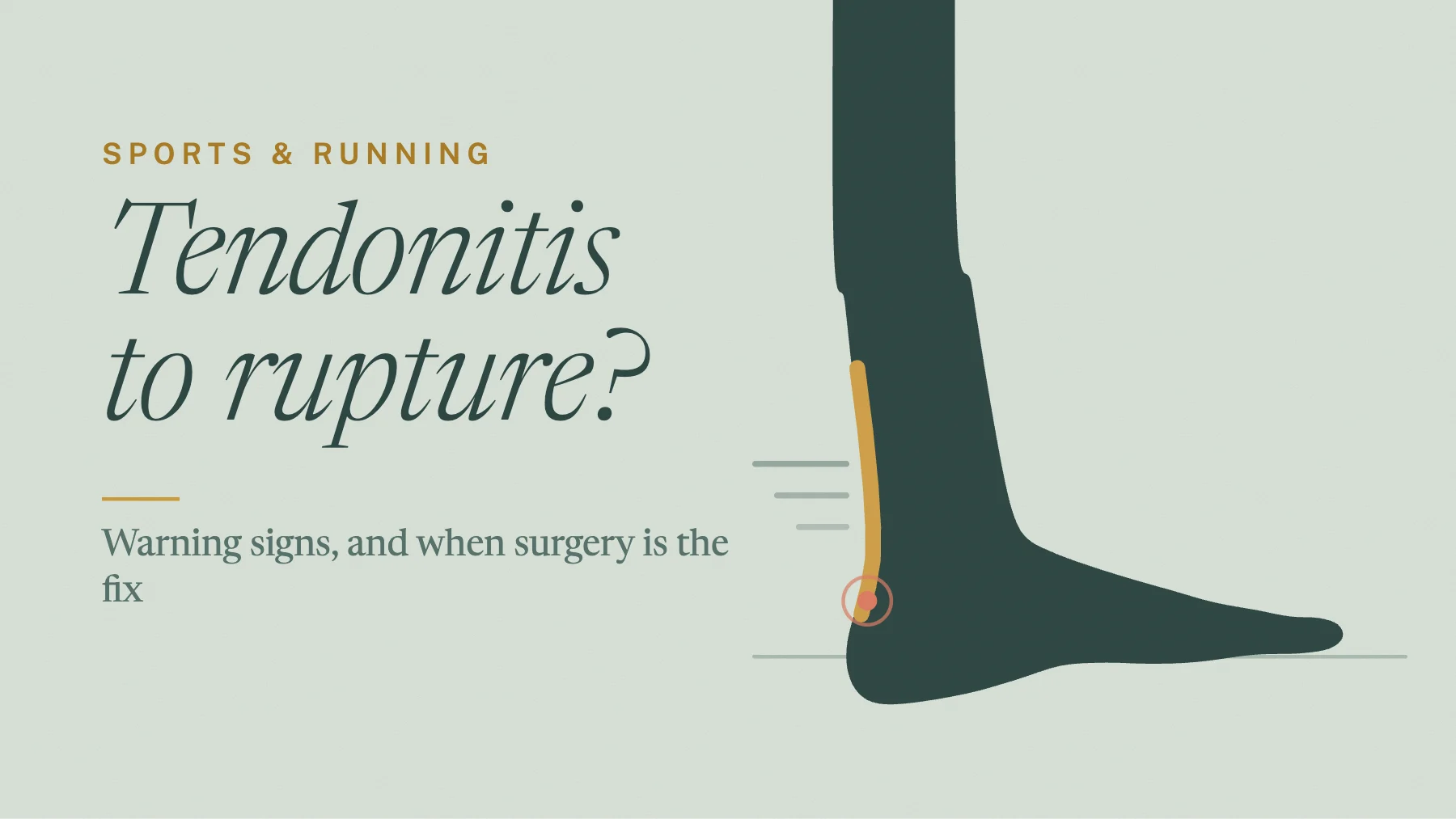
An NFL star’s sore Achilles has a lot of people asking the same thing about their own: can Achilles tendonitis lead to rupture? Here’s what the research says, the warning signs to know, and where surgery fits.
A note first: we have no connection with Mike Evans or the 49ers and haven’t examined him. Details come from public reports as of November 9, 2026. Nothing here suggests he will tear his tendon.
What was reported about Mike Evans’s Achilles
Evans left the 49ers’ October 19 Monday night win over Washington with a sore right Achilles. Coach Kyle Shanahan said Evans has Achilles tendinitis and has had it before.[9] On November 6, the Associated Press reported he would miss a second straight game.[6] On November 8, NFL Network’s Mike Garafolo called him questionable at best for the Week 10 game against Dallas.[7]
Can Achilles tendonitis lead to rupture?
The tendon usually wears before it tears. In the 891-person study, 397 of the torn tendons were Achilles tendons. Two-thirds of comparison tendons from healthy people looked normal, but no torn tendon did. The researchers concluded that wear is common after age 35 and is linked with tears that happen without a big injury.[1]
Tendonitis can hide a partial tear. In 342 tendons operated on for long-lasting Achilles pain, surgeons found a partial tear in 23%. Earlier steroid shots and being male predicted a tear.[10]
But pain is a poor alarm. In a UK emergency department study, 46.2% of people with a rupture had a previous rupture or tendinopathy (long-term tendon damage), yet only 23.3% reported Achilles pain before the rupture.[2] A 2023 review rated tendinopathy as a possible risk factor, with low to very low certainty.[11] So no pain doesn’t mean a healthy tendon, and a painful tendon is not doomed to tear.
Achilles tendinitis rupture risk: what raises it
- Fluoroquinolone antibiotics. Across 15 studies, this antibiotic family was linked with about 2.5 times the odds of rupture, and the risk held in people 60 and older.[12] Risk differs by drug: about 0.17% of people had an Achilles problem on ciprofloxacin or levofloxacin, and 1.4% on ofloxacin.[13] If you have Achilles pain, tell whoever prescribes one. Don’t stop a medicine on your own.
- Steroid shots. In a study of 947 ruptures, steroid shots were linked with 2.2 times the odds.[14] Experts advise against cortisone shots into the Achilles, since they can lead to a tear.[3] See our guide to cortisone shots in the foot.
- Other factors. Men had 3 times the odds, and people with obesity twice the odds. Rheumatoid arthritis (1.9 times) and steroid pills (1.4 times) also added risk.[14] Diabetes and inflammatory diseases can weaken the tendon too.[8]
Achilles tendinitis rupture symptoms: the warning signs
A full rupture. Many people hear a pop. Severe heel pain and swelling follow, and walking on that leg or rising onto your toes may be impossible.[8]
A partial tear. It is easy to mistake for a bad flare-up. Look for pain that starts sharply, a tendon you can’t fully load, one tender spot and weak heel raises.[15]
The Thompson test
We squeeze your calf and watch whether your foot moves. If it doesn’t, the tendon may be torn.[8] In 174 people with a rupture, this calf squeeze test caught 96% of tears. In 28 people without one, it correctly cleared 93%.[16] Ultrasound shows whether there is a tear, and MRI shows its size and location.[8]
Don’t wait it out. In a Swedish hospital, 11% of ruptures weren’t treated for more than 14 days. In 84% of those, the patient delayed seeking care, while misdiagnosis was rare.[17] Repair works better soon after the injury, before the tendon shortens and scars.[8]
When surgery is the fix
For tendonitis that won’t heal
Strengthening comes first; our Achilles tendonitis treatment guide covers that path. When pain hasn’t improved after 6 months, surgery is considered. A surgeon can remove damaged tissue and bone spurs or lengthen a tight calf muscle. When more than half the tendon must be removed, a nearby tendon is moved in to support it.[3]
In a review of 801 tendons with midportion tendonitis (pain a few centimeters above the heel), surgery succeeded 83.4% of the time. Complications were 5.3% with small incisions and 10.5% with open surgery.[4] Small-incision options include Tenex for Achilles tendonitis.
After a rupture
Across 29 studies with more than 15,000 patients, re-rupture was 2.3% after surgery and 3.9% without it.[5] In 14 randomized trials, minimally invasive repair lowered re-rupture without a clear rise in complications, and those patients returned to work sooner than people treated without surgery.[18] After repair, 77.4% of 748 patients returned to sport, at a mean of 8.1 months.[19]
That includes tendons that hurt first. In 17 elite athletes with tendon problems before their rupture, all walked fully on the leg by 8 weeks after a small-incision repair, and they returned to full sport at about 4.8 months.[20]
A missed rupture still has a surgical answer. In the Swedish study, people who had surgery for a late rupture scored 77 out of 100 on a rupture symptom scale, versus 34 without surgery. They rated their recovery at 85% versus 40%.[17] Read more on our surgery site: Achilles rupture: surgery or not? (external site)
The limits. Surgery for a rupture had more complications than nonsurgical care (4.9% vs 1.6%), mostly infection. With accelerated early-motion rehab, the gap in re-rupture was no longer significant.[5] In a 2017 review of 23 studies, none compared surgery for midportion tendonitis with nonsurgical care.[21] The evidence linking tendinopathy to rupture is low to very low certainty.[11] Professional athletes returned to play after a rupture 76% of the time, at about 11 months.[22]
How we treat Achilles pain
Dr. Efe Ozturk is a Foot and Ankle Surgeon and podiatrist. We examine the whole tendon, do the Thompson test and use ultrasound at the practice, with an MRI arranged when needed. Tendonitis gets a loading program, such as our heel-drop exercises, and a clear plan if it stalls. A rupture gets a prompt talk about repair. See our Achilles tendon care. We see patients in Lyndhurst, Paramus and Millburn, NJ.
Common questions
Can Achilles tendonitis cause a tear?
Long-lasting tendonitis can hide one. Surgeons found a partial tear in 23% of tendons operated on for long-lasting Achilles pain.[10]
Can Achilles tendonitis heal on its own?
Most people get enough relief without surgery. It often takes a few months, and treating it early doesn’t always clear the pain within 3 months. Surgery is considered after 6 months without improvement.[3]
What does an Achilles rupture feel like?
Often a pop, then pain and swelling near the heel, and trouble standing on your toes.[8]
When to see a Foot and Ankle Surgeon or podiatrist
About the author
Dr. Efe Ozturk
Foot and Ankle Surgeon. Dr. Ozturk is double board certified, as a Diplomate of the American Board of Podiatric Medicine (DABPM) and a Fellow of the Academy of Physicians in Wound Healing (FAPWH), and is a Fellow of the American Society of Podiatric Surgeons (FASPS) and the American Society of Podiatric Medicine (FASPM). Trained in forefoot and rearfoot reconstructive surgery at Morristown Medical Center; sees patients in Lyndhurst, Paramus and Millburn.
Where to be seen
Dr. Ozturk sees patients at each of these offices, and one phone number reaches all of them.
References
- 1.Kannus P, Józsa L. Histopathological changes preceding spontaneous rupture of a tendon. A controlled study of 891 patients. J Bone Joint Surg Am. 1991;73(10):1507-1525. PubMed 1748700 (external site)
- 2.Briggs-Price S, Mangwani J, Houchen-Wolloff L, et al. Incidence, demographics, characteristics and management of acute Achilles tendon rupture: An epidemiological study. PLoS One. 2024;19(6):e0304197. PubMed 38905182 (external site)
- 3.American Academy of Orthopaedic Surgeons. Achilles Tendinitis. OrthoInfo. orthoinfo.org (external site)
- 4.Lohrer H, David S, Nauck T. Surgical treatment for achilles tendinopathy - a systematic review. BMC Musculoskelet Disord. 2016;17:207. PubMed 27165287 (external site)
- 5.Ochen Y, Beks RB, van Heijl M, et al. Operative treatment versus nonoperative treatment of Achilles tendon ruptures: systematic review and meta-analysis. BMJ. 2019;364:k5120. PubMed 30617123 (external site)
- 6.The Associated Press via Fox Sports. Receiver Mike Evans will miss his 2nd straight game for the 49ers with Achilles tendinitis. Published November 6, 2026. foxsports.com (external site)
- 7.NBC Sports (Kyle Dvorchak). Garafolo: Evans “questionable at best” for Week 10. Published November 8, 2026. nbcsports.com (external site)
- 8.American Academy of Orthopaedic Surgeons. Achilles Tendon Rupture (Tear). OrthoInfo. orthoinfo.org (external site)
- 9.ESPN (Nick Wagoner). Mike Evans unable to finish 49ers’ win, exits with Achilles soreness. Published October 19, 2026. espn.com (external site)
- 10.Aström M. Partial rupture in chronic Achilles tendinopathy. A retrospective analysis of 342 cases. Acta Orthop Scand. 1998;69(4):404-407. PubMed 9798451 (external site)
- 11.Xergia SA, Tsarbou C, Liveris NI, Hadjithoma M, Tzanetakou IP. Risk factors for Achilles tendon rupture: an updated systematic review. Phys Sportsmed. 2023;51(6):506-516. PubMed 35670156 (external site)
- 12.Alves C, Mendes D, Marques FB. Fluoroquinolones and the risk of tendon injury: a systematic review and meta-analysis. Eur J Clin Pharmacol. 2019;75(10):1431-1443. PubMed 31270563 (external site)
- 13.Sangiorgio A, Sirone M, Adravanti FM, Testa EA, Riegger M, Filardo G. Achilles tendon complications of fluoroquinolone treatment: a molecule-stratified systematic review and meta-analysis. EFORT Open Rev. 2024;9(7):581-588. PubMed 38949172 (external site)
- 14.Seeger JD, West WA, Fife D, Noel GJ, Johnson LN, Walker AM. Achilles tendon rupture and its association with fluoroquinolone antibiotics and other potential risk factors in a managed care population. Pharmacoepidemiol Drug Saf. 2006;15(11):784-792. PubMed 16456878 (external site)
- 15.Gatz M, Spang C, Alfredson H. Partial Achilles tendon rupture, a neglected entity: a narrative literature review on diagnostics and treatment options. J Clin Med. 2020;9(10):3380. PubMed 33096900 (external site)
- 16.Maffulli N. The clinical diagnosis of subcutaneous tear of the Achilles tendon. A prospective study in 174 patients. Am J Sports Med. 1998;26(2):266-70. PubMed 9548122 (external site)
- 17.Nilsson N, Larsson E, Dyrehag E, Carmont M, Brorsson A, Nilsson Helander K. Incidence, reason for treatment delay and patient-reported outcome of patients affected by a chronic Achilles tendon rupture in a Swedish population. BMC Musculoskelet Disord. 2026;27(1):371. PubMed 42067876 (external site)
- 18.Xu S, Xiao J, Li Y, Liu E, Qin Y, Shen X. Operative versus nonoperative management of acute Achilles tendon rupture: a systematic review and meta-analysis of clinical outcomes from randomized controlled trials. Ann Med. 2025;57(1):2537349. PubMed 41243574 (external site)
- 19.Cofano E, Colace S, Piro F, et al. Successful functional outcomes and return to sport rate can be achieved after surgery for acute Achilles tendon rupture: a systematic review. J Exp Orthop. 2025;12(4):e70469. PubMed 41164319 (external site)
- 20.Maffulli N, Longo UG, Maffulli GD, Khanna A, Denaro V. Achilles tendon ruptures in elite athletes. Foot Ankle Int. 2011;32(1):9-15. PubMed 21288429 (external site)
- 21.Baltes TPA, Zwiers R, Wiegerinck JI, van Dijk CN. Surgical treatment for midportion Achilles tendinopathy: a systematic review. Knee Surg Sports Traumatol Arthrosc. 2017;25(6):1817-1838. PubMed 26971111 (external site)
- 22.Johns W, Walley KC, Seedat R, Thordarson DB, Jackson B, Gonzalez T. Career Outlook and Performance of Professional Athletes After Achilles Tendon Rupture: A Systematic Review. Foot Ankle Int. 2021;42(4):495-509. PubMed 33218267 (external site)
This is general health information and isn’t a substitute for advice from a clinician who knows your history. Read our medical disclaimer and how we write and review content.
More from the blog
Sports & running
Broken ankle recovery time: when you can walk, drive and play again
A milestone-by-milestone timeline for a broken ankle, from first steps to driving, work and sport, and why fixing an unstable break lets you put weight on it sooner, with the news on the 49ers’ Gracen Halton.
Sports & running
Biggest sports injuries this week: Gracen Halton, Manuel Neuer, Lamine Yamal and more across the NFL, NBA, NHL, MLB and soccer
The new board: the biggest sports injuries across the NFL, NBA, NHL, MLB and the big soccer leagues as of November 9, 2026, weighted to the ankle and foot. One athlete is back from surgery, one more is headed for it, and each league has a lesson for everyday athletes.
Sports & running
High ankle sprain recovery time: by grade, and when surgery is needed
Why a high ankle sprain can take two weeks or three months, how a Foot and Ankle Surgeon tells a stable injury from an unstable one, and what suture-button (TightRope) surgery adds, with this week’s college football ankle news.