PRP injections for the foot and ankle: what the evidence says
Where PRP helps, where trials show it doesn’t, and what to expect from an injection.

By Efe Ozturk, DPM
· 3 min read
Medically reviewed by Efe Ozturk, DPM · Last reviewed
PRP is one of the most talked-about treatments in sports medicine, and the claims range from sensible to wildly overstated. Here’s what the research actually shows for the foot and ankle, so you can decide whether it’s worth it for you.
What PRP is
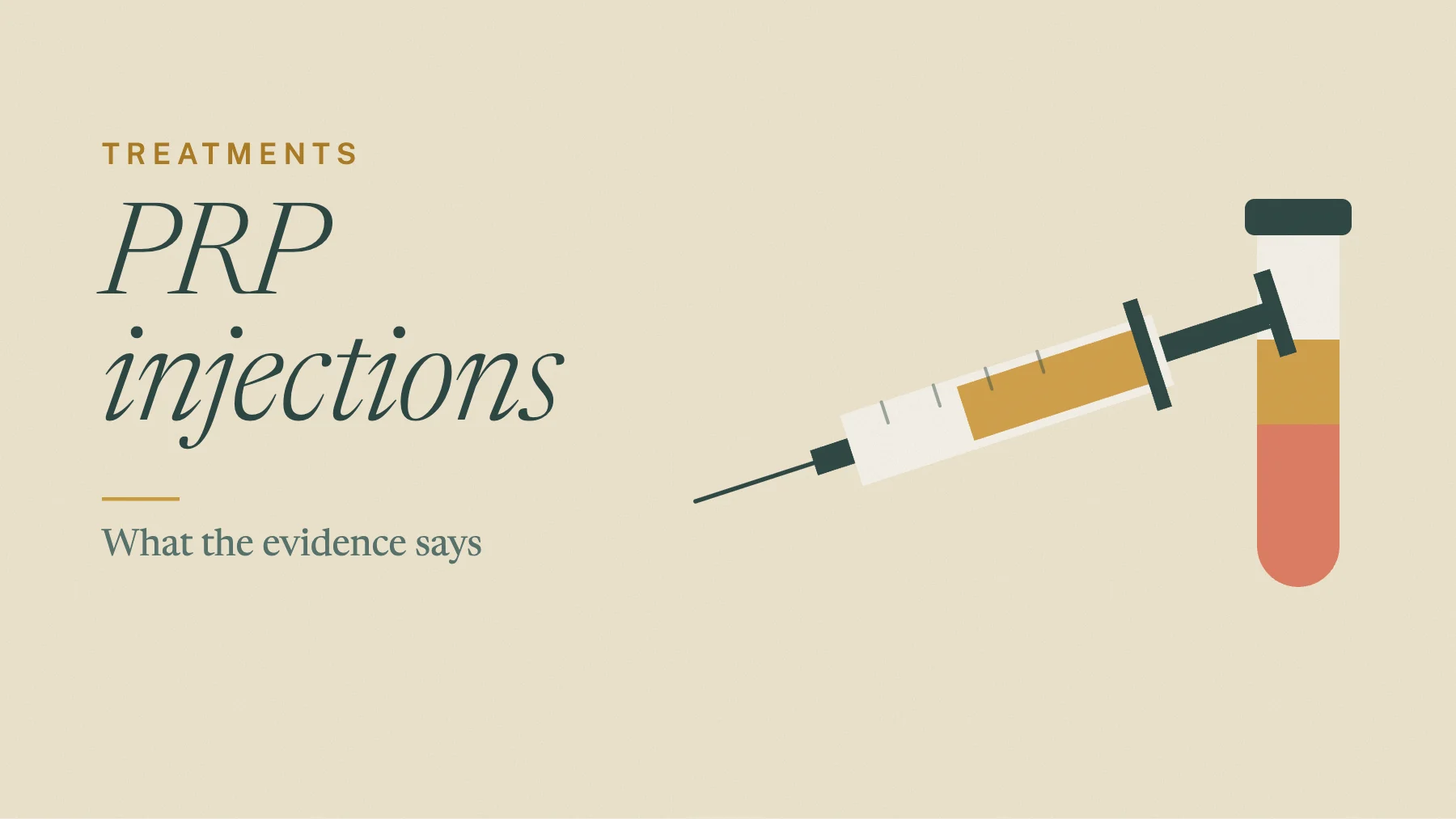
A small amount of blood is drawn from your arm and spun in a centrifuge to separate its parts. The layer rich in platelets, which carry growth factors involved in healing, is collected and injected into the injured tissue, often guided by ultrasound. The whole process takes less than an hour in the office.
Where PRP helps: plantar fasciitis
For chronic plantar fasciitis that hasn’t responded to stretching, footwear and inserts, the evidence is encouraging. A meta-analysis of 15 studies comparing PRP with corticosteroid injections found:
- no advantage for corticosteroid in the short term,
- better pain relief with PRP at three, six and twelve months,
- better function with PRP at six and twelve months.[1]
The authors cautioned that many studies had a high risk of bias, so the findings should be interpreted carefully.[1] Still, PRP is a reasonable option for stubborn heel pain, particularly for people who want to avoid repeated steroid injections. Shockwave therapy is another well-supported option at this stage.[5]
Where it doesn’t: Achilles tendinopathy and ankle arthritis
- Chronic Achilles tendinopathy: in a randomized trial published in JAMA, people doing eccentric exercises improved just as much with a saline injection as with PRP.[2] A 2025 meta-analysis of randomized trials found no benefit of PRP over placebo for pain or function, and concluded it shouldn’t be used for this condition until better trials show a benefit.[3]
- Ankle arthritis: a randomized trial found PRP injections did not improve symptoms or function over a year compared with placebo injections.[4]
For these conditions, other treatments have better evidence. See Achilles heel-drop exercises and arthritis.
What to expect if you have PRP
- A blood draw, then the injection, in one visit.
- Soreness for a few days is common.
- You may be asked to avoid anti-inflammatory medicine around the treatment, and to protect the area for a short time.
- Improvement, if it comes, builds over weeks to months.
- PRP is often not covered by insurance; we’ll confirm your cost first.
Common questions
Is PRP the same as a cortisone shot?
No. A cortisone shot is a steroid medicine that calms inflammation. PRP is a concentrate of your own platelets, intended to support the tissue’s healing response. For stubborn plantar fasciitis, PRP gave better pain relief than steroid injections from three months onward in the pooled studies.[1]
What about amniotic injections for heel pain?
In a network analysis of injection treatments for plantar fasciitis, dehydrated amniotic membrane injections relieved pain better than steroid injections in the first two months, but there was no information on how they did after that.[6] At our practice, amniotic and placental products are used in an operating-room setting rather than as office injections.
How many PRP injections will I need?
It varies: studies have used one injection or a short series. We reassess a few weeks after each one before recommending another, and don’t repeat an injection that hasn’t helped.
A word on “regenerative” claims
PRP supports healing in selected conditions; it doesn’t regrow tissue. Be cautious of clinics that promise it will fix everything. We’ll tell you plainly whether it’s likely to help your problem. See regenerative medicine, where we also explain the amniotic and bone marrow treatments used in surgery.
When to see a podiatrist

About the author
Efe Ozturk, DPM
Foot and Ankle Surgeon. Dr. Ozturk is double board certified, as a Diplomate of the American Board of Podiatric Medicine (DABPM) and a Fellow of the Academy of Physicians in Wound Healing (FAPWH), and is a Fellow of the American Society of Podiatric Surgeons (FASPS) and the American Society of Podiatric Medicine (FASPM). Trained in forefoot and rearfoot reconstructive surgery at Morristown Medical Center; sees patients in Lyndhurst, Paramus and Millburn.
References
- 1.Hohmann E, Tetsworth K, Glatt V. Platelet-Rich Plasma Versus Corticosteroids for the Treatment of Plantar Fasciitis: A Systematic Review and Meta-analysis. Am J Sports Med. 2021;49(5):1381-1393. PubMed 32822236 (external site)
- 2.de Vos RJ, Weir A, van Schie HT, et al. Platelet-rich plasma injection for chronic Achilles tendinopathy: a randomized controlled trial. JAMA. 2010;303(2):144-9. PubMed 20068208 (external site)
- 3.Barreto ESR, Antunes Júnior CR, Silva IC, Alencar VB, Faleiro TB, Kraychete DC. Is Platelet-rich Plasma Effective in Treating Achilles Tendinopathy? A Meta-analysis of Randomized Clinical Trials. Clin Orthop Relat Res. 2025;483(5):779-790. PubMed 39745256 (external site)
- 4.Paget LDA, Reurink G, de Vos RJ, et al. Platelet-Rich Plasma Injections for the Treatment of Ankle Osteoarthritis. Am J Sports Med. 2023;51(10):2625-2634. PubMed 37417359 (external site)
- 5.Cortés-Pérez I, Moreno-Montilla L, Ibáñez-Vera AJ, Díaz-Fernández Á, Obrero-Gaitán E, Lomas-Vega R. Efficacy of extracorporeal shockwave therapy, compared to corticosteroid injections, on pain, plantar fascia thickness and foot function in patients with plantar fasciitis: A systematic review and meta-analysis. Clin Rehabil. 2024;38(8):1023-1043. PubMed 38738305 (external site)
- 6.Tsikopoulos K, Vasiliadis HS, Mavridis D. Injection therapies for plantar fasciopathy ('plantar fasciitis'): a systematic review and network meta-analysis of 22 randomised controlled trials. Br J Sports Med. 2016;50(22):1367-1375. PubMed 27143138 (external site)
This is general health information and isn’t a substitute for advice from a clinician who knows your history. Read our medical disclaimer and how we write and review content.
More from the blog
Treatments
Does shockwave therapy work for heel pain? What the studies show
Shockwave therapy has strong evidence for stubborn heel pain. What the studies show, and where it fits.
Treatments
Custom vs. store-bought orthotics: what the research says
Custom orthotics aren’t automatically better. When store-bought works, and when custom is worth it.
Treatments
Class IV laser therapy for foot pain: what a session is like and what the research says
What a Class IV laser session is like, and an honest look at what the research shows.