Achilles heel-drop exercises: how to do them properly
Step-by-step instructions for the two exercise programs with the most evidence for Achilles tendinopathy.

By Efe Ozturk, DPM
· 3 min read
Medically reviewed by Efe Ozturk, DPM · Last reviewed
Exercise is the foundation of treatment for Achilles tendinopathy, and clinical guidelines are built around it.[4] Here are the two best-studied programs, and how to do them properly.
Option 1: The eccentric heel-drop program
This is the program from Håkan Alfredson’s 1998 study, in which recreational athletes whose Achilles pain hadn’t responded to other treatment returned to running after 12 weeks.[1]
How to do it:
- Stand on the edge of a step on the balls of both feet, holding a rail.
- Rise up onto your toes using both legs.
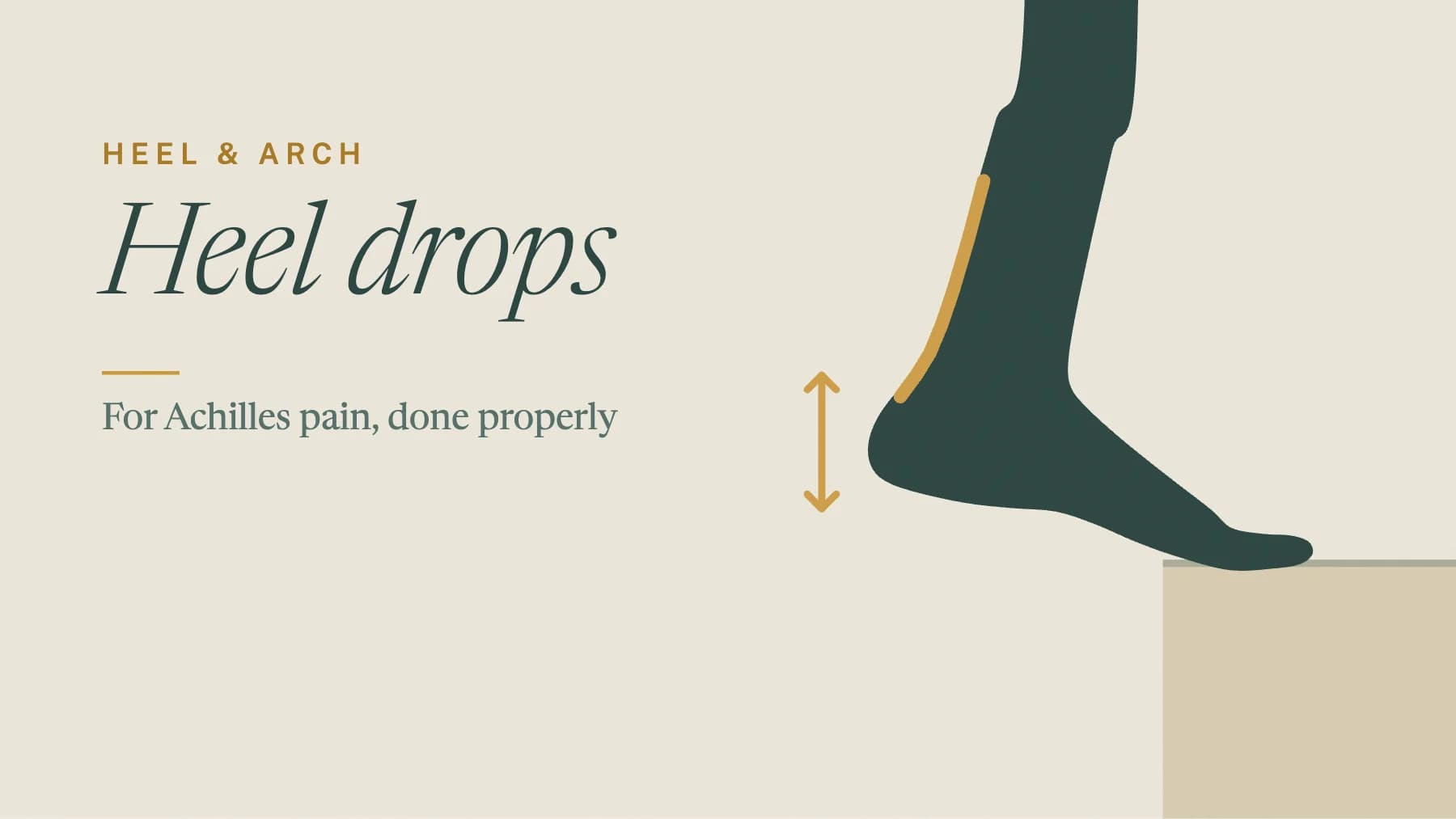
- Shift your weight onto the painful leg and slowly lower the heel below the level of the step, over about 3 seconds.
- Use both legs to come back up. The work is in the lowering.
- Do it with the knee straight (3 sets of 15), then again with the knee slightly bent (3 sets of 15).
- Twice a day, every day, for 12 weeks.
Progression: when it becomes easy, add weight in a backpack.
Option 2: Heavy, slow resistance
In a 2015 randomized trial, this program worked just as well as eccentric training at 12 weeks and at a year, and people were more likely to complete their sessions.[2]
How to do it:
- Three times a week (not daily).
- Seated heel raises (a weight on the knees, or a seated calf machine), standing heel raises on a step, and standing heel raises on a leg-press machine.
- Each rep slow: about 3 seconds up and 3 seconds down.
- Start around 15 reps per set, and increase the weight over the weeks so that you do fewer, heavier reps (down to about 6).
Which should you choose?
Both work. Pick the one you’ll actually do. Eccentric drops need no gym but are done twice a day; heavy slow resistance takes more equipment but only three sessions a week.
If your pain is at the heel
For insertional pain, where the tendon attaches to the heel bone, dropping the heel below the step compresses the tendon against the bone and can make it worse. Do the exercises on flat ground at first, stopping at level, and add range gradually.[3]
How much pain is OK?
Mild discomfort during the exercises is expected and doesn’t mean you’re doing harm. As a rule of thumb, pain up to about 3 out of 10 that settles by the next morning is acceptable. If the tendon is stiffer or more painful the following morning, reduce the load and build back more gradually.
Keep going
Tendons adapt slowly. Improvement usually starts after several weeks, and the full program takes about three months. Keep some calf strengthening going even after the pain settles, to protect against a recurrence.
When to get help
If you’ve been consistent for six to eight weeks without clear progress, or you’re not sure whether it’s the tendon at all, get it evaluated. See our Achilles tendon page and Achilles pain in runners.
When to see a podiatrist

About the author
Efe Ozturk, DPM
Foot and Ankle Surgeon. Dr. Ozturk is double board certified, as a Diplomate of the American Board of Podiatric Medicine (DABPM) and a Fellow of the Academy of Physicians in Wound Healing (FAPWH), and is a Fellow of the American Society of Podiatric Surgeons (FASPS) and the American Society of Podiatric Medicine (FASPM). Trained in forefoot and rearfoot reconstructive surgery at Morristown Medical Center; sees patients in Lyndhurst, Paramus and Millburn.
References
- 1.Alfredson H, Pietilä T, Jonsson P, Lorentzon R. Heavy-load eccentric calf muscle training for the treatment of chronic Achilles tendinosis. Am J Sports Med. 1998;26(3):360-6. PubMed 9617396 (external site)
- 2.Beyer R, Kongsgaard M, Hougs Kjær B, Øhlenschlæger T, Kjær M, Magnusson SP. Heavy Slow Resistance Versus Eccentric Training as Treatment for Achilles Tendinopathy: A Randomized Controlled Trial. Am J Sports Med. 2015;43(7):1704-11. PubMed 26018970 (external site)
- 3.American Academy of Orthopaedic Surgeons. Achilles Tendinitis. OrthoInfo. orthoinfo.org (external site)
- 4.Chimenti RL, Neville C, Houck J, Cuddeford T, Carreira D, Martin RL. Achilles Pain, Stiffness, and Muscle Power Deficits: Midportion Achilles Tendinopathy Revision - 2024. J Orthop Sports Phys Ther. 2024;54(12):CPG1-CPG32. PubMed 39611662 (external site)
This is general health information and isn’t a substitute for advice from a clinician who knows your history. Read our medical disclaimer and how we write and review content.
More from the blog
Heel & arch
Heel spurs: are they really the cause of your heel pain?
Most people with heel spurs have no heel pain. Where the pain really comes from, and what helps.
Heel & arch
Why does my heel hurt in the morning? Plantar fasciitis explained
That stab of pain with your first steps out of bed is the classic sign of plantar fasciitis. Here’s why it happens and what helps.
Heel & arch
Plantar fasciitis stretches and exercises that are backed by evidence
The heel pain exercises that have actually been tested in trials, and how to do them properly.