A bump on the back of the heel: Haglund’s deformity
A firm bump on the back of your heel that your shoes rub red has a name: Haglund’s deformity. Here’s why it hurts, and how to take the pressure off.

By Efe Ozturk, DPM
· 5 min read
Medically reviewed by Efe Ozturk, DPM · Last reviewed
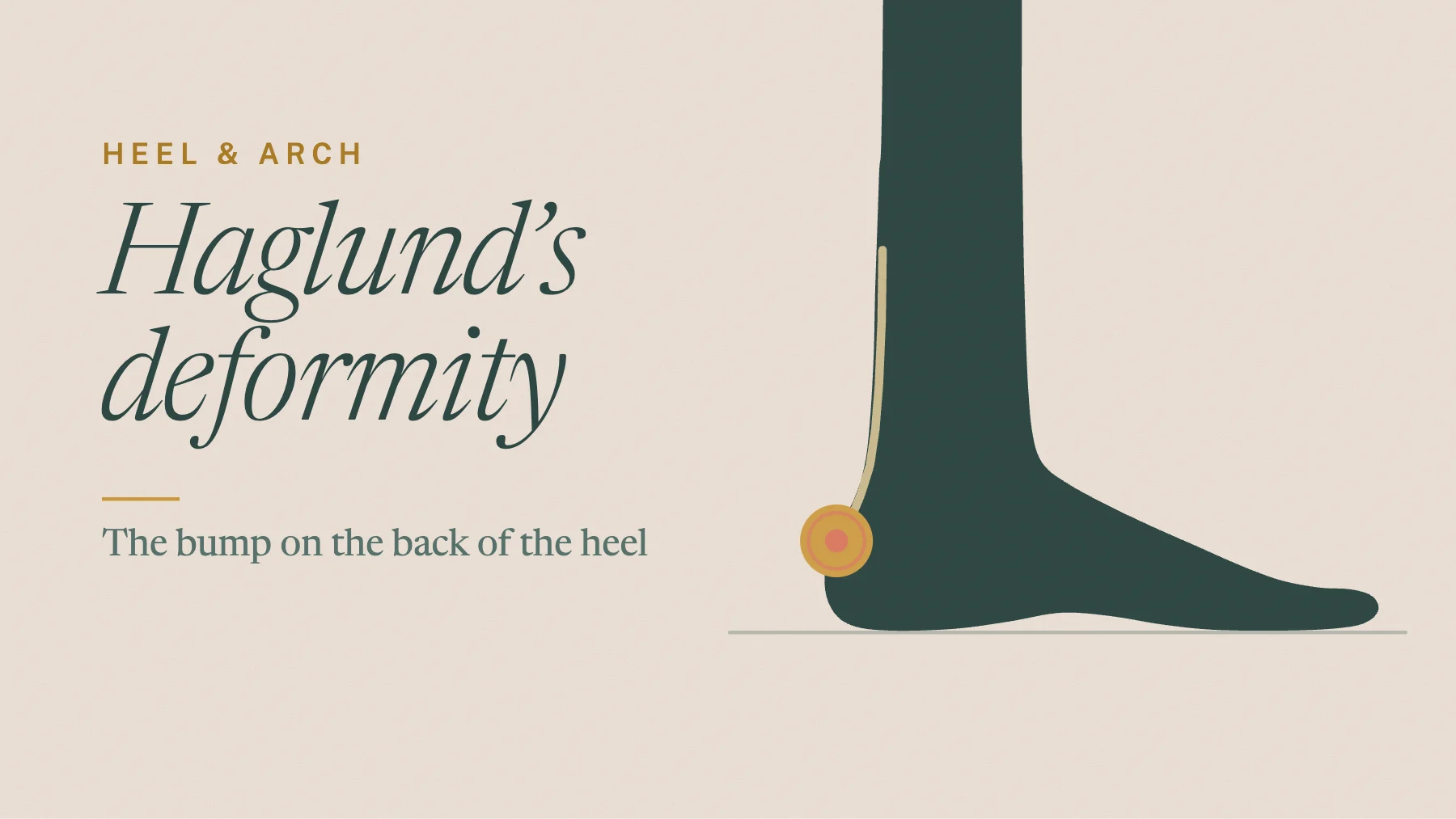
A firm bump on the back of your heel, and shoes that rub it red by evening: that’s the classic picture of Haglund’s deformity. Nonsurgical care won’t shrink the bump, but much of what makes it hurt can be changed.
What the bump is
Haglund’s deformity is a bony prominence at the upper back corner of the heel bone.[4] It grows near the spot where the Achilles tendon attaches, and it can appear in one foot or both.[2,1] Inherited traits that make it more likely include a high arch, a tight Achilles tendon and a tendency to walk on the outside of the heel.[1] It isn’t the same as the more familiar heel spur, which sits under the heel.
Its nickname, “pump bump,” comes from the rigid backs of pump-style shoes, which press on it as you walk. Ice skates, men’s dress shoes and any other shoe with a rigid back can do the same.[1]
Why it hurts: the bursa and the tendon
Between the Achilles tendon and the heel bone sits a bursa, a small fluid-filled sac. When the bump rubs against your shoe, the nearby soft tissue gets irritated, and the bursa often becomes inflamed, a problem called retrocalcaneal bursitis.[1,4] It’s seen more often in women aged 40 to 60 who have a Haglund’s deformity and a thickened Achilles tendon.[3]
The enlarged bone can also rub on the Achilles tendon itself and inflame it.[2] Pain right where the tendon attaches is called insertional Achilles tendinopathy, and tight calf muscles are a frequent cause.[2] Our guide to Achilles pain in runners explains how it differs from pain higher up the tendon.
Symptoms and diagnosis
Common signs are a noticeable bump on the back of the heel, pain where the Achilles tendon attaches, swelling at the back of the heel, and redness near the irritated tissue.[1] If the tendon is involved, the back of the heel may hurt in shoes, and the tendon can be painful and stiff in the morning.[2]
We check for swelling and tenderness at the back of the heel, heel pain when your calf is stretched, and limited ankle motion.[2] We have X-ray and ultrasound at the practice. X-rays show the shape of the heel bone and any spurs at the back of the heel.[1,2] Ultrasound can be done in the office, and it’s used more and more for heel pain.[2,3] An MRI isn’t needed to diagnose Achilles tendinitis, but it’s important for planning surgery if it comes to that.[2]
Taking the pressure off
Nonsurgical treatment aims to calm the inflamed bursa. It can relieve pain and inflammation, but the bony bump stays.[1] For both the bump and the bursitis, first-line treatment includes reducing pressure on the sore area.[3]
- Shoes. Backless or soft-backed shoes, or shoes open at the back of the heel, can reduce irritation.[1,2]
- Heel lifts and pads. A heel lift can ease strain on the tendon, and pads cushion the heel and may reduce irritation when you walk.[2,1]
- Ice and anti-inflammatory medicine to ease pain and swelling during a flare.[1]
- Activity changes. Cycling, swimming or the elliptical instead of running lowers the load on the tendon for a while.[2]
- A short spell in a boot for severe pain. Longer use is discouraged because it can weaken the calf muscle.[2]
Our Achilles tendon page covers the full range of care.
Stretching and strengthening, with one caution
Calf stretching helps relieve tension on the Achilles tendon, especially if your heel cord is tight.[1] Strengthening needs one change. Heel drops below the edge of a step are meant for pain higher up the tendon, not for insertional pain.[2] In a small pilot study, 27 people with long-standing insertional pain did a 12-week program that never lowered the heel past level. At follow-up, about four months on average, 67% were satisfied and back to their usual activity.[5] Our heel-drop exercise guide shows how to adapt them.
When surgery comes up
For Achilles tendinitis, surgery should be considered only if the pain hasn’t improved after six months of nonsurgical treatment.[2] The operation for Haglund’s typically removes the inflamed bursa, takes down the bony prominence and cleans up the damaged tendon.[4] In a review of 20 studies, both open and endoscopic approaches significantly improved function and patient satisfaction.[4] The Center for Lower Extremity Surgery explains Haglund’s deformity (external site) and the surgery (external site) in detail.
Common questions
Does shockwave therapy help?
The evidence is mixed. An earlier systematic review favored it for insertional Achilles pain, alone or with eccentric exercise.[6] A 2026 review of randomized trials found no clinically meaningful benefit over sham treatment for insertional pain (low to moderate certainty), and advised against routine use.[7]
Can I get a cortisone shot?
Cortisone injected into the Achilles tendon isn’t recommended, because it can make the tendon rupture.[2] An ultrasound-guided cortisone shot into the bursa may ease bursitis pain in the short term, but it raises the risk of an Achilles tendon rupture.[3]
When to see a podiatrist

About the author
Efe Ozturk, DPM
Foot and Ankle Surgeon. Dr. Ozturk is double board certified, as a Diplomate of the American Board of Podiatric Medicine (DABPM) and a Fellow of the Academy of Physicians in Wound Healing (FAPWH), and is a Fellow of the American Society of Podiatric Surgeons (FASPS) and the American Society of Podiatric Medicine (FASPM). Trained in forefoot and rearfoot reconstructive surgery at Morristown Medical Center; sees patients in Lyndhurst, Paramus and Millburn.
References
- 1.American College of Foot and Ankle Surgeons. Haglund’s Deformity. FootHealthFacts. foothealthfacts.org (external site)
- 2.American Academy of Orthopaedic Surgeons. Achilles Tendinitis. OrthoInfo. orthoinfo.org (external site)
- 3.Morancie NA, Irvin L, Rayala BZ. Heel Pain: Diagnosis and Management. Am Fam Physician. 2025;112(6):648-656. PubMed 41533410 (external site)
- 4.Yuen WLP, Tan PT, Kon KKC. Surgical Treatment of Haglund’s Deformity: A Systematic Review and Meta-Analysis. Cureus. 2022;14(7):e27500. PubMed 36060327 (external site)
- 5.Jonsson P, Alfredson H, Sunding K, Fahlström M, Cook J. New regimen for eccentric calf-muscle training in patients with chronic insertional Achilles tendinopathy: results of a pilot study. Br J Sports Med. 2008;42(9):746-9. PubMed 18184750 (external site)
- 6.Zhi X, Liu X, Han J, Xiang Y, Wu H, Wei S, et al. Nonoperative treatment of insertional Achilles tendinopathy: a systematic review. J Orthop Surg Res. 2021;16(1):233. PubMed 33785026 (external site)
- 7.Korakakis V, Kotsifaki R, Sotiralis Y, Malliaras P. Shockwave Therapy for Midportion and Insertional Achilles Tendinopathy: A Nail in the Coffin? A Systematic Review With Meta-Analysis. J Orthop Sports Phys Ther. 2026;56(5):282-299. PubMed 42063301 (external site)
This is general health information and isn’t a substitute for advice from a clinician who knows your history. Read our medical disclaimer and how we write and review content.
More from the blog
Heel & arch
Heel spurs: are they really the cause of your heel pain?
Most people with heel spurs have no heel pain. Where the pain really comes from, and what helps.
Heel & arch
Why does my heel hurt in the morning? Plantar fasciitis explained
That stab of pain with your first steps out of bed is the classic sign of plantar fasciitis. Here’s why it happens and what helps.
Heel & arch
Plantar fasciitis stretches and exercises that are backed by evidence
The heel pain exercises that have actually been tested in trials, and how to do them properly.