Turf toe: the big-toe sprain athletes shouldn’t ignore
A sprain of the big-toe joint that can sideline athletes. Grades, treatment and return to play.

By Efe Ozturk, DPM
· 3 min read
Medically reviewed by Efe Ozturk, DPM · Last reviewed
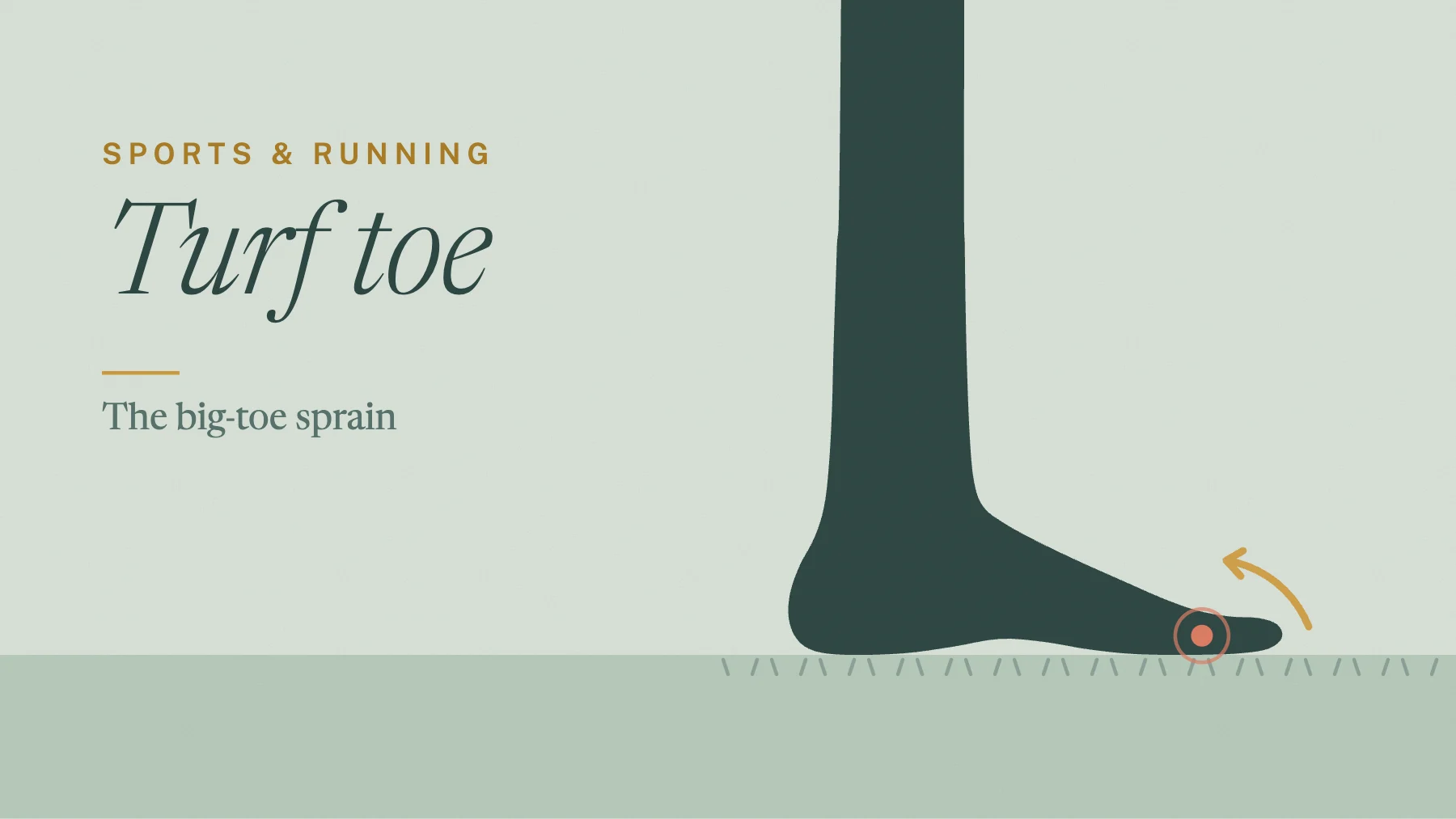
Turf toe got its name from football on artificial turf, where the hard surface and flexible cleats let the big toe bend back further than it should. But it happens on grass, on basketball courts and on dance floors too. It sounds minor. It isn’t always.
What happens
The big-toe joint (the first metatarsophalangeal, or MTP, joint) is supported underneath by a tough capsule and ligament complex called the plantar plate, along with two small bones called sesamoids. When the toe is forced upward, for example when a player’s foot is planted with the heel up and someone lands on the back of their leg, that complex can stretch or tear.[1]
Symptoms
- Pain at the base of the big toe, especially pushing off.
- Swelling and bruising around the joint.
- Stiffness and loss of upward motion.
- In severe injuries, a feeling of instability, or the big toe drifting.
Grades
- Grade I: a stretch of the soft tissues. Mild pain and swelling; you can often keep playing.
- Grade II: a partial tear. More pain, swelling and bruising, and limited motion.
- Grade III: a complete tear, sometimes with injury to the sesamoids or the joint surface. Significant pain, and the joint may be unstable.[1]
Diagnosis
We examine the joint for tenderness, swelling, motion and stability, and take X-rays at the practice, sometimes comparing both feet, to look for fractures and the position of the sesamoids. An MRI shows the soft tissues when a higher-grade injury is suspected.
Treatment and return to play
- Grade I: rest, ice, taping to limit upward bend of the toe, and a stiff shoe insert. Return when pain is minimal with normal weight-bearing and push-off.[1]
- Grade II: a walking boot or stiff-soled shoe for a period, then rehabilitation.
- Grade III: immobilization, and sometimes surgery to repair the torn structures.
Rehabilitation after non-operative treatment typically runs in three phases over up to about ten weeks; after surgery it’s longer, up to about five months. Fewer than 2% of turf toe injuries need an operation.[1]
Protecting against it
- Stiffer-soled shoes or a carbon-fiber plate insert for athletes who’ve had turf toe before.
- Strong calves and foot muscles.
- Taping for return to sport after an injury.
Common questions
Can I play through it?
With a mild (grade I) sprain, often yes, with taping and a stiff insert that stop the toe bending too far. Higher-grade injuries need protection first: playing on a torn plantar plate risks turning a sprain into an unstable joint.[1]
Will I need surgery?
Probably not. Turf toe injuries have become more common in recent years, and most are treated without an operation: rest, ice, compression, immobilization when needed, and a dedicated rehabilitation program.[2] Surgery is for the minority where the structures under the joint are torn and the joint is unstable, and athletes can expect to return to play afterward.[2,1]
Is it the same as a stubbed or broken toe?
No. A stubbed toe is usually a bruise, and a broken toe is a crack in one of the small bones. Turf toe is an injury to the ligaments and capsule under the big-toe joint from bending it too far upward, and it is diagnosed by examining the joint’s stability; X-rays rule out a fracture.
Why it’s worth taking seriously
An untreated higher-grade turf toe can lead to ongoing pain, stiffness, a drifting big toe and, later, arthritis in the joint. Getting the grade right early is what keeps a small injury small. Our sports medicine page explains how we plan a return to play.
When to see a podiatrist
About the author
Efe Ozturk, DPM
Foot and Ankle Surgeon. Dr. Ozturk is double board certified, as a Diplomate of the American Board of Podiatric Medicine (DABPM) and a Fellow of the Academy of Physicians in Wound Healing (FAPWH), and is a Fellow of the American Society of Podiatric Surgeons (FASPS) and the American Society of Podiatric Medicine (FASPM). Trained in forefoot and rearfoot reconstructive surgery at Morristown Medical Center; sees patients in Lyndhurst, Paramus and Millburn.
References
- 1.Gupta A, Singh PK, Xu AL, Bronheim RS, McDaniel CM, Aiyer AA. Turf Toe Injuries in the Athlete: an Updated Review of Treatment Options, Rehabilitation Protocols, and Return-to-Play Outcomes. Curr Rev Musculoskelet Med. 2023;16(11):563-574. PubMed 37789169 (external site)
- 2.Waldrop NE 3rd. Assessment and Treatment of Sports Injuries to the First Metatarsophalangeal Joint. Foot Ankle Clin. 2021;26(1):1-12. PubMed 33487233 (external site)
This is general health information and isn’t a substitute for advice from a clinician who knows your history. Read our medical disclaimer and how we write and review content.
More from the blog
Sports & running
Pain on the outside of the ankle: peroneal tendon problems
Ankle pain that won’t settle after a sprain may be the peroneal tendons. The signs, and how they’re treated.
Sports & running
Pickleball foot and ankle injuries: how to play longer and hurt less
Pickleball injuries are rising fast. The foot and ankle injuries to know, and how to keep playing without them.
Sports & running
Sprained ankle recovery: the first 72 hours and getting back to sport
A week-by-week plan for a sprained ankle, from the first days to getting back to your sport.