Wound Care Specialist: What They Do and When You Need One
A wound care specialist finds out why a wound won’t heal and treats that cause. Here, that doctor is also a Foot and Ankle Surgeon who can perform the operation that fixes it.
Medically reviewed by Dr. Efe Ozturk · Last reviewed
Published 7 min read
Many people search for a wound care specialist after weeks of ointments and bandages. Here is why a surgeon’s training matters, what a specialist does, the signs you need one, and how care works at our offices.
Why does it matter if your wound care specialist is a surgeon?
Many wounds stay open for a reason a dressing can’t reach. The international diabetic foot guideline warns that even excellent local wound care can’t make up for untreated infection, poor blood flow or continued pressure.[3] Several of those causes are treated with surgery:
- Deep infection. For moderate and severe diabetic foot infections, the guideline suggests considering surgery within 24 to 48 hours, and it calls a surgical opinion essential in judging severe cases.[4]
- Pressure that won’t let up. When a device hasn’t healed an ulcer under the ball of the foot, the guideline suggests considering surgery such as Achilles lengthening. For an ulcer on a flexible bent toe, a tendon release is a recommended first-line treatment. These operations change the foot itself, so the relief depends less on wearing a device.[5]
- Dead tissue. Sharp debridement, with a scalpel or similar instrument, is standard care, and extensive dead tissue calls for an urgent surgical opinion.[6]
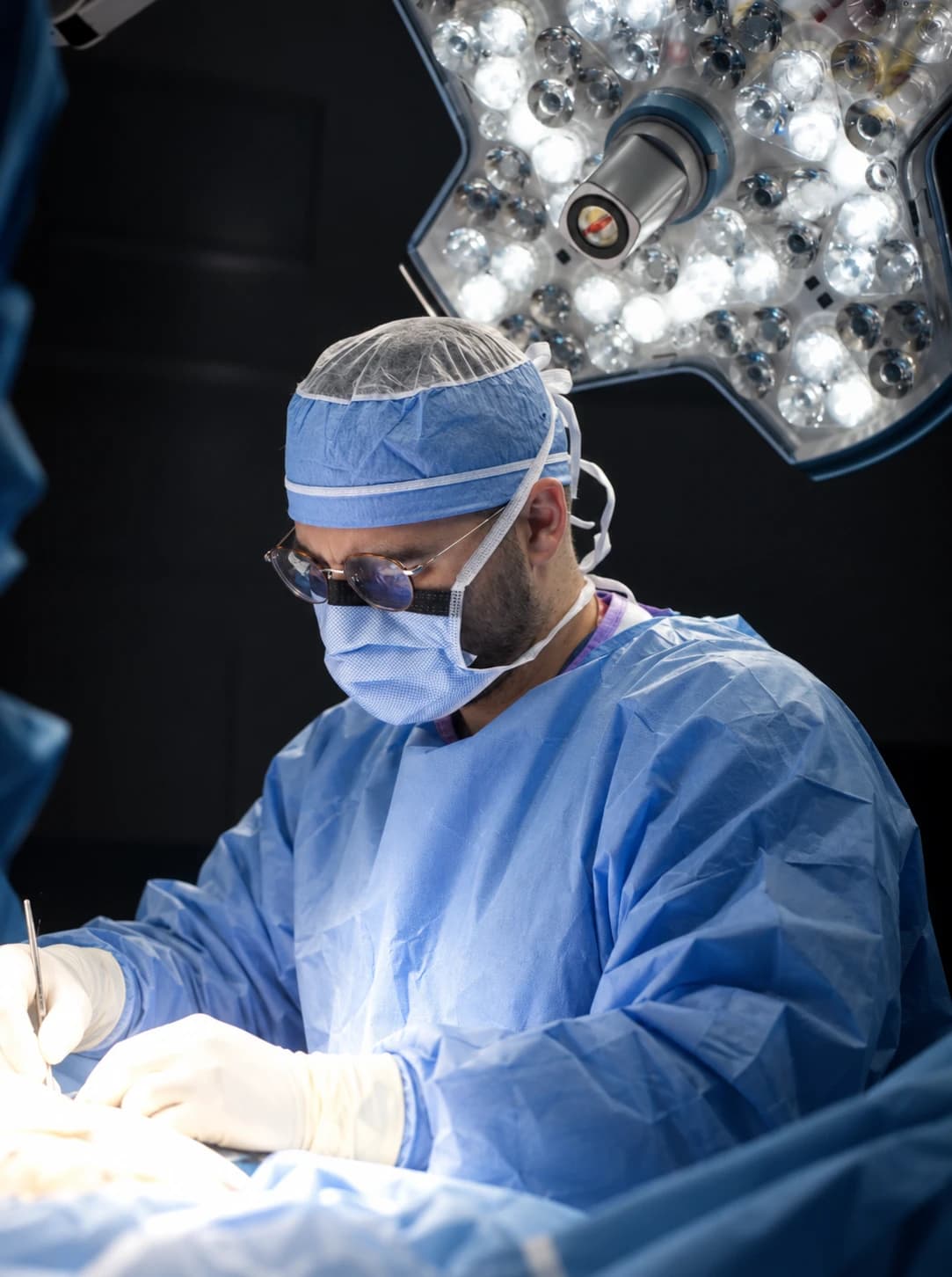
Dr. Efe Ozturk is a Foot and Ankle Surgeon who is also board certified in wound care (FAPWH). He sees you in the office and performs the operation himself when a wound needs one: debridement, draining infection, removing infected bone or a bony prominence, Achilles lengthening, toe tendon release, metatarsal head resection and skin grafts. You don’t start over with a new doctor when the plan changes. See limb salvage surgery and surgery that takes pressure off ulcers.
Some steps are done by others. Vascular specialists perform procedures that restore blood flow, and we coordinate with them. Vein procedures and hyperbaric oxygen are by referral.
What is wound care?
Wound care is the medical treatment of a wound and of whatever is keeping it open. Dressings are only part of it. Good wound care also covers cleaning away dead tissue, treating infection, checking blood flow, and taking pressure or swelling off the area.
What does a wound care specialist do?
“Wound care specialist” describes a focus more than one job title. The international diabetic foot guideline lists podiatrists, surgeons, vascular specialists, infectious disease specialists and nurses among the people involved.[3]
A specialist will usually:
- find the cause, and measure the wound so progress is a number
- remove dead tissue (debridement) and treat infection
- check circulation and arrange vascular care when needed
- relieve pressure with a boot or cast, or swelling with compression
- step up to surgery or skin substitutes when a wound stalls
No one does all of this alone. A review of 33 diabetic foot studies, none of them randomized, found fewer major amputations after a team was set up in 31 of them. Those teams drew on both medical and surgical disciplines.[7]
Signs a wound needs a specialist
It hasn’t improved in four weeks. This is the clearest sign. In a trial of 203 people with diabetic foot ulcers, ulcers that shrank more than the median by week 4 healed by week 12 in 58% of cases, against 9% of the rest.[1] Among 104 people with venous leg ulcers, early change also predicted healing.[2]
See a specialist sooner if:
- you have diabetes, numb feet or poor circulation
- the wound is getting bigger, deeper or more painful
- it has new drainage, redness or warmth (spreading redness, fever or foul-smelling drainage means the emergency room)
- you can see tendon or bone (call us the same day)
- a surgical wound has opened up
- the wound healed and came back in the same place
- you have been told you may need an amputation
Wound won’t heal on your leg? Common causes
About 80% of people with chronic leg ulcers have vein disease, artery disease or both. A leg ulcer is a sign, not a diagnosis, and the treatment depends on the cause.[8]
- Vein problems. Compression is the key treatment: a Cochrane review found people were more likely to heal fully within 12 months with compression than without it.[9] See venous leg ulcers.
- Artery problems. A wound needs blood to heal. Palpable foot pulses alone don’t rule out artery disease.[8]
- Less common causes. Inflamed blood vessels and skin cancer can cause leg ulcers too, and a biopsy may be needed to tell them apart.[8]
What happens at a first wound care visit?
Most of the first visit is listening, examining and measuring.
- Your story. How long the wound has been there, what has been tried, and your health history.
- The exam. We measure the wound, check for infection and sensation, and look at your shoes and how you walk.
- Blood flow. We check your pulses and do noninvasive circulation testing at our practice.
- Imaging. X-ray and ultrasound are available on site. MRI is arranged at an outside imaging center.
- Treatment. We clean the wound, remove dead tissue if it is safe to do so, dress it and fit any boot or cast you need.
- A plan. You leave knowing what we think is keeping the wound open and when you’ll be back. Wound care visits are usually every week or two.
Our first-visit guide lists what to bring.
If a wound still stalls, the plan changes. That may mean surgery, a skin substitute applied in the office, a vascular procedure or a referral for hyperbaric oxygen.
Surgery has limits too. Not every wound closes on time: about 23% of diabetic foot ulcers are still open at 12 months.[10] The guideline advises against the operating room when debridement can be done safely in the office.[6] Every procedure has risks, which we go over with you first.
Wound care near me: Lyndhurst, Paramus and Millburn
All three of our New Jersey offices provide wound care, with Dr. Ozturk.
- Lyndhurst: 623 Ridge Road, Suite 301, Lyndhurst, NJ 07071
- Paramus: 275 Forest Avenue, Suite 120, Paramus, NJ 07652
- Millburn: 90 Millburn Avenue, Suite 206, Millburn, NJ 07041
To book, call 908-215-5953 or book through Zocdoc, and tell us you have a wound so we can see you soon. Hours are Monday to Friday, 9 a.m. to 5 p.m., with Saturday by appointment. See our office locations, or read more about wound care at Ozturk Foot & Ankle. Please call our office at 908-215-5953 to inquire about your insurance.
Common questions
Can a wound care specialist prescribe medication?
Usually, yes, depending on their license. Doctors and podiatrists prescribe as part of their practice. Nurse practitioners can too.[11] At our practice, that includes antibiotics when a wound is infected, adjusted to your culture results.
Is a wound care center the same as a wound care specialist?
Not quite. A wound care center is a clinic set up for wound treatment, and many are based at hospitals.[12] A specialist is the clinician treating you, in a center or an office, as Dr. Ozturk does.
How do I find a good wound care specialist near me?
Ask a few questions. Do they check circulation? Do they measure the wound every visit? What is the plan if it isn’t smaller in four weeks? Can they do surgery themselves, or do they have a surgeon to call?
Do I need a referral to see a wound care specialist?
It depends on your insurance plan. Please call our office at 908-215-5953 to inquire about your insurance.
The bottom line
A wound care specialist looks for the reason a wound won’t heal and treats it. Here, that doctor is also a Foot and Ankle Surgeon who can perform the operation when one is the fix. If a wound hasn’t clearly improved in four weeks, it’s time to be seen, and with diabetes, numbness or poor circulation, the time is now.
Reviewing surgeon
Foot and Ankle Surgeon at Limb Salvage Institute, a specialty practice of Ozturk Foot & Ankle. Dr. Ozturk is double board certified, as a Diplomate of the American Board of Podiatric Medicine (DABPM) and a Fellow of the Academy of Physicians in Wound Healing (FAPWH), and is a Fellow of the American Society of Podiatric Surgeons (FASPS) and the American Society of Podiatric Medicine (FASPM).
References
- 1.Sheehan P, Jones P, Caselli A, et al. Percent change in wound area of diabetic foot ulcers over a 4-week period is a robust predictor of complete healing in a 12-week prospective trial. Diabetes Care. 2003;26(6):1879-82. PubMed 12766127 (external site)
- 2.Kantor J, Margolis DJ. A multicentre study of percentage change in venous leg ulcer area as a prognostic index of healing at 24 weeks. Br J Dermatol. 2000;142(5):960-4. PubMed 10809855 (external site)
- 3.Schaper NC, van Netten JJ, Apelqvist J, Bus SA, Fitridge R, Game F, et al. Practical guidelines on the prevention and management of diabetes-related foot disease (IWGDF 2023 update). Diabetes Metab Res Rev. 2024;40(3):e3657. PubMed 37243927 (external site)
- 4.Senneville É, Albalawi Z, van Asten SA, Abbas ZG, Allison G, Aragón-Sánchez J, et al. IWGDF/IDSA guidelines on the diagnosis and treatment of diabetes-related foot infections (IWGDF/IDSA 2023). Diabetes Metab Res Rev. 2024;40(3):e3687. PubMed 37779323 (external site)
- 5.Bus SA, Armstrong DG, Crews RT, Gooday C, Jarl G, Kirketerp-Moller K, et al. Guidelines on offloading foot ulcers in persons with diabetes (IWGDF 2023 update). Diabetes Metab Res Rev. 2024;40(3):e3647. PubMed 37226568 (external site)
- 6.Chen P, Vilorio NC, Dhatariya K, Jeffcoate W, Lobmann R, McIntosh C, et al. Guidelines on interventions to enhance healing of foot ulcers in people with diabetes (IWGDF 2023 update). Diabetes Metab Res Rev. 2024;40(3):e3644. PubMed 37232034 (external site)
- 7.Musuuza J, Sutherland BL, Kurter S, Balasubramanian P, Bartels CM, Brennan MB. A systematic review of multidisciplinary teams to reduce major amputations for patients with diabetic foot ulcers. J Vasc Surg. 2020;71(4):1433-1446.e3. PubMed 31676181 (external site)
- 8.Dissemond J, Placke JM, Moelleken M, Kröger K. The Differential Diagnosis of Leg Ulcers. Dtsch Arztebl Int. 2024;121(22):733-739. PubMed 39115274 (external site)
- 9.Shi C, Dumville JC, Cullum N, Connaughton E, Norman G. Compression bandages or stockings versus no compression for treating venous leg ulcers. Cochrane Database Syst Rev. 2021;7(7):CD013397. PubMed 34308565 (external site)
- 10.Armstrong DG, Tan TW, Boulton AJM, et al. Diabetic Foot Ulcers: A Review. JAMA. 2023;330(1):62-75. PubMed 37395769 (external site)
- 11.MedlinePlus Medical Encyclopedia. Types of health care providers. National Library of Medicine. medlineplus.gov (external site)
- 12.Fife CE, Carter MJ. Wound Care Outcomes and Associated Cost Among Patients Treated in US Outpatient Wound Centers: Data From the US Wound Registry. Wounds. 2012;24(1):10-7. PubMed 25875947 (external site)
This article is general health information and isn’t a substitute for advice from a clinician who knows your history. Read our medical disclaimer and how we review content.
Learn more about this
Treatment
Wound care visits
What happens at a wound care visit, how often you’re seen, what you do at home, and when wound care steps up to surgery.
Condition
Diabetic foot ulcers
Open sores on the feet of people with diabetes, and the step-by-step care, including surgery when it’s needed, that aims to heal them and keep them closed.
Condition
Venous leg ulcers
Open sores on the lower leg, commonly near the inner ankle, caused by high pressure in leaky or blocked leg veins.
Diagnosis guide
How wounds are evaluated
How a foot wound is evaluated, from the exam and measurements to the probe-to-bone test, cultures, X-rays, MRI, bone biopsy and circulation checks.
Treatment
Limb salvage surgery
Operations that clear infection, remove infected bone, take pressure off ulcers, rebuild collapsed feet and close wounds, with the aim of saving the foot and keeping you walking.
Keep reading
Ulcers & offloading
Why a Foot Wound Deserves Prompt, Thorough Care
A painless sore on the foot can be more serious than it looks. What the research shows about waiting, what thorough wound care covers, and when surgery is the step that saves the foot.
8 min read
Ulcers & offloading
Skin Substitutes for Diabetic Foot Ulcers: What the Trials Show
Do skin substitutes work for diabetic foot ulcers? In trials, they help more stalled ulcers close. What the evidence shows, what it leaves out, and when surgery is the more direct fix.
8 min read
Circulation & healing
Why Ankle Pressures Can Look Normal With Diabetes: Toe Pressures Explained
Calcified leg arteries can make ankle pressures look normal, or even high, when the foot is short of blood. Why toe pressures give a truer picture, and how the numbers shape wound care and surgery.
9 min read
Limb salvage surgery
Can Gangrene Toes Be Saved? What Decides How Much of the Foot Stays
Dead tissue can’t come back, but restoring blood flow and prompt, precise surgery can protect the rest of the foot. When to go to the emergency room, and how a surgeon chooses the level.
8 min read
Ulcers & offloading
Why Diabetic Foot Ulcers Don’t Heal: The Five Usual Reasons and What Fixes Each
A stalled ulcer usually has a cause a dressing can’t reach, and four of the five usual causes have a surgical or procedural answer. How each is found, what fixes it, and when surgery closes the wound.
7 min read
On the Ozturk Foot & Ankle blog
General foot care and non-surgical basics, from our parent practice.