Achilles pain in runners: load, rest and recovery
Why runners get Achilles pain, why rest isn’t the answer, and how to recover without losing your season.

By Efe Ozturk, DPM
· 3 min read
Medically reviewed by Efe Ozturk, DPM · Last reviewed
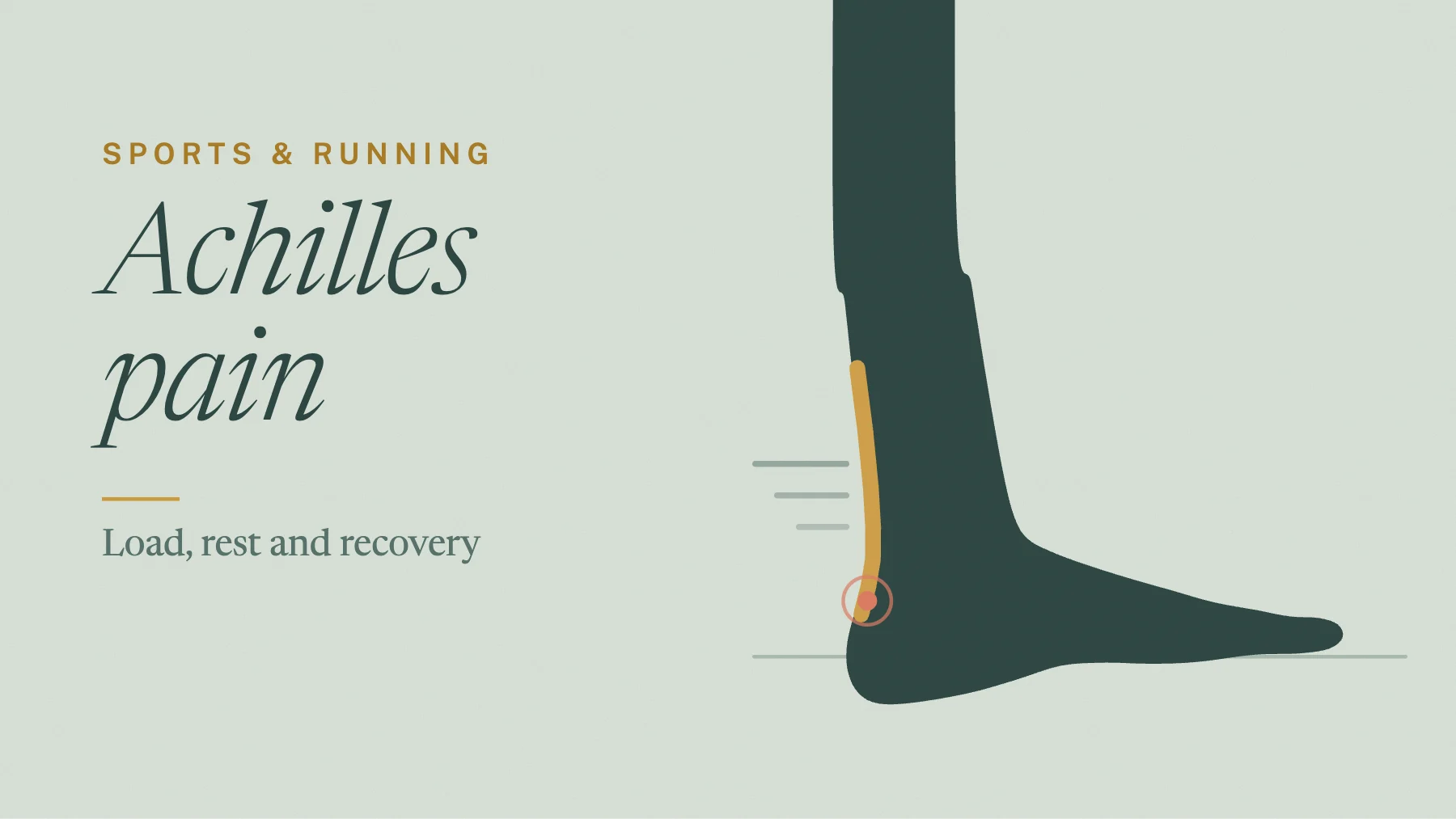
The Achilles tendon takes several times your body weight with every running stride. Most of the time it handles that beautifully. But when training changes faster than the tendon can adapt, it starts to protest, and runners know the feeling: stiffness first thing in the morning, pain during the first mile that eases as you warm up, and a tendon that feels thick and tender to squeeze.
Why it happens
Achilles tendinopathy is a problem of load. It’s common in runners, and in anyone who suddenly increases their activity.[1] Training characteristics, such as how much, how fast and how quickly volume changes, are among the strongest risk factors for running injuries in general.[2]
Typical triggers:
- a jump in weekly mileage,
- adding hills, speed sessions or a new race distance,
- switching to lower-drop or minimal shoes too quickly,
- tight or weak calves,
- returning after a break at the same volume you left off.
Midportion or insertional?
- Midportion: pain and thickening about 2 to 6 centimeters above the heel. The most common type in runners.
- Insertional: pain right where the tendon attaches to the heel bone, often worse in shoes that press there, and sometimes with a bony bump.
The difference matters for the exercises you do: people with insertional pain usually avoid dropping the heel below the level of a step early on.[6]
What helps
- A progressive loading program. Clinical guidelines for midportion Achilles tendinopathy are built around exercise.[3] Both eccentric heel drops and heavy, slow resistance training work; in a head-to-head trial the results were the same at a year, and people were more likely to stick with the heavy, slow program.[4] Our guide to Achilles heel-drop exercises shows how.
- Adjust, don’t stop, running. Use the pain as a guide: mild discomfort during a run (say 3 out of 10 or less) that settles by the next morning is usually acceptable. Cut hills and speed first, and go back to flatter, easier running.
- Calf strength and flexibility, and a look at your shoes. A small heel lift can take pressure off an irritated tendon for a while.
What doesn’t help much
- Complete rest lets the tendon lose capacity, and pain often returns when running resumes.
- Injections. A Cochrane review found little evidence that injection therapies improve function for Achilles tendinopathy,[7] and platelet-rich plasma was no better than placebo in randomized trials.[8,9]
When to get help
If a few weeks of adjusted training and exercises aren’t making progress, an evaluation helps. We confirm the diagnosis (sometimes with ultrasound at the practice), check your running and shoes, and build a plan. For insertional pain that won’t settle, shockwave therapy has good evidence.[10] See our Achilles tendon page and sports medicine.
When to see a podiatrist

About the author
Efe Ozturk, DPM
Foot and Ankle Surgeon. Dr. Ozturk is double board certified, as a Diplomate of the American Board of Podiatric Medicine (DABPM) and a Fellow of the Academy of Physicians in Wound Healing (FAPWH), and is a Fellow of the American Society of Podiatric Surgeons (FASPS) and the American Society of Podiatric Medicine (FASPM). Trained in forefoot and rearfoot reconstructive surgery at Morristown Medical Center; sees patients in Lyndhurst, Paramus and Millburn.
References
- 1.Medina Pabón MA, Bergman R, Naqvi U. Achilles Tendinopathy. In: StatPearls. StatPearls Publishing; updated 2026. PubMed 30844176 (external site)
- 2.Correia CK, Machado JM, Dominski FH, de Castro MP, de Brito Fontana H, Ruschel C. Risk factors for running-related injuries: An umbrella systematic review. J Sport Health Sci. 2024;13(6):793-804. PubMed 38697289 (external site)
- 3.Chimenti RL, Neville C, Houck J, Cuddeford T, Carreira D, Martin RL. Achilles Pain, Stiffness, and Muscle Power Deficits: Midportion Achilles Tendinopathy Revision - 2024. J Orthop Sports Phys Ther. 2024;54(12):CPG1-CPG32. PubMed 39611662 (external site)
- 4.Beyer R, Kongsgaard M, Hougs Kjær B, Øhlenschlæger T, Kjær M, Magnusson SP. Heavy Slow Resistance Versus Eccentric Training as Treatment for Achilles Tendinopathy: A Randomized Controlled Trial. Am J Sports Med. 2015;43(7):1704-11. PubMed 26018970 (external site)
- 5.Shamrock AG, Dreyer MA, Varacallo MA. Achilles Tendon Rupture. In: StatPearls. StatPearls Publishing; updated 2023. PubMed 28613594 (external site)
- 6.American Academy of Orthopaedic Surgeons. Achilles Tendinitis. OrthoInfo. orthoinfo.org (external site)
- 7.Kearney RS, Parsons N, Metcalfe D, Costa ML. Injection therapies for Achilles tendinopathy. Cochrane Database Syst Rev. 2015;2015(5):CD010960. PubMed 26009861 (external site)
- 8.de Vos RJ, Weir A, van Schie HT, et al. Platelet-rich plasma injection for chronic Achilles tendinopathy: a randomized controlled trial. JAMA. 2010;303(2):144-9. PubMed 20068208 (external site)
- 9.Barreto ESR, Antunes Júnior CR, Silva IC, Alencar VB, Faleiro TB, Kraychete DC. Is Platelet-rich Plasma Effective in Treating Achilles Tendinopathy? A Meta-analysis of Randomized Clinical Trials. Clin Orthop Relat Res. 2025;483(5):779-790. PubMed 39745256 (external site)
- 10.Zhi X, Liu X, Han J, Xiang Y, Wu H, Wei S, et al. Nonoperative treatment of insertional Achilles tendinopathy: a systematic review. J Orthop Surg Res. 2021;16(1):233. PubMed 33785026 (external site)
This is general health information and isn’t a substitute for advice from a clinician who knows your history. Read our medical disclaimer and how we write and review content.
More from the blog
Sports & running
Pain on the outside of the ankle: peroneal tendon problems
Ankle pain that won’t settle after a sprain may be the peroneal tendons. The signs, and how they’re treated.
Sports & running
Pickleball foot and ankle injuries: how to play longer and hurt less
Pickleball injuries are rising fast. The foot and ankle injuries to know, and how to keep playing without them.
Sports & running
Sprained ankle recovery: the first 72 hours and getting back to sport
A week-by-week plan for a sprained ankle, from the first days to getting back to your sport.