Greg Newsome injury: why NFL players get TightRope surgery for a high ankle sprain
Giants cornerback Greg Newsome II was reported to need TightRope surgery for a high ankle sprain. Here is why an unstable sprain is fixed mid-season, how a suture button can speed the return, and what it means for weekend athletes.

By Dr. Efe Ozturk
· 7 min read
Medically reviewed by Dr. Efe Ozturk · Last reviewed
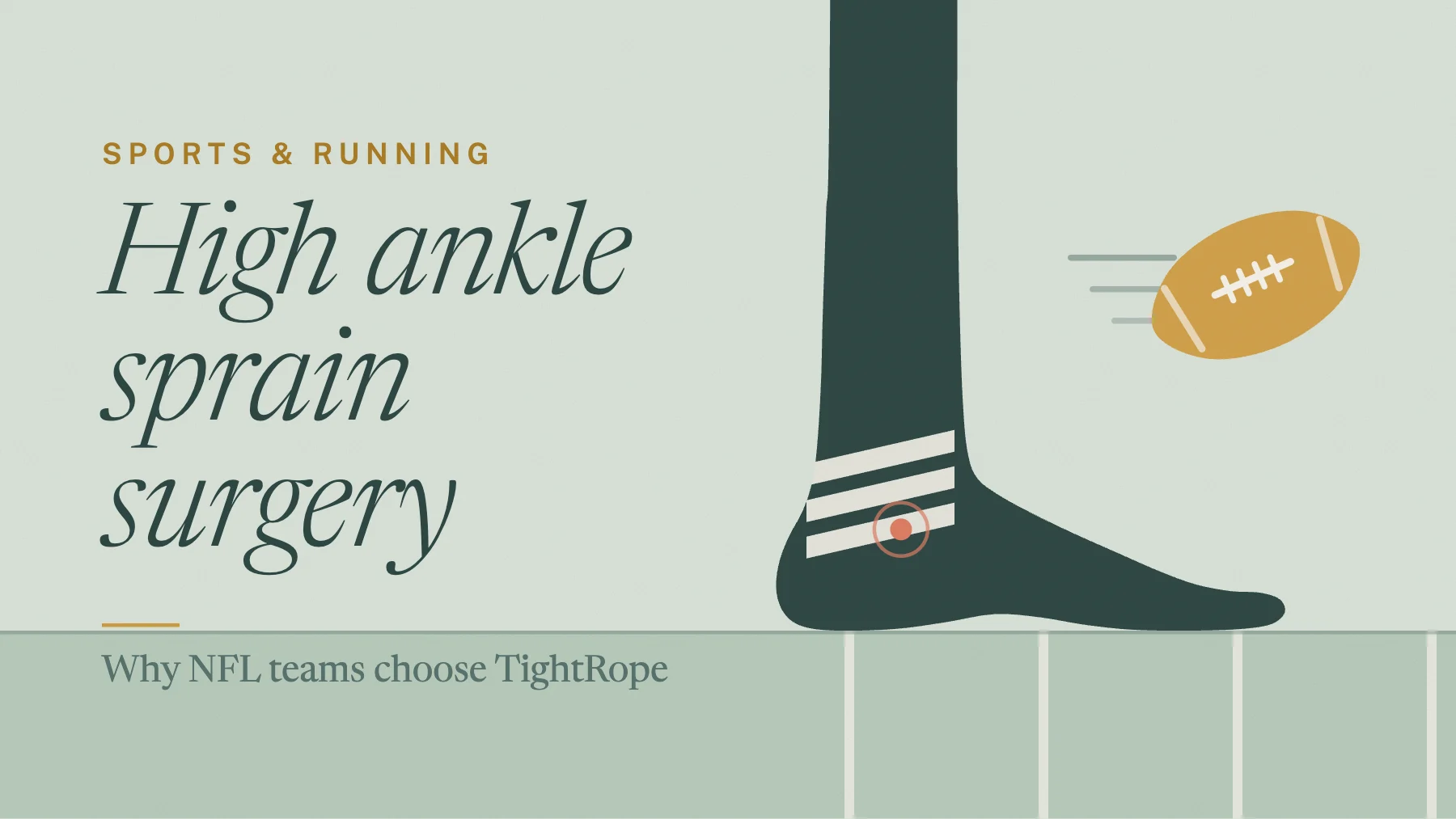
Our Lyndhurst office is minutes from MetLife Stadium, so a Giants injury is a local story for us. We wish Greg Newsome II a smooth recovery. Here is why a team might choose surgery for a sprain mid-season, and how an operation can mean a faster return.
A note first: we have no connection with Newsome or the Giants and have not examined him. The details below come from news reports as of November 26, 2026. Nothing here describes his injury, its severity or his care.
Greg Newsome injury update: what was reported
Newsome was injured on a running play on the Giants’ first drive against Jacksonville, and he left MetLife Stadium in a boot, ESPN reported.[1] The next day, coach John Harbaugh said Newsome had a high ankle sprain that would keep him out multiple weeks. “It’s a serious high ankle,” he said.[9,1] ESPN reported then that no decision on surgery had been made.[1]
On Tuesday, November 24, the Giants placed Newsome on injured reserve, which keeps him out at least the next four games.[2] NFL insider Jordan Schultz reported that Newsome would have TightRope surgery that week and miss about four to six weeks.[3] ClutchPoints, citing The Athletic, reported the surgery was scheduled for Tuesday.[4] As of November 26, no team or major-outlet report we found said it was done.
What makes a high ankle sprain unstable?
Most sprains hurt the ligaments on the outside of the ankle. A high ankle sprain injures the syndesmosis, the ligaments that tie your shin bone (tibia) to the thin outer bone (fibula) just above the ankle. It usually happens when the foot is forced to twist outward or bend sharply upward, often in football and other turf sports.[10]
The key question is stability. If the two bones stay in their normal position, the joint is stable. If enough is torn that the bones spread apart, called widening or diastasis, the joint is unstable. X-rays measure the space between the bones to help tell the two apart.[5]
Severity changes the clock. In 83 NFL syndesmosis injuries reviewed with MRI, only 13% were truly isolated; most came with other ligament damage or a fracture. Return to full participation took a median of 250 days with a fracture and 175 days with acute widening or a complete tear of the deep ligament on the inner ankle. All other syndesmosis injuries took a median of 27 days.[11]
Why would you get surgery for a high ankle sprain?
Because an unstable joint does not reliably hold itself together while it heals. The European consensus advises a cast or brace for stable injuries and an operation for unstable ones.[5] Waiting carries a cost. Among ankle sprains in athletes, high ankle sprains are the most likely to leave lasting symptoms, and when an unstable injury is diagnosed late, results are poorer and the return to sport is delayed.[12]
Arthroscopy, a look inside with a small camera, can confirm the injury and treat other damage at the same operation.[6] In 27 patients with an unstable syndesmosis, 48% had cartilage injuries, and 19% had damage that needed its own treatment.[13] Read more about ankle arthroscopy.
How a suture button can mean a faster return
TightRope surgery uses a suture button: a heavy suture passed across both bones and tightened against a small button on each side.[14] Researchers describe it as semirigid, dynamic stabilization, meaning firm but slightly flexible.[7]
- Back to sports sooner. In a randomized trial of 54 patients, those with a knotless suture button returned to sports at about 14 weeks, against 19 weeks with a screw, and had fewer complications.[7]
- Back to work sooner. In an early comparison of 32 patients, suture-button patients returned to work at 2.8 months, against 4.6 with screws, and none needed a second surgery to remove the implant.[14]
- Bones held in place. Across five randomized trials of 285 patients, the joint ended up out of position in 0.8% after a suture button, against 11.5% after a screw.[15]
For the full suture button vs. screw evidence, see our Center for Lower Extremity Surgery’s guide to TightRope surgery for a high ankle sprain (external site).
TightRope surgery recovery time in football
In a study of 7 college and 14 NFL players treated with a suture button for an unstable syndesmosis, every player returned to his level of sport. College players reached their first game about 39 days after surgery on average.[8] In five seasons of NCAA football, high ankle sprains made up about a quarter of all ankle sprains, were nearly 14 times as likely in games as in practice, and 75% came from contact with another player.[16]
These figures describe other players, not a forecast for Newsome.
What it means for a weekend athlete in New Jersey
For a weekend athlete, the question is the same: is the joint stable? Dr. Efe Ozturk, a double board certified Foot and Ankle Surgeon and podiatrist, examines both ankles. We take X-rays and ultrasound at the practice and arrange an MRI when needed. A stable sprain gets a boot and a rehab plan through our sports medicine team. An unstable one gets a frank talk about stabilizing it early, since a late diagnosis leads to poorer results.[12]
For recovery times by grade, read our guide to high ankle sprain recovery time, or see ankle sprains.
The limits. Most high ankle sprains heal without surgery: fewer than 3% of those in NCAA football needed an operation,[16] and one NFL team treated all 36 syndesmosis sprains in 15 years without surgery, with 15.4 days lost on average.[17] In 901 elite athletes, return rates were 98% after suture-button fixation and 98% without surgery, and the review found signs of publication bias.[18] The 54-patient trial found similar function scores with both devices, and its patients had a median age of 37.[7] In the 21-player study, NFL players averaged about 190 days to their next game, and times ranged from 12 to 427 days overall.[8] Implants were removed in 6% after a suture button.[15] And alignment matters: in 68 patients with ankle fractures, 39% of fixed syndesmoses were out of position on CT, and those patients had worse function.[19]
Also this week
LaMelo Ball, Timberwolves. Ball turned his left ankle landing on Isaiah Hartenstein’s foot with two minutes and 29 seconds left in Minnesota’s 113-106 win over Oklahoma City on November 25, ESPN reported. Coach Chris Finch said it looked bad but that he wasn’t sure how serious it was.[20] As of November 26, we found no reported diagnosis, so we are not guessing at one.
Common questions
Why would someone have surgery for a high ankle sprain?
To hold the two leg bones together when the injury is unstable. Experts advise an operation for unstable injuries, and late diagnosis leads to poorer results.[5,12]
How long is TightRope surgery recovery time for football players?
College players in one study reached their first game about 39 days after surgery on average; NFL players took longer, with wide variation.[8]
Does a grade 2 ankle sprain need surgery?
The grade matters less than stability. Stable injuries are treated in a cast or brace, and unstable ones with surgery.[5] Imaging and sometimes arthroscopy tell them apart.[6]
When can Greg Newsome return?
Injured reserve keeps him out at least four games,[2] and reports gave four to six weeks.[3] The studies above are not a forecast for him.
When to see a Foot and Ankle Surgeon
See us soon for pain above the ankle after a twist, pain when the foot turns outward, or a sprain that isn’t improving. We see patients in Lyndhurst, Paramus and Millburn; find an office on our locations page. Please call our office at 908-215-5953 to inquire about your insurance.
About the author
Dr. Efe Ozturk
Foot and Ankle Surgeon. Dr. Ozturk is double board certified, as a Diplomate of the American Board of Podiatric Medicine (DABPM) and a Fellow of the Academy of Physicians in Wound Healing (FAPWH), and is a Fellow of the American Society of Podiatric Surgeons (FASPS) and the American Society of Podiatric Medicine (FASPM). Trained in forefoot and rearfoot reconstructive surgery at Morristown Medical Center; sees patients in Lyndhurst, Paramus and Millburn.
Where to be seen
Dr. Ozturk sees patients at each of these offices, and one phone number reaches all of them.
References
- 1.Raanan J. Giants’ Greg Newsome out ‘multiple weeks’ with ankle sprain. ESPN. Published November 23, 2026. espn.com (external site)
- 2.Alper J. Giants put Greg Newsome on injured reserve. NBC Sports ProFootballTalk. Published November 24, 2026. nbcsports.com (external site)
- 3.Mosher T. Giants facing troubling development after Greg Newsome II surgery update. Athlon Sports, via Yahoo Sports. Published November 24, 2026. sports.yahoo.com (external site)
- 4.Bhatnagar R. Giants’ Greg Newsome II goes on IR immediately after having surgery on ankle injury. ClutchPoints, via Yahoo Sports. Published November 25, 2026. sports.yahoo.com (external site)
- 5.van Dijk CN, Longo UG, Loppini M, et al. Classification and diagnosis of acute isolated syndesmotic injuries: ESSKA-AFAS consensus and guidelines. Knee Surg Sports Traumatol Arthrosc. 2016;24(4):1200-16. PubMed 26704800 (external site)
- 6.McCollum GA, van den Bekerom MP, Kerkhoffs GM, Calder JD, van Dijk CN. Syndesmosis and deltoid ligament injuries in the athlete. Knee Surg Sports Traumatol Arthrosc. 2013;21(6):1328-37. PubMed 23052109 (external site)
- 7.Colcuc C, Blank M, Stein T, et al. Lower complication rate and faster return to sports in patients with acute syndesmotic rupture treated with a new knotless suture button device. Knee Surg Sports Traumatol Arthrosc. 2018;26(10):3156-3164. PubMed 29224059 (external site)
- 8.Ziedas A, Nasir M, Dubé M, et al. Full return to sport in all athletes after suture-button fixation for syndesmotic injuries; however, faster recovery was seen in National Collegiate Athletic Association football players compared with National Football League players. Arthrosc Sports Med Rehabil. 2025;7(6):101220. PubMed 41541541 (external site)
- 9.Salomone D. CB Greg Newsome II to miss ‘multiple weeks’ with high ankle sprain. Giants.com. Published November 24, 2026. giants.com (external site)
- 10.Lin CF, Gross ML, Weinhold P. Ankle syndesmosis injuries: anatomy, biomechanics, mechanism of injury, and clinical guidelines for diagnosis and intervention. J Orthop Sports Phys Ther. 2006;36(6):372-384. PubMed 16776487 (external site)
- 11.Kuhn AW, Coughlin MJ, McGonegle SJ, et al. Distal Tibiofibular Syndesmosis Injuries in the National Football League (NFL): A Spectrum of Pathology That Correlates With Time to Return to Full Participation. Sports Health. 2025;17(2):404-411. PubMed 38804171 (external site)
- 12.Mak MF, Gartner L, Pearce CJ. Management of syndesmosis injuries in the elite athlete. Foot Ankle Clin. 2013;18(2):195-214. PubMed 23707173 (external site)
- 13.Rellensmann K, Behzadi C, Usseglio J, et al. Acute, isolated and unstable syndesmotic injuries are frequently associated with intra-articular pathologies. Knee Surg Sports Traumatol Arthrosc. 2021;29(5):1516-1522. PubMed 32728787 (external site)
- 14.Thornes B, Shannon F, Guiney AM, Hession P, Masterson E. Suture-button syndesmosis fixation: accelerated rehabilitation and improved outcomes. Clin Orthop Relat Res. 2005;(431):207-12. PubMed 15685077 (external site)
- 15.Shimozono Y, Hurley ET, Myerson CL, Murawski CD, Kennedy JG. Suture Button Versus Syndesmotic Screw for Syndesmosis Injuries: A Meta-analysis of Randomized Controlled Trials. Am J Sports Med. 2019;47(11):2764-2771. PubMed 30475639 (external site)
- 16.Hunt KJ, George E, Harris AH, Dragoo JL. Epidemiology of syndesmosis injuries in intercollegiate football: incidence and risk factors from National Collegiate Athletic Association injury surveillance system data from 2004-2005 to 2008-2009. Clin J Sport Med. 2013;23(4):278-82. PubMed 23339895 (external site)
- 17.Osbahr DC, Drakos MC, O’Loughlin PF, et al. Syndesmosis and lateral ankle sprains in the National Football League. Orthopedics. 2013;36(11):e1378-84. PubMed 24200441 (external site)
- 18.Li R, Sun C, Qi P, Xu Z. Return-to-sport rate and time in elite athletes after ankle syndesmosis injuries: a systematic review and meta-analysis. J Orthop Surg Res. 2025;21(1):69. PubMed 41476226 (external site)
- 19.Sagi HC, Shah AR, Sanders RW. The functional consequence of syndesmotic joint malreduction at a minimum 2-year follow-up. J Orthop Trauma. 2012;26(7):439-43. PubMed 22357084 (external site)
- 20.MacMahon T. Timberwolves’ LaMelo Ball limps off vs. OKC after hurting left ankle. ESPN. Published November 25, 2026. espn.com (external site)
This is general health information and isn’t a substitute for advice from a clinician who knows your history. Read our medical disclaimer and how we write and review content.
More from the blog
Sports & running
Return to Sport After Foot and Ankle Injuries: Published Rates and Times (2026 Table)
A reference table of published return-to-sport rates and times after Jones fracture, Lisfranc, navicular, ankle fracture, syndesmosis, ankle ligament, talus cartilage, Achilles and turf toe treatment, surgical and non-surgical, each figure checked against the abstract and free to download.
Sports & running
Foot and Ankle Injury Tracker 2026-27: NFL, NBA, NHL and Soccer
Our foot and ankle injury tracker: 67 notable ankle, Achilles, foot and toe injuries across the NFL, NBA, NHL and Europe’s big soccer clubs as of November 22, 2026, each with a dated source. Surgery was reported for 19 of them.
Sports & running
Biggest sports injuries this week: Harry Kane’s ankle surgery, Puka Nacua, Asa Newell and more across the NFL, NBA, NHL, MLB and soccer
The new board: the biggest sports injuries across the NFL, NBA, NHL, MLB and five soccer leagues as of November 22, 2026, led by Harry Kane’s ankle surgery. Nine of the 21 athletes have had surgery on the injured area, and each league has a lesson for everyday athletes.