Heel spurs: are they really the cause of your heel pain?
Most people with heel spurs have no heel pain. Where the pain really comes from, and what helps.

By Efe Ozturk, DPM
· 4 min read
Medically reviewed by Efe Ozturk, DPM · Last reviewed
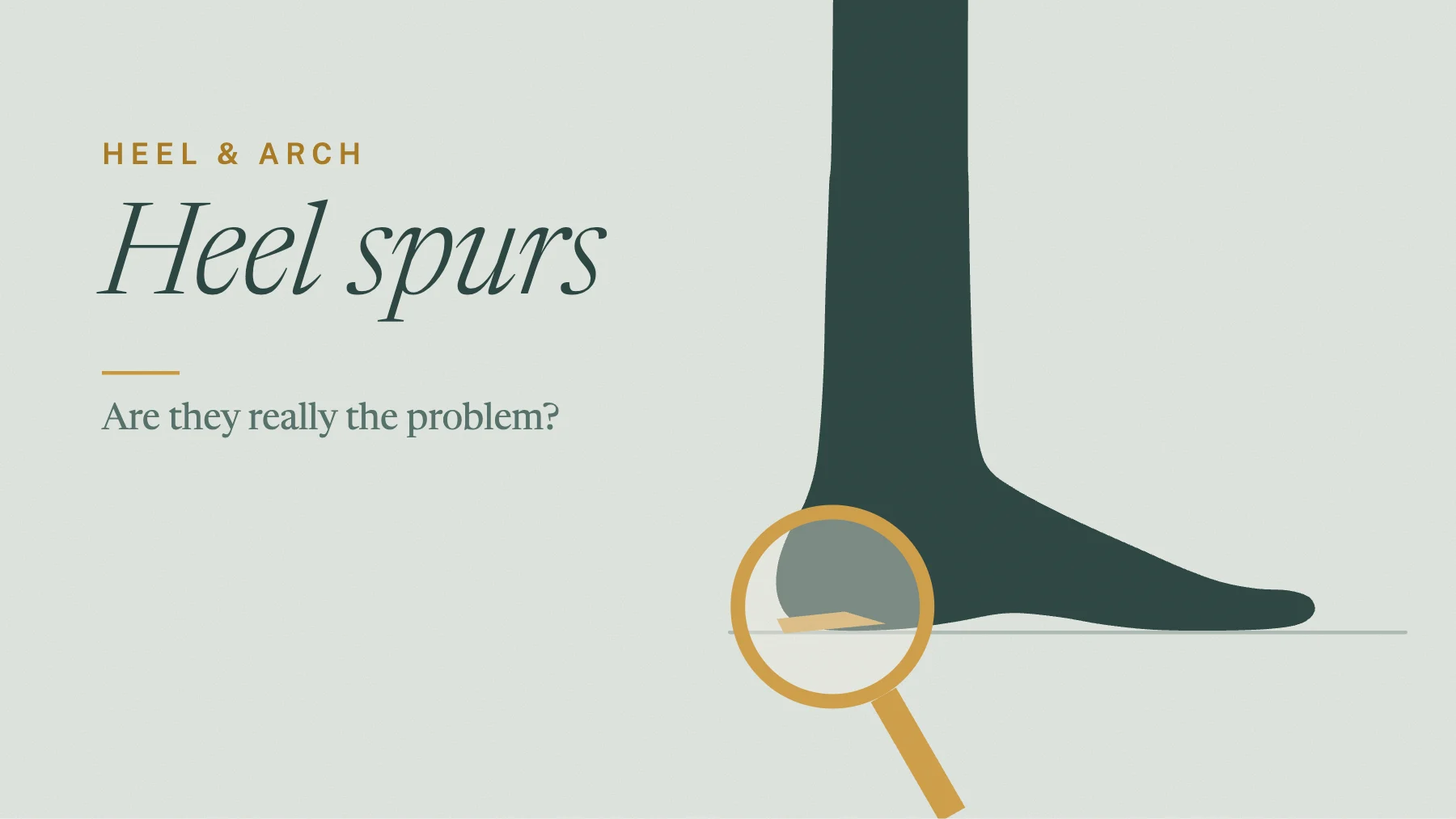
“It’s a heel spur.” Many people hear that after an X-ray for heel pain, and it sounds like the answer: a sharp piece of bone, digging in with every step. It’s an easy picture to believe. It’s also mostly wrong. Understanding why can save you from worrying about the wrong thing, and point you to treatment that works.
What a heel spur is
A plantar heel spur is a bony outgrowth from the bottom of the heel bone (the calcaneus), close to where the plantar fascia and some of the small foot muscles attach.[1] You can’t feel it from the outside; it’s seen on an X-ray.[2]
Nobody is completely sure why spurs form. Researchers have proposed several explanations, including long-term pulling from the plantar fascia, repeated small injuries, and the heel being compressed under body weight.[1,3] Spurs are more common with age, higher body weight and arthritis.[1,3]
How common they are
Very. In one study of older adults, 55% had a spur under at least one heel.[3] In a review of the X-rays of 1,103 consecutive patients, about 1 in 8 had one, more often women and older patients.[4] Most people who have heel spurs don’t have heel pain.[2]
So is the spur causing my pain?
Probably not directly. People with long-standing heel pain are more likely than people without it to have a spur on their X-ray.[5] But that link doesn’t mean the spur is the source of the pain. Heel spurs don’t cause plantar fasciitis pain, and plantar fasciitis can be treated without removing the spur.[2]
One theory is that a spur is the bone’s response to years of load on the heel.[3] And in one study, people with spurs were more likely to be heavier, to have diabetes, and to have arthritis in the legs, and they had more foot pain even when plantar fasciitis was ruled out. The authors concluded that spurs may not cause pain themselves, but may point to other conditions worth attention.[4]
Where the pain really comes from
Most pain under the heel is plantar fasciitis: irritation of the thick band that runs from the heel to the toes. It’s typically worst with the first steps in the morning or after sitting, and it’s tender just in front of the heel bone.[2] On ultrasound, a painful plantar fascia is usually thickened.[5] Our article on morning heel pain explains it in detail.
Other causes of heel pain are worth ruling out too, such as a stress fracture of the heel bone, Achilles tendon problems at the back of the heel, or an irritated nerve.[2] That’s why we examine the foot rather than rely on an X-ray alone.
What helps
Because the spur isn’t the problem, the treatment is the same as for plantar fasciitis. More than 90% of people with plantar fasciitis improve within 10 months with simple treatment:[2]
- Stretching the calf and the plantar fascia, especially before your first steps in the morning. See our heel pain stretches.
- Supportive, cushioned shoes, and heel pads or orthotics. Avoid worn-out or unsupportive shoes.
- Cutting back on pounding activities for a while, and switching to cycling or swimming.
- Icing the sore area.
When pain lasts for months despite these steps, other options include shockwave therapy and custom orthotics. Surgery is rarely needed. When it is, it releases part of the plantar fascia; removing a large spur is possible but usually isn’t done, because the spur isn’t what hurts.[2] Our heel pain page covers the full range of treatment.
Common questions
Will the spur go away?
It doesn’t need to. Plantar fasciitis pain can be treated without removing the spur, so the goal is a comfortable heel with the spur still there.[2]
I have a spur on the back of my heel. Is that the same thing?
No. A spur at the back of the heel sits where the Achilles tendon attaches and is linked to Achilles tendon problems, which are treated differently. See our Achilles tendon page.
Do I need an X-ray?
Not always. The diagnosis of plantar fasciitis is mostly made by examining the foot. X-rays are useful to rule out other causes, such as a fracture or arthritis.[2] We have X-ray at the practice if it’s needed.
When to see a podiatrist

About the author
Efe Ozturk, DPM
Foot and Ankle Surgeon. Dr. Ozturk is double board certified, as a Diplomate of the American Board of Podiatric Medicine (DABPM) and a Fellow of the Academy of Physicians in Wound Healing (FAPWH), and is a Fellow of the American Society of Podiatric Surgeons (FASPS) and the American Society of Podiatric Medicine (FASPM). Trained in forefoot and rearfoot reconstructive surgery at Morristown Medical Center; sees patients in Lyndhurst, Paramus and Millburn.
References
- 1.Kirkpatrick J, Yassaie O, Mirjalili SA. The plantar calcaneal spur: a review of anatomy, histology, etiology and key associations. J Anat. 2017;230(6):743-751. PubMed 28369929 (external site)
- 2.American Academy of Orthopaedic Surgeons. Plantar Fasciitis and Bone Spurs. OrthoInfo. orthoinfo.org (external site)
- 3.Menz HB, Zammit GV, Landorf KB, Munteanu SE. Plantar calcaneal spurs in older people: longitudinal traction or vertical compression? J Foot Ankle Res. 2008;1(1):7. PubMed 18822162 (external site)
- 4.Moroney PJ, O'Neill BJ, Khan-Bhambro K, O'Flanagan SJ, Keogh P, Kenny PJ. The conundrum of calcaneal spurs: do they matter? Foot Ankle Spec. 2014;7(2):95-101. PubMed 24379452 (external site)
- 5.McMillan AM, Landorf KB, Barrett JT, Menz HB, Bird AR. Diagnostic imaging for chronic plantar heel pain: a systematic review and meta-analysis. J Foot Ankle Res. 2009;2:32. PubMed 19912628 (external site)
This is general health information and isn’t a substitute for advice from a clinician who knows your history. Read our medical disclaimer and how we write and review content.
More from the blog
Heel & arch
Why does my heel hurt in the morning? Plantar fasciitis explained
That stab of pain with your first steps out of bed is the classic sign of plantar fasciitis. Here’s why it happens and what helps.
Heel & arch
Plantar fasciitis stretches and exercises that are backed by evidence
The heel pain exercises that have actually been tested in trials, and how to do them properly.
Heel & arch
Achilles heel-drop exercises: how to do them properly
Step-by-step instructions for the two exercise programs with the most evidence for Achilles tendinopathy.