Why does my heel hurt in the morning? Plantar fasciitis explained
That stab of pain with your first steps out of bed is the classic sign of plantar fasciitis. Here’s why it happens and what helps.

By Efe Ozturk, DPM
· 3 min read
Medically reviewed by Efe Ozturk, DPM · Last reviewed
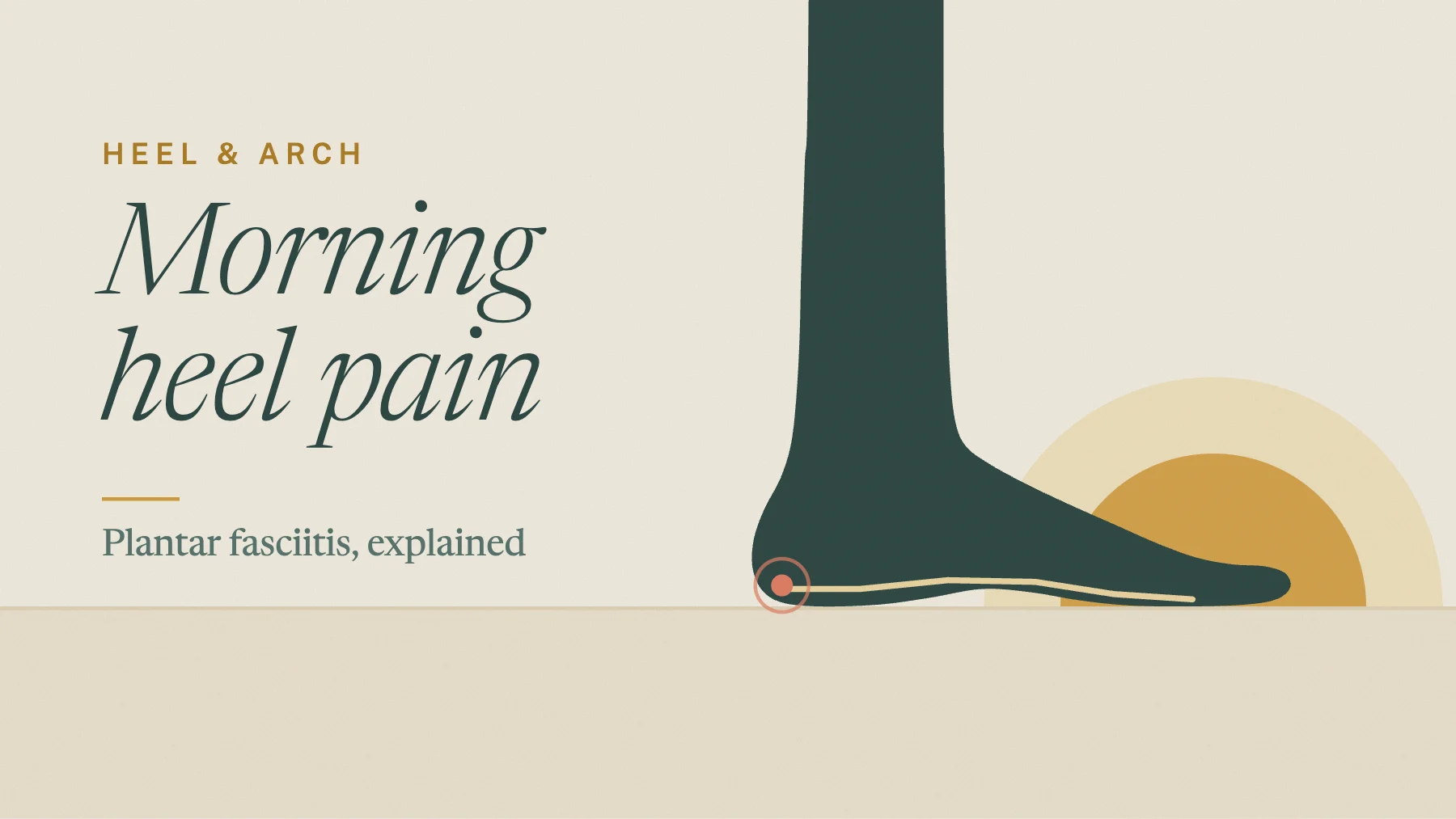
You swing your legs out of bed, stand up, and a sharp pain stabs the bottom of your heel. After a few minutes of shuffling around the kitchen it settles to a dull ache. By evening, after a day on your feet, it’s back. If that sounds familiar, you’re describing plantar fasciitis almost word for word.
Why the first steps hurt most
The plantar fascia is a thick band of tissue running from your heel bone to the base of your toes. It supports your arch and acts like a spring every time you step. In plantar fasciitis, the fascia becomes painful where it attaches to the heel.[1]
Overnight, your foot rests pointing slightly downward and the fascia and calf tighten up. That first step out of bed stretches the irritated tissue all at once, and that’s the stab you feel. As you walk, the tissue loosens and the pain eases. Sit for a while, and it stiffens again.[1,2]
Who gets it
Plantar fasciitis is one of the most common causes of heel pain, and it’s most common between the ages of 40 and 60. It’s more likely if you:
- spend long hours standing or walking, especially on hard floors,
- run, or recently increased your mileage,
- carry extra body weight,
- have very flat feet or very high arches,
- have a tight calf or limited ankle motion.[1]
What you can start today
These steps help most people, but they take weeks to work, so stick with them:
- Stretch before you stand. Before getting out of bed, pull your toes back toward your shin for 10 seconds, several times. Our guide to plantar fasciitis stretches walks through the exercises that have been tested.
- Stretch your calf a few times a day.[3]
- Don’t go barefoot on hard floors. Wear supportive shoes or sandals with a cushioned heel, even at home.
- Try a heel cushion or an over-the-counter arch support. Inserts reduce pain for many people, and simple ones often work as well as custom-made ones.[4]
- Ease back, don’t stop. Swap some running for cycling or swimming for a few weeks rather than stopping all activity.
- Ice the heel after activity, by rolling your foot over a frozen water bottle.
When it’s not plantar fasciitis
Heel pain has a long list of possible causes, and where it hurts is the first clue.[2,5]
- Pain that steadily worsens after you increase activity, and hurts when you squeeze the sides of the heel, can be a stress fracture of the heel bone.
- Burning, tingling or numbness suggests a nerve, such as tarsal tunnel syndrome or Baxter’s nerve entrapment.
- Pain at the back of the heel usually comes from the Achilles tendon.
- A deep, bruise-like ache in the center of the heel can come from the fat pad.
- Heel pain in a child aged about 8 to 14 is usually Sever’s disease. See Sever’s disease.
If it isn’t getting better
If you’ve been consistent for six to eight weeks and the pain isn’t clearly improving, it’s time for an evaluation. We confirm the diagnosis, check your shoes and foot mechanics, and add treatments such as shockwave therapy, which in a large meta-analysis was the treatment that improved plantar fasciitis pain in the medium and long term.[6] Read more on our heel pain and plantar fasciitis page.
When to see a podiatrist

About the author
Efe Ozturk, DPM
Foot and Ankle Surgeon. Dr. Ozturk is double board certified, as a Diplomate of the American Board of Podiatric Medicine (DABPM) and a Fellow of the Academy of Physicians in Wound Healing (FAPWH), and is a Fellow of the American Society of Podiatric Surgeons (FASPS) and the American Society of Podiatric Medicine (FASPM). Trained in forefoot and rearfoot reconstructive surgery at Morristown Medical Center; sees patients in Lyndhurst, Paramus and Millburn.
References
- 1.American Academy of Orthopaedic Surgeons. Plantar Fasciitis and Bone Spurs. OrthoInfo. orthoinfo.org (external site)
- 2.Tu P. Heel Pain: Diagnosis and Management. Am Fam Physician. 2018;97(2):86-93. PubMed 29365222 (external site)
- 3.Morrissey D, Cotchett M, Said J'Bari A, Prior T, Griffiths IB, Rathleff MS, et al. Management of plantar heel pain: a best practice guide informed by a systematic review, expert clinical reasoning and patient values. Br J Sports Med. 2021;55(19):1106-1118. PubMed 33785535 (external site)
- 4.Whittaker GA, Munteanu SE, Menz HB, Tan JM, Rabusin CL, Landorf KB. Foot orthoses for plantar heel pain: a systematic review and meta-analysis. Br J Sports Med. 2018;52(5):322-328. PubMed 28935689 (external site)
- 5.Thomas JL, Christensen JC, Kravitz SR, Mendicino RW, Schuberth JM, Vanore JV, et al. The diagnosis and treatment of heel pain: a clinical practice guideline-revision 2010. J Foot Ankle Surg. 2010;49(3 Suppl):S1-19. PubMed 20439021 (external site)
- 6.Guimarães JS, Arcanjo FL, Leporace G, Metsavaht LF, Conceição CS, Moreno MVMG, et al. Effects of therapeutic interventions on pain due to plantar fasciitis: A systematic review and meta-analysis. Clin Rehabil. 2023;37(6):727-746. PubMed 36571559 (external site)
This is general health information and isn’t a substitute for advice from a clinician who knows your history. Read our medical disclaimer and how we write and review content.
More from the blog
Heel & arch
Heel spurs: are they really the cause of your heel pain?
Most people with heel spurs have no heel pain. Where the pain really comes from, and what helps.
Heel & arch
Plantar fasciitis stretches and exercises that are backed by evidence
The heel pain exercises that have actually been tested in trials, and how to do them properly.
Heel & arch
Achilles heel-drop exercises: how to do them properly
Step-by-step instructions for the two exercise programs with the most evidence for Achilles tendinopathy.