Tenex for Achilles tendonitis: insertional vs midportion, Haglund’s, results and recovery
A deep look at the Tenex procedure for the Achilles: results at the heel bone and higher up, why a Haglund’s bump or calcium matters, how it compares with open surgery, and recovery week by week.

By Dr. Efe Ozturk
· 10 min read
Medically reviewed by Dr. Efe Ozturk · Last reviewed
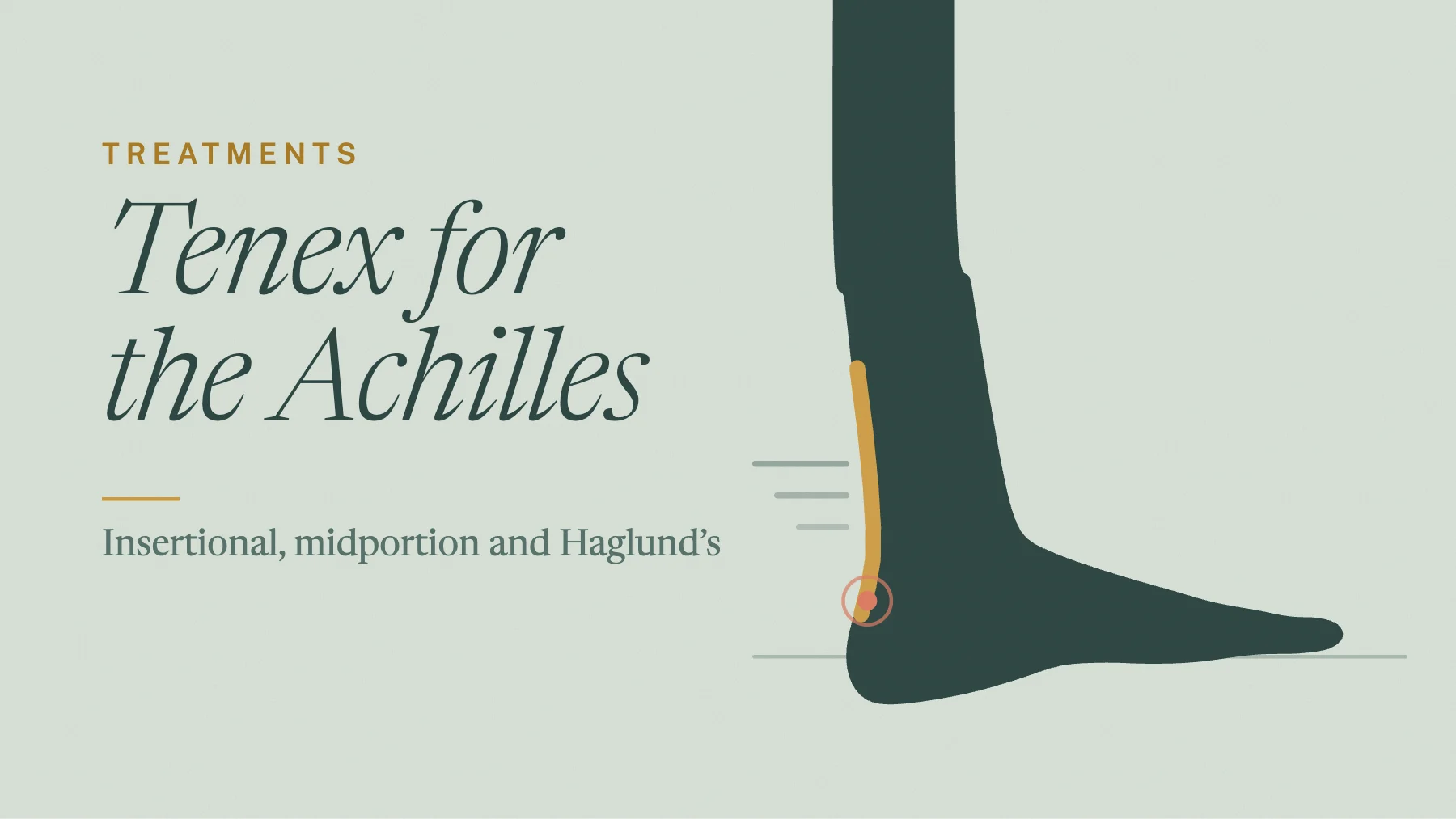
Your Achilles has hurt for months. You’ve done the heel drops, changed shoes, maybe tried shockwave. This guide covers one device for one tendon: what the Tenex procedure for Achilles tendonitis does, how results differ at the heel bone and higher up, what a Haglund’s bump means, and what recovery looks like week by week. For how Tenex compares with TenJet, see our Tenex and TenJet overview.
Why consider a procedure for Achilles tendonitis?
Exercise comes first, and for many tendons it works. But it works much less well at the heel bone. In one study, a 12-week heel-drop program was satisfactory for 89% of tendons with pain in the middle, but only 32% with pain at the insertion.[4] A review of surgery for insertional pain estimates that 10% to 30% of people end up needing an operation.[5]
For that group, the question isn’t whether to treat the damaged tissue, but how big the operation needs to be. Tenex is the smallest option: one small cut, local numbing, and walking out in a boot. Our Achilles tendonitis treatment guide covers the non-surgical steps that come before it.
What is the Tenex procedure for Achilles tendonitis?
Tenex is also called percutaneous ultrasonic tenotomy. “Percutaneous” means through the skin, and “tenotomy” means cutting into a tendon.
- The tool. The TX1 and TX2 handpieces use ultrasonic energy to cut and break up damaged tissue, while saline rinses the area and suction removes the debris.[6]
- The target. In the 2026 study, the tendons were thickened on ultrasound, and 94% showed new small blood vessels growing in.[3] The device first cleared the irritated bursa (a fluid sac) and the thickened lining on the back of the tendon, then treated the damaged area inside it, including calcium deposits.[1,3]
- The clearance. The FDA cleared the Tenex Health TX System in 2016 as an ultrasonic surgical instrument.[7]
In the insertional series, the device was running for about 7 minutes on average, from 2½ to 19 minutes depending on how much tissue needed treating.[1]
Insertional or midportion: does the location change Tenex results?
There are two kinds of Achilles tendonitis:
- Insertional: pain low down, where the tendon meets the heel bone. Bone spurs often form there.[2]
- Midportion (noninsertional): pain in the middle of the tendon, with small tears, more common in younger, active people.[2]
Insertional pain has the most Tenex data. Most of the published patients had this type. In the 2026 study, 48 of the 56 had insertional pain, and the type made no significant difference to pain or to daily function scores, though midportion patients gained less on a second function measure.[3] Two insertional series add more:
| Study | Patients | Follow-up | What happened |
|---|---|---|---|
| Hall 2026[3] | 56 (48 insertional) | 1 year | Pain down about 3 points; function up 25 points; no complications |
| Chimenti 2019[1] | 34, insertional | Median 1.7 years | Moderate or severe pain 68% to 15%; all 14 with recorded work status back at work by 12 weeks |
| Freed 2019[8] | 25, insertional | 16 months | Ultrasound-guided microresection; 84.6% success, counting two repeat procedures; no infections |
Midportion pain has less. The Iowa safety series included 23 people with midportion pain. Early on, 11 of the 12 who answered were very satisfied, and physical function scores rose from about 37 to 49 over the longer term.[6] But a case report of two tendon ruptures after ultrasonic treatment involved midportion tendons.[9] We discuss that below.
What does a Haglund’s bump or calcification mean for Tenex?
A Haglund’s deformity is an enlarged bump on the back of the heel bone.[2] Calcification means calcium deposits inside the tendon. Both are common in insertional pain. In the 2026 study, 52% had a Haglund’s deformity and 67% had calcium in the tendon.[3]
Each went with a smaller gain in function: about 13 points less with a Haglund’s deformity and about 15 points less with calcification.[3] The researchers suggested checking the heel bone’s shape and the calcium on ultrasound before choosing the procedure, and said there may be a level of calcium above which it works less well.[3]
In these studies, the device was sometimes used on bone, removing heel spurs and shaving a little of a Haglund’s bump.[3,1] In the earlier series, this bone work was off-label, meaning outside the device’s cleared use, and was discussed with each patient first.[1]
For a large bump, we think removing the bone is the better plan, and it can now be done through small incisions too. In a review of Haglund’s surgery, camera-guided (endoscopic) bump removal had 4.1% complications versus 15.5% for open surgery, and people were back to daily activities in about 6 weeks versus 17.[10] See Haglund’s deformity and our surgical page on Haglund’s deformity (external site).
Who is a candidate for Tenex?
You may be a candidate if:
- Achilles pain has not improved after six months of non-surgical care.[2]
- Ultrasound shows a damaged area that a probe can reach.
- Any bone bump is small or absent, since a Haglund’s bump went with smaller gains.[3]
Other plans may fit better if more than half the tendon is damaged, which can call for a tendon transfer, or if a tight calf hasn’t loosened with stretching, which can call for calf lengthening.[2]
What happens on the day?
- Positioning and mapping. You lie face down with your feet over the end of the table, and ultrasound maps the tendon.[1]
- Numbing. About 5 to 10 mL of lidocaine numbs the skin, the tendon and the area in front of it.[1] If bone work is planned, nerve blocks are added.[3]
- The cut. A small blade makes a cut of about 5 mm, in line with the tendon fibers to protect them.[1]
- Treatment. Watching on ultrasound, the surgeon treats the damaged tissue.[1]
- Closing. Adhesive strips, a clear dressing and a compression sleeve go on, and you leave in a walking boot.[1]
No one in that series needed sedation or, afterward, opioid pain medicine.[1]
What is the Tenex Achilles recovery time, week by week?
This follows the Iowa Achilles protocol. Your plan depends on how much tissue was treated.
- Day 1. You can take the boot off for gentle, pain-free ankle motion, and you don’t have to sleep in it.[1]
- Weeks 1 to 2. Walk as comfortable in the boot, using crutches or a cane until walking in it is pain-free. Physical therapy starts right away.[3]
- Week 2. Wean out of the boot into your own shoes. Strengthening begins.[1]
- Weeks 2 to 6. Daily activities as tolerated. No prolonged walking, running, jumping or quick changes of direction before six weeks.[1]
- Week 6. Pain and function are already better. In the 2026 study, pain had dropped about 2 points and function about 14 points by six weeks.[3]
- Weeks 6 to 12. Load builds step by step. All 14 insertional patients whose work status was recorded were back at work by 12 weeks.[1]
- Months 3 to 4. Most people were released to full activity.[3]
- Up to a year. In the Iowa team’s experience, full pain relief can take up to a year.[1]
How does Tenex compare with open or endoscopic Achilles surgery?
Open surgery has good results. In 465 insertional operations, 89.6% had good or excellent results, but the average complication rate was 18.3%.[5] After open debridement, OrthoInfo notes that many people need up to 12 months of rehabilitation, and continued pain affects up to 20% to 30%.[2]
Smaller operations have recovered faster than open ones in published comparisons:
| Comparison | Smaller approach | Open surgery |
|---|---|---|
| Insertional, endoscopic: back to daily activities[11] | 6.75 weeks | 22.45 weeks |
| Insertional, small-incision heel bone cut: unrestricted walking[12] | 7.1 weeks | 13.2 weeks |
| Insertional, small-incision heel bone cut: wound problems[12] | None | 26.7% |
| Midportion: complications (a trend, not firm)[13] | 5.3% | 10.5% |
Final scores were often similar.[11,12,13] None of those studies tested Tenex. Against them, the Iowa Tenex studies reported one superficial skin infection in 40 insertional procedures, with most people released to full activity by three to four months.[1,3] The Iowa team noted that satisfaction after open insertional debridement is usually above 87%, with complication rates from 6% to over 30%.[1] If Tenex isn’t enough, open or endoscopic surgery remains available through our Center for Lower Extremity Surgery (external site).
How does Tenex compare with shockwave, PRP and injections?
No study has compared Tenex directly with any of these at the Achilles.
- Shockwave. In a trial of 50 people with insertional pain, 64% were recovered or much improved at four months after shockwave, versus 28% after heel-drop exercise.[14] A 2026 review of nine trials found no clinically meaningful benefit over sham, though most of that evidence was of very low or low certainty.[15] We offer shockwave therapy as a step before a procedure.
- PRP. A 2025 review of six trials found platelet-rich plasma did not improve pain or function compared with placebo.[16]
- Active treatments in general. A network review of 29 trials found no clinically relevant difference between active treatments for midportion pain, though all beat wait-and-see at three months.[17]
What are the risks?
Published rates are low. Across 289 procedures at several body sites, there were two complications: one superficial wound infection and one area of skin sensitivity.[6] The 2026 Achilles study reported none.[3]
Serious problems have been reported in small series. One described six Achilles patients with worsening pain, partial tearing and a blood clot.[6] Its authors concluded that ultrasonic tenotomy is a surgical procedure with complications similar to other Achilles surgery.[18] Another reported two closed tendon ruptures after treatment of midportion tendons.[9] The Iowa team thought technique or rehabilitation likely played a large part, and recommends cutting along the fibers, never across them, with loading that builds in step with healing.[6]
What are the limits of the evidence?
We found no randomized trial of Tenex for Achilles tendonitis. The 2026 study had no comparison group, and its authors call for trials against other second-line options, including open and endoscopic surgery.[3] Results were not uniform: of 39 who rated their outcome, 20.5% called it ideal and 56.4% satisfactory with occasional pain, but 23.1% found the effect small and unsatisfactory, and 46.2% said their symptoms were not acceptable at their last follow-up.[3] Midportion data are thin. The Iowa team’s lead physician has consulted for Tenex Health.[1,6]
How we decide
Dr. Efe Ozturk is a Foot and Ankle Surgeon and podiatrist who offers both Tenex and TenJet. We examine the tendon, take X-rays to look at the heel bone, and use in-office ultrasound to map the damage and any calcium. Then we lay out the options side by side: Tenex, TenJet, calf lengthening, or bump removal and debridement. See our Achilles tendon care page. We see patients in Lyndhurst, Paramus and Millburn, NJ. Please call our office at 908-215-5953 to inquire about your insurance.
Common questions
Is Tenex surgery?
Yes. It’s a minimally invasive surgical procedure done through a small cut under local anesthetic, and surgeons who studied its complications say it should be treated as surgery.[1,18]
Can Tenex remove a bone spur on the back of the heel?
Sometimes. In the Iowa studies, the device was used to remove heel spurs and shave part of a Haglund’s bump.[3] In our view, a large bump is better treated with bone removal surgery, which can be done endoscopically.[10]
How long does recovery take after Tenex for the Achilles?
Expect about two weeks in a boot, no heavy loading before six weeks, and full activity by three to four months for most people.[1,3]
Is Tenex better than PRP for Achilles tendonitis?
That hasn’t been tested at the Achilles. A review of six trials found PRP no better than placebo.[16]
When to see a Foot and Ankle Surgeon or podiatrist
About the author
Dr. Efe Ozturk
Foot and Ankle Surgeon. Dr. Ozturk is double board certified, as a Diplomate of the American Board of Podiatric Medicine (DABPM) and a Fellow of the Academy of Physicians in Wound Healing (FAPWH), and is a Fellow of the American Society of Podiatric Surgeons (FASPS) and the American Society of Podiatric Medicine (FASPM). Trained in forefoot and rearfoot reconstructive surgery at Morristown Medical Center; sees patients in Lyndhurst, Paramus and Millburn.
Where to be seen
Dr. Ozturk sees patients at each of these offices, and one phone number reaches all of them.
References
- 1.Chimenti RL, Stover DW, Fick BS, Hall MM. Percutaneous Ultrasonic Tenotomy Reduces Insertional Achilles Tendinopathy Pain With High Patient Satisfaction and a Low Complication Rate. J Ultrasound Med. 2019;38(6):1629-1635. PubMed 30280399 (external site)
- 2.American Academy of Orthopaedic Surgeons. Achilles Tendinitis. OrthoInfo. orthoinfo.org (external site)
- 3.Hall MM, Chimenti RL, Danielson JF, Fleagle TR. Effects of Ultrasound-Guided Tenotomy and Debridement on Pain, Function, and Psychological Factors for Achilles Tendinopathy: A Prospective Cohort Study. J Orthop Res. 2026;44(2):na. PubMed 41015820 (external site)
- 4.Fahlström M, Jonsson P, Lorentzon R, Alfredson H. Chronic Achilles tendon pain treated with eccentric calf-muscle training. Knee Surg Sports Traumatol Arthrosc. 2003;11(5):327-33. PubMed 12942235 (external site)
- 5.Traina F, Perna F, Ruffilli A, et al. Surgical treatment of insertional Achilles tendinopathy: a systematic review. J Biol Regul Homeost Agents. 2016;30(4 Suppl 1):131-138. PubMed 28002910 (external site)
- 6.Fick B, Stover DW, Chimenti RL, Hall MM. The Safety of Ultrasound Guided Tenotomy and Debridement for Upper and Lower Extremity Tendinopathies: A Retrospective Study. Iowa Orthop J. 2021;41(2):82-90. PubMed 34924874 (external site)
- 7.U.S. Food and Drug Administration. 510(k) Premarket Notification K153299: Tenex Health TX System. Decision date March 3, 2016. accessdata.fda.gov (external site)
- 8.Freed L, Ellis MB, Johnson K, Haddon TB. Fasciotomy and Surgical Tenotomy for Chronic Achilles Insertional Tendinopathy (A Retrospective Study Using Ultrasound-Guided Percutaneous Microresection). J Am Podiatr Med Assoc. 2019;109(1):1-8. PubMed 30964321 (external site)
- 9.Gurin D, Sultan AA, Berkowitz M, Miniaci-Coxhead SL. Spontaneous Closed Rupture of Achilles Tendon Following Minimally Invasive Ultrasonic Energy Therapy: A Report of Two Cases. Surg Technol Int. 2019;34:483-487. PubMed 30742702 (external site)
- 10.Alessio-Mazzola M, Russo A, Capello AG, et al. Endoscopic calcaneoplasty for the treatment of Haglund's deformity provides better clinical functional outcomes, lower complication rate, and shorter recovery time compared to open procedures: a systematic review. Knee Surg Sports Traumatol Arthrosc. 2021;29(8):2462-2484. PubMed 33216187 (external site)
- 11.Chen PY, Tzeng IS, Yang KC, Wang CC. Endoscopic versus open surgery for insertional achilles tendinopathy: A systematic review and meta-analysis of comparative outcomes. J Exp Orthop. 2025;12(3):e70374. PubMed 40708889 (external site)
- 12.Gengatharan D, Huang D, Png WX, Rikhraj IS, Cher EWL. Outcomes of open versus minimally invasive Zadek osteotomy in treatment of insertional Achilles tendinopathy. Foot Ankle Surg. 2026;32(6):574-579. PubMed 41565540 (external site)
- 13.Lohrer H, David S, Nauck T. Surgical treatment for achilles tendinopathy - a systematic review. BMC Musculoskelet Disord. 2016;17:207. PubMed 27165287 (external site)
- 14.Rompe JD, Furia J, Maffulli N. Eccentric loading compared with shock wave treatment for chronic insertional achilles tendinopathy. A randomized, controlled trial. J Bone Joint Surg Am. 2008;90(1):52-61. PubMed 18171957 (external site)
- 15.Korakakis V, Kotsifaki R, Sotiralis Y, Malliaras P. Shockwave Therapy for Midportion and Insertional Achilles Tendinopathy: A Nail in the Coffin? A Systematic Review With Meta-Analysis. J Orthop Sports Phys Ther. 2026;56(5):282-299. PubMed 42063301 (external site)
- 16.Barreto ESR, Antunes Júnior CR, Silva IC, Alencar VB, Faleiro TB, Kraychete DC. Is Platelet-rich Plasma Effective in Treating Achilles Tendinopathy? A Meta-analysis of Randomized Clinical Trials. Clin Orthop Relat Res. 2025;483(5):779-790. PubMed 39745256 (external site)
- 17.van der Vlist AC, Winters M, Weir A, et al. Which treatment is most effective for patients with Achilles tendinopathy? A living systematic review with network meta-analysis of 29 randomised controlled trials. Br J Sports Med. 2021;55(5):249-256. PubMed 32522732 (external site)
- 18.Sanchez PJ, Grady JF, Saxena A. Percutaneous Ultrasonic Tenotomy for Achilles Tendinopathy Is a Surgical Procedure With Similar Complications. J Foot Ankle Surg. 2017;56(5):982-984. PubMed 28842108 (external site)
This is general health information and isn’t a substitute for advice from a clinician who knows your history. Read our medical disclaimer and how we write and review content.
More from the blog
Treatments
TenJet for plantar fasciitis: how the procedure works, what the evidence shows, and recovery
How the TenJet saline jet treats stubborn plantar fasciitis through a small incision, who it suits, what the evidence does and doesn’t show yet, and recovery week by week.
Treatments
TenJet for Achilles tendonitis: how the procedure works, who it suits, and recovery
How the TenJet saline jet treats stubborn Achilles tendonitis through a small incision, how it differs from Tenex, what the evidence does and doesn’t show, and recovery week by week.
Treatments
Tenex for plantar fasciitis: how the procedure works, results, recovery and risks
A deep look at the Tenex procedure for plantar fasciitis: how the ultrasonic probe works, who is a candidate, the published heel studies, and what recovery looks like week by week.