Peroneal tendonitis stretches: what the research supports, and when surgery is the fix
We found no trial of a stretch for peroneal tendonitis. Here is the band and balance training with published support, the exact doses, and why a tendon that snaps out of place needs a Foot and Ankle Surgeon.

By Dr. Efe Ozturk
· 7 min read
Medically reviewed by Dr. Efe Ozturk · Last reviewed
You searched for a stretch because the outside of your ankle hurts. Here is what the research shows. These are study protocols, not a plan for your ankle, so have the diagnosis confirmed first.
Do peroneal tendonitis stretches work?
We can’t say they do, because we found no study that tested them. Two family-medicine reviews list range-of-motion work, tendon loading or strengthening, and balance training for this condition, but neither gives a stretch or a dose.[8,9] Treatment advice for these tendons rests mainly on case series and expert opinion.[4]
In our view, stretching may also be the wrong move. On exam, doctors push the foot up and in to bring out peroneal pain.[8] No study shows that repeating that motion helps.
Non-surgical care is still the first step, and most peroneal tendinopathy responds to it.[8] Each exercise below names who was studied. None of those studies was about peroneal tendonitis.
When is stretching a bad idea, and surgery the fix?
A tendon that snaps out of place. The tendons sit in a groove behind the outer ankle bone, held there by a band of tissue called the retinaculum. Damage to that band lets them slip, and a tendon that keeps slipping is more likely to tear or rupture.[7] A sudden dislocation typically happens when the muscles fire hard as the ankle bends up and turns out.[10] No study has tested stretching a slipping tendon. Given how it happens, we advise against stretching it until a surgeon has examined you.
Non-surgical care for a fresh dislocation means a cast or boot for six weeks, then strengthening, with about a 50% chance it dislocates again.[10] With taping, 60% dislocated again.[11] An international consensus panel recommends surgery first for chronic slipping and for athletes.[10] Return to sport averaged 3.0 and 4.6 months after the two main repairs,[3] and a review of 31 studies described excellent clinical and functional results.[12]
A tear that doesn’t settle. Care starts without surgery, and for a peroneus longus tear (one of the two tendons) the panel’s approach is to take load off the tendon with orthotics and activity changes.[10] When symptoms continue, surgery cleans and repairs the tendon. A review of 336 ankles, repaired or rebuilt with a tendon or graft, found pain fell from 4.7 to 1.2 out of 10 and function scores rose from about 70 to 89 out of 100 in the studies that measured them.[13] In one long-term series, 17 of the 18 patients who answered follow-up returned to full sport, with no repeat operations.[14]
A Foot and Ankle Surgeon decides when non-surgical care has run its course. Our Center for Lower Extremity Surgery (external site) explains the operations.
What are the peroneal tendonitis exercises with a resistance band?
Turning the foot outward (eversion) is these tendons’ main job.[4] Borrowed from: a trial of 39 young adults with chronic ankle instability, not tendonitis. It excluded anyone with ankle pain or swelling. The 13 in the band group, trained under supervision, gained eversion strength and felt steadier.[5]
- Sit on the floor with the sore knee bent and your heel resting on the floor.
- Anchor the band to something sturdy on the inner side of your foot, and wrap the other end around the ball of your foot.
- Slide back until the band stretches about 70% past its resting length, so a 10-inch band reaches 17 inches.
- Pivot on your heel and turn your foot outward through its full range. Take 3 to 5 seconds per repetition.
- Three days a week: week 1, 3 sets of 10; week 2, 4 sets of 10. Move to a stronger band for weeks 3 and 4, and again for weeks 5 and 6, repeating 3 sets, then 4 sets.
- The trial trained four directions in turn (up, down, in, out) before each new set.
How do you do single-leg balance training?
In chronic ankle instability, balance training gave the most consistent gains in self-reported function.[15] Borrowed from: a supervised trial of 18 young athletes with chronic ankle instability. Nine did a four-exercise balance program, and this stance hold was its first exercise. The others were ball tosses, kicks against tubing and step-downs. Function and ankle position sense improved.[6]
- Stand on the sore leg with your arms crossed over your chest. We suggest staying near a counter for safety.
- Hold for 60 seconds, 2 times.
- Count an error if your other foot touches down, your trunk leans more than about 30 degrees to the side, your arms uncross, or your free leg braces against the standing leg.
- After a full error-free set, close your eyes. The trial then added outside disturbances. We advise doing those only with a therapist.
- Train three days a week for 4 weeks, as the trial’s full program did.
Which stretch has the closest evidence?
The calf stretch. Borrowed from: a trial of 22 people with a fresh ankle sprain. They held a standing calf stretch for 30 seconds, 1 minute or 2 minutes, three times a day for 6 weeks, plus home exercises. Ankle bend returned to normal within 4 weeks, whatever the hold time.[16,17] There was no group without stretching, and the study measured motion, not pain or healing. This stretch targets the calf, not the peroneal tendons. We think it may suit a stiff ankle after a sprain, if nothing snaps. The report we read says only “standing,” so the wall setup shown here is ours.
- Face a wall with your hands on it for balance. Step the sore leg back, with the heel down and the knee straight.
- Lean forward until you feel the stretch in your calf.
- Hold for 30 seconds.
- Repeat 3 times a day.
The limits. None of these trials studied peroneal tendonitis, so they can’t show that these exercises heal a tendon. The band group didn’t improve on balance reach or crossover hopping,[5] and a small 4-week band trial found no change in evertor strength.[18] In the tear review, 38.7% had a complication, most often minor ankle pain.[13] Rerouting and bone procedures had more complications, and no high-quality surgical trials exist.[12] Elite athletes may not regain their old level after a rupture.[10]
How we decide
Dr. Efe Ozturk is a Foot and Ankle Surgeon and podiatrist. We examine where it hurts, check whether the tendons slip, and use X-ray and ultrasound at the practice. If pain lasts beyond three months, the consensus panel supports considering shockwave therapy.[10] See peroneal tendon problems, outside of foot pain and foot and ankle surgery. We see patients in Lyndhurst, Paramus and Millburn, NJ.
Common questions
Where is peroneal tendonitis pain located?
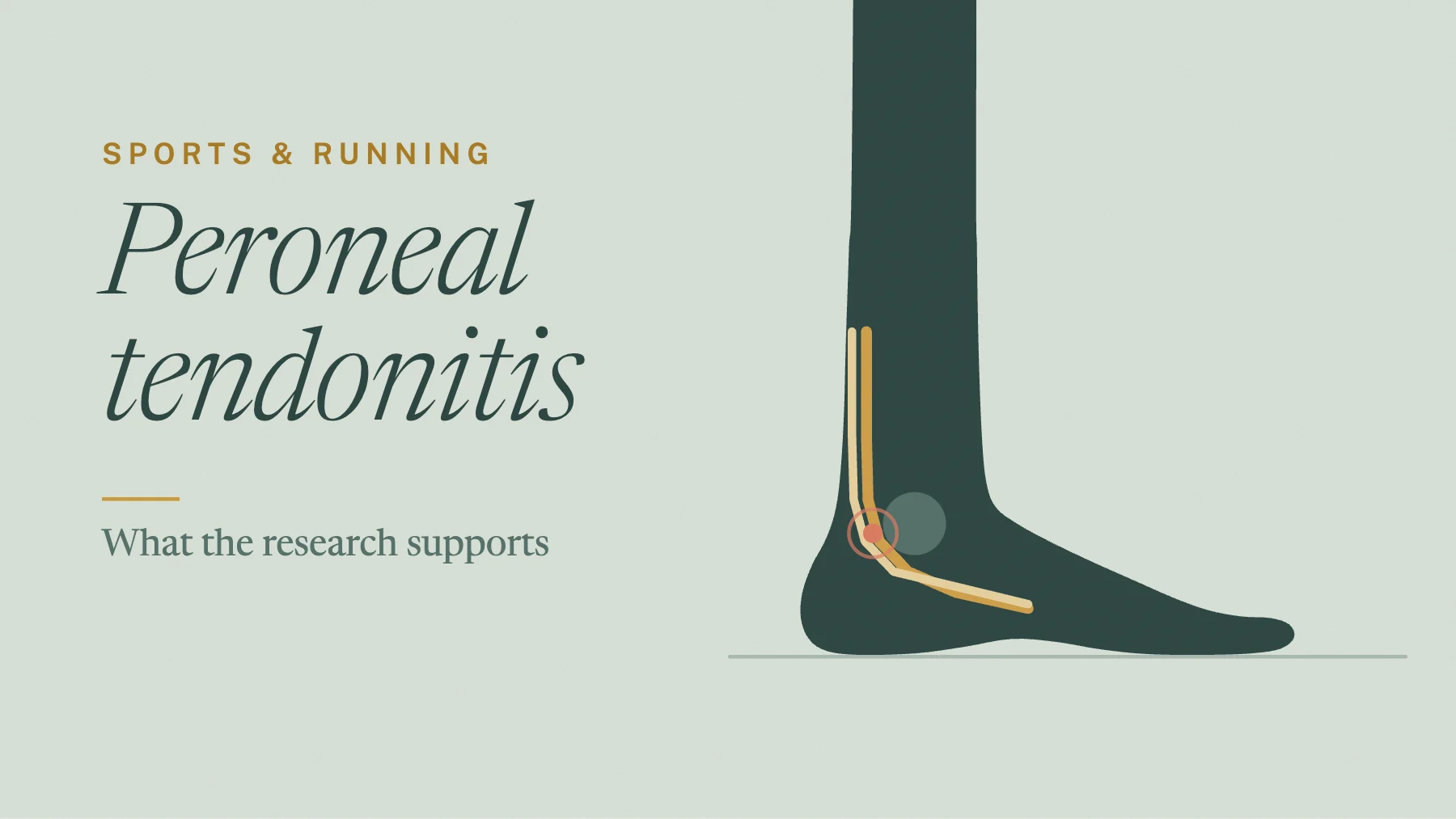
Peroneus brevis pain sits behind the outer ankle bone. Peroneus longus pain sits farther down, at the cuboid bone on the outer foot.[8] It tends to worsen with activity and ease with rest.[4] If it started with a sprain, read about chronic ankle instability.
Should I do peroneal tendonitis stretching before running?
No study has tested it. In a review of 25 trials and 26,610 people in sports, stretching didn’t reduce injuries, while strength training did. Those trials weren’t about peroneal tendons.[19]
What peroneal tendonitis exercises should I avoid?
No study gives a list. We advise holding stretching and band work if a tendon snaps or you suspect a tear, until you’re examined. After a fresh injury, the panel starts motion and tendon loading only once the pain settles.[10]
When to see a Foot and Ankle Surgeon or podiatrist

About the author
Dr. Efe Ozturk
Foot and Ankle Surgeon. Dr. Ozturk is double board certified, as a Diplomate of the American Board of Podiatric Medicine (DABPM) and a Fellow of the Academy of Physicians in Wound Healing (FAPWH), and is a Fellow of the American Society of Podiatric Surgeons (FASPS) and the American Society of Podiatric Medicine (FASPM). Trained in forefoot and rearfoot reconstructive surgery at Morristown Medical Center; sees patients in Lyndhurst, Paramus and Millburn.
Where to be seen
Dr. Ozturk sees patients at each of these offices, and one phone number reaches all of them.
References
- 1.Hensley CP, Kavchak AJ. Novel use of a manual therapy technique and management of a patient with peroneal tendinopathy: a case report. Man Ther. 2012;17(1):84-8. PubMed 21570893 (external site)
- 2.Zade AP, Ramteke SU, Keoliya A, Deshmukh TV. Rehabilitation Approaches for Proximal Peroneal Tendinopathy With Concurrent Anterior Cruciate Ligament (ACL) Sprain: A Case Report. Cureus. 2024;16(9):e69706. PubMed 39429395 (external site)
- 3.van Dijk PA, Gianakos AL, Kerkhoffs GM, Kennedy JG. Return to sports and clinical outcomes in patients treated for peroneal tendon dislocation: a systematic review. Knee Surg Sports Traumatol Arthrosc. 2016;24(4):1155-64. PubMed 26519186 (external site)
- 4.Davda K, Malhotra K, O’Donnell P, Singh D, Cullen N. Peroneal tendon disorders. EFORT Open Rev. 2017;2(6):281-292. PubMed 28736620 (external site)
- 5.Hall EA, Docherty CL, Simon J, Kingma JJ, Klossner JC. Strength-training protocols to improve deficits in participants with chronic ankle instability: a randomized controlled trial. J Athl Train. 2015;50(1):36-44. PubMed 25365134 (external site)
- 6.Anguish B, Sandrey MA. Two 4-Week Balance-Training Programs for Chronic Ankle Instability. J Athl Train. 2018;53(7):662-671. PubMed 30192681 (external site)
- 7.American College of Foot and Ankle Surgeons. Peroneal Tendon Injuries. FootHealthFacts. foothealthfacts.org (external site)
- 8.Deu RS, Coslick AM, Dreher G. Tendinopathies of the Foot and Ankle. Am Fam Physician. 2022;105(5):479-486. PubMed 35559641 (external site)
- 9.Simpson MR, Howard TM. Tendinopathies of the foot and ankle. Am Fam Physician. 2009;80(10):1107-14. PubMed 19904895 (external site)
- 10.van Dijk PA, Miller D, Calder J, et al. The ESSKA-AFAS international consensus statement on peroneal tendon pathologies. Knee Surg Sports Traumatol Arthrosc. 2018;26(10):3096-3107. PubMed 29767272 (external site)
- 11.Bakker D, Schulte JB, Meuffels DE, Piscaer TM. Non-operative treatment of peroneal tendon dislocations: A systematic review. J Orthop. 2020;18:255-260. PubMed 32082036 (external site)
- 12.Lootsma J, Wuite S, Hoekstra H, Matricali GA. Surgical treatment options for chronic instability of the peroneal tendons: a systematic review and proportional meta-analysis. Arch Orthop Trauma Surg. 2023;143(4):1903-1913. PubMed 35260916 (external site)
- 13.Mercer NP, Gianakos AL, Mercurio AM, Kennedy JG. Clinical Outcomes of Peroneal Tendon Tears: A Systematic Review. J Foot Ankle Surg. 2021;60(5):1008-1013. PubMed 33785239 (external site)
- 14.Demetracopoulos CA, Vineyard JC, Kiesau CD, Nunley JA 2nd. Long-term results of debridement and primary repair of peroneal tendon tears. Foot Ankle Int. 2014;35(3):252-7. PubMed 24318625 (external site)
- 15.Kosik KB, McCann RS, Terada M, Gribble PA. Therapeutic interventions for improving self-reported function in patients with chronic ankle instability: a systematic review. Br J Sports Med. 2017;51(2):105-112. PubMed 27806951 (external site)
- 16.Youdas JW, McLean TJ, Krause DA, Hollman JH. Changes in active ankle dorsiflexion range of motion after acute inversion ankle sprain. J Sport Rehabil. 2009;18(3):358-74. PubMed 19827500 (external site)
- 17.Terada M, Pietrosimone BG, Gribble PA. Therapeutic interventions for increasing ankle dorsiflexion after ankle sprain: a systematic review. J Athl Train. 2013;48(5):696-709. PubMed 23914912 (external site)
- 18.Han K, Ricard MD. Effects of 4 weeks of elastic-resistance training on ankle-evertor strength and latency. J Sport Rehabil. 2011;20(2):157-73. PubMed 21576708 (external site)
- 19.Lauersen JB, Bertelsen DM, Andersen LB. The effectiveness of exercise interventions to prevent sports injuries: a systematic review and meta-analysis of randomised controlled trials. Br J Sports Med. 2014;48(11):871-7. PubMed 24100287 (external site)
This is general health information and isn’t a substitute for advice from a clinician who knows your history. Read our medical disclaimer and how we write and review content.
More from the blog
Sports & running
Jones fracture: who needs surgery, healing time and return to sport
Who benefits from a screw, how it compares with a boot for healing time and return to sport, and how a Jones fracture differs from an avulsion or stress fracture.
Sports & running
Biggest sports injuries right now: Jalen Williams, Ben Simmons, Lamar Jackson and more
The whole board on one page: the biggest sports injuries across the NBA, NFL, NHL, MLB and soccer as of October 30, 2026. At least 11 of 21 athletes reportedly had surgery, and each league has a lesson for everyday athletes.
Sports & running
NFL Week 4 foot and ankle injuries: Edgerrin Cooper’s Achilles, Tyquan Thornton’s ankle and more
A foot and ankle look at NFL Week 4: Edgerrin Cooper’s suspected Achilles tear, Tyquan Thornton’s dislocated ankle and three more ankle injuries, and what each means for athletes at every level.